One data vocabulary spans the live markets
Comparable market tables, natural-gas fundamentals, and current weather now sit in one query-ready catalog with explicit units, provenance, revision handling, and coverage.
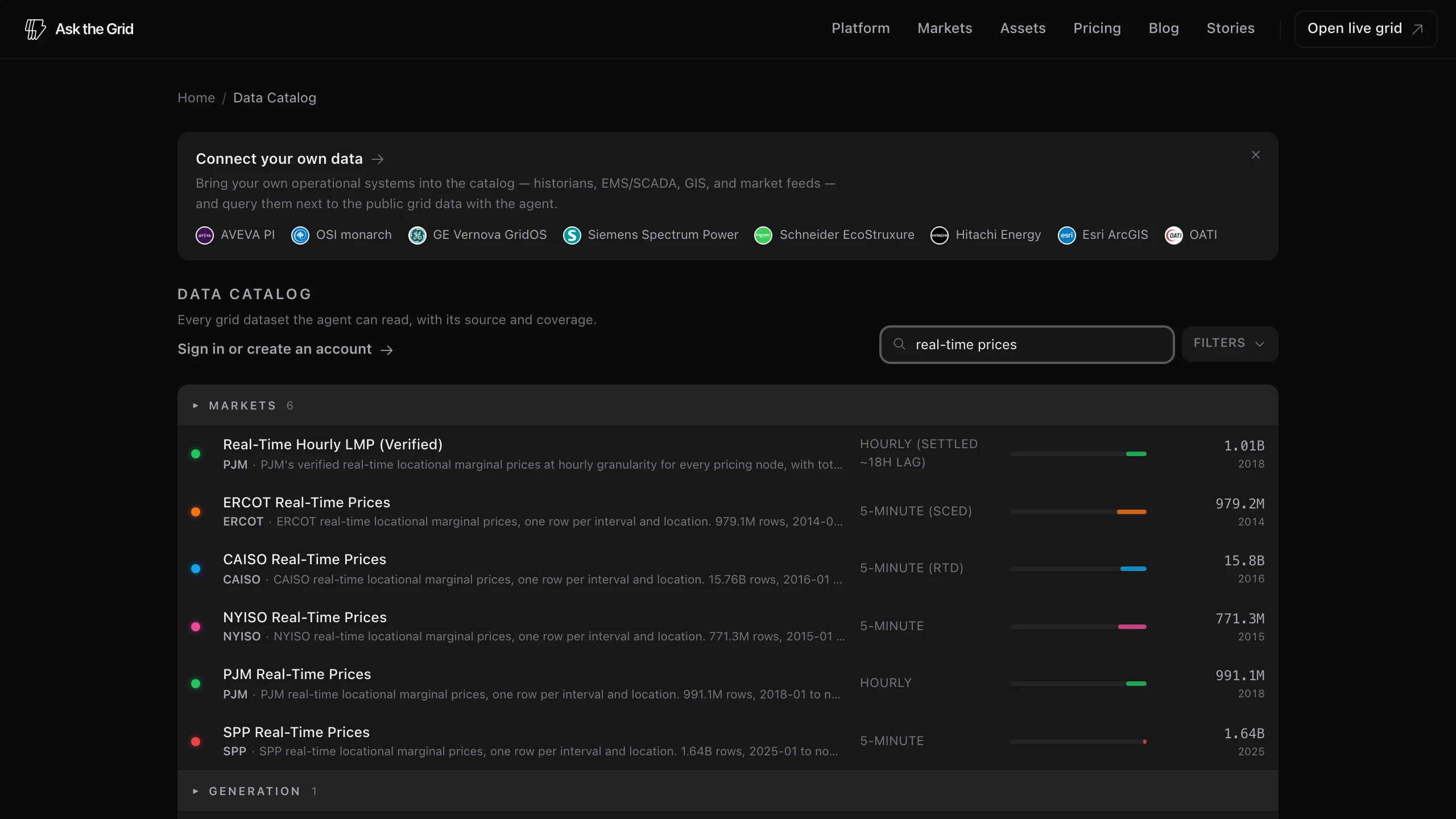
Cross-market research used to begin with translation: different location keys, component signs, column names, revision rules, and time conventions for the same market concept. Thirty-eight canonical datasets now give real-time and day-ahead prices, load, generation mix, ancillary prices, and binding constraints a shared shape across ERCOT, CAISO, NYISO, PJM, and SPP.
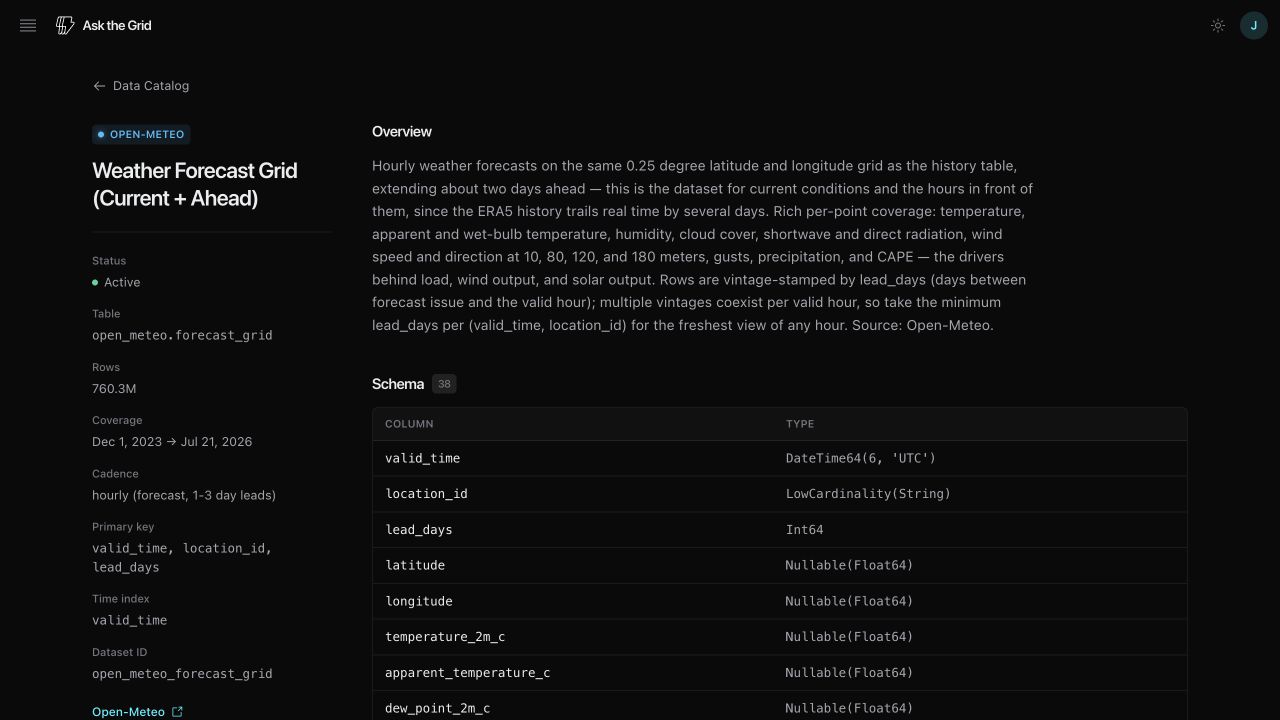
The catalog also reaches beyond market outcomes to two of their principal drivers. Natural-gas datasets cover delivered regional fuel prices, Henry Hub, and interstate pipeline capacity and schedules. Current and forecast weather adds hourly temperature, wind, cloud, radiation, and precipitation through the near-term horizon while remaining separate from delayed historical reanalysis.
Ask one cross-market question
The canonical tables use the same names and units for common concepts while retaining each market's native locations and published components. Price-location dimensions resolve operator names and types, and source revisions are collapsed so a restated interval is not counted twice.
Coverage varies by feed and remains visible. ERCOT generation mix reaches back to 2007, ERCOT and NYISO prices to 2014 and 2015, and CAISO prices to 2016; thinner datasets say so instead of implying equal history.
Put fuel cost beside power prices
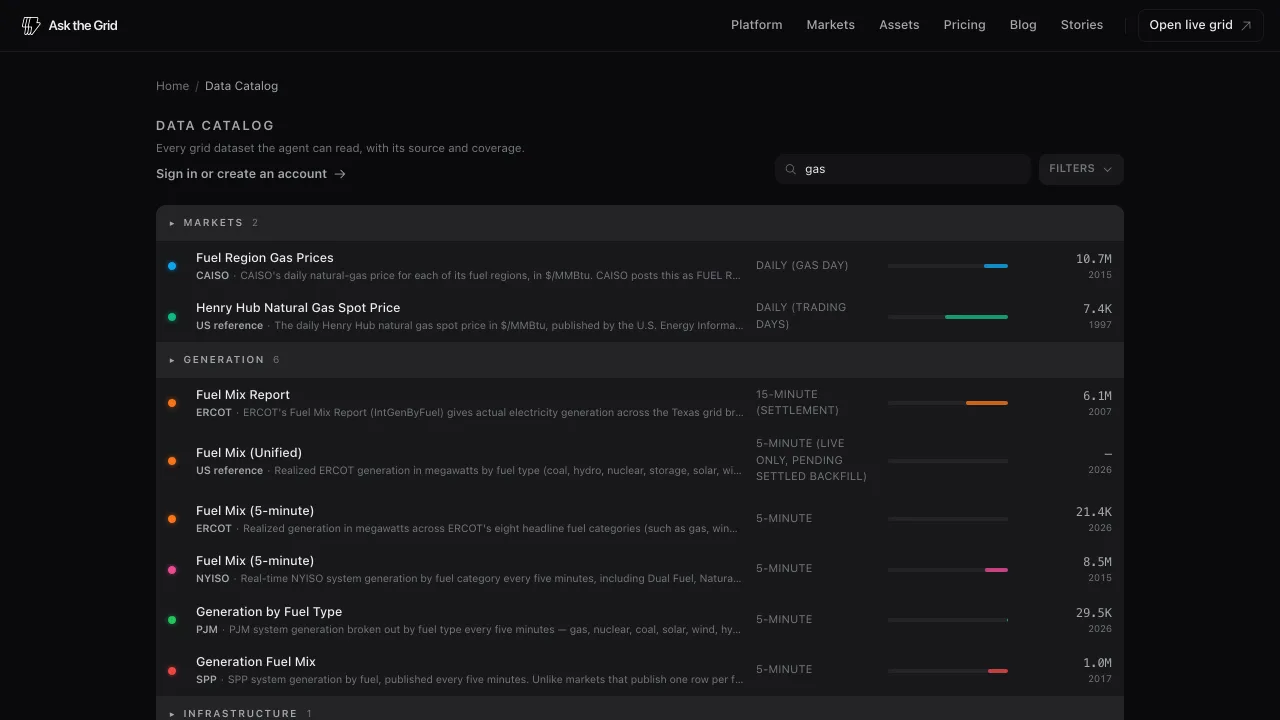
CAISO's daily fuel-region series covers 201 delivered-cost regions, including Waha, back to 2015. EIA's Henry Hub spot series reaches January 1997. FERC pipeline postings add design, operating, available, and scheduled quantities at metering points on 34 interstate pipelines.
The distinctions matter: the CAISO values are a gas index plus transport adder, not hub settlement prices, and pipeline schedules are physical postings rather than proof of a causal relationship with a power-market move.
Separate current weather from historical reanalysis
The hourly forecast grid covers temperature, humidity, wind at several heights, cloud cover, solar radiation, precipitation, and other grid-relevant conditions through the next two days. Historical ERA5 remains available for backward-looking work, with its delayed status shown separately.