The source-backed developer platform enters preview
Source-backed answers, MCP connections, Forecast and Data APIs, an interactive console, and scheduled reports make the same grid research system usable in the product or from code.
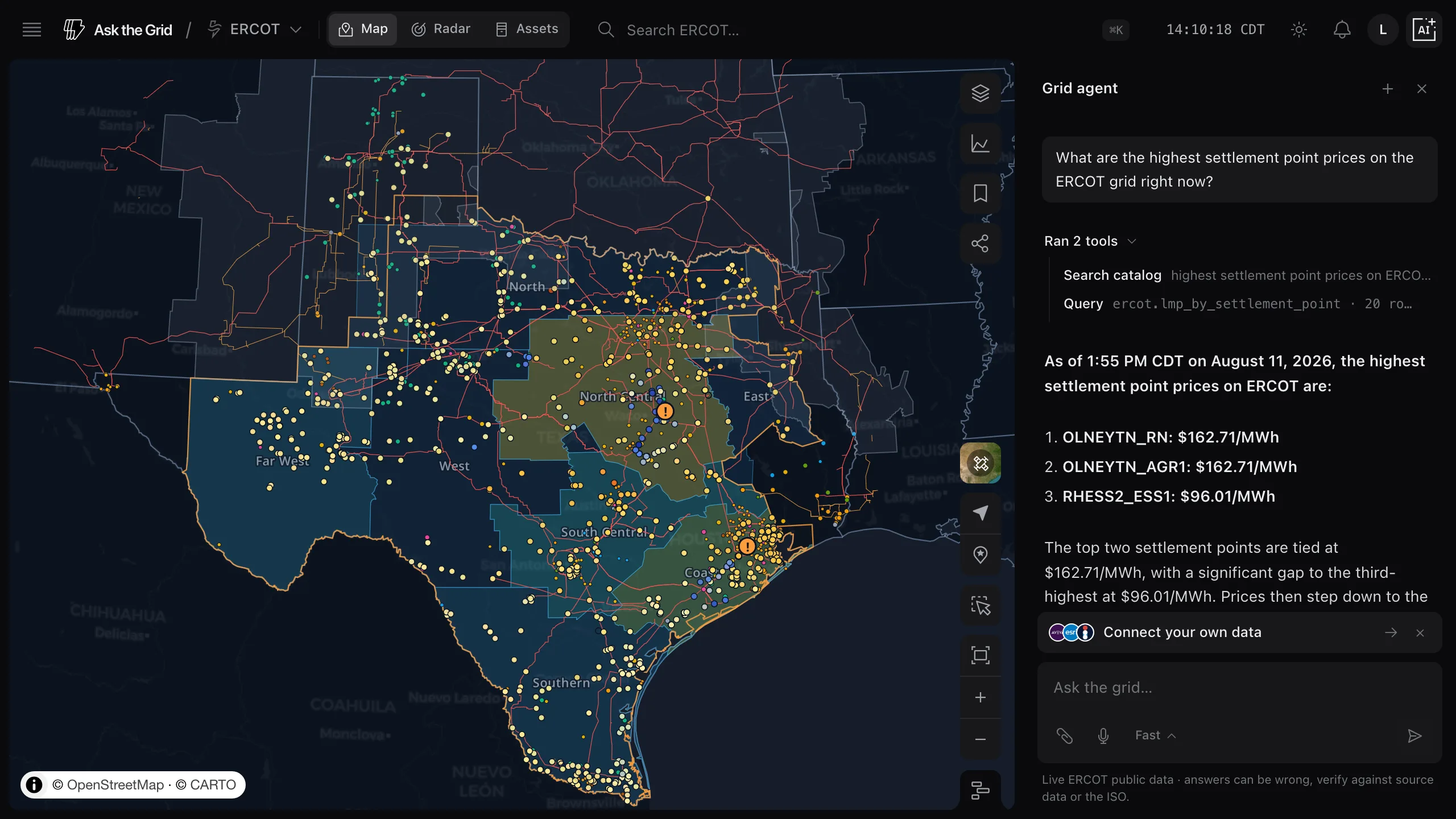
The grid agent is built around a checkable path from question to claim to source. Answers cite the datasets and public reports used, execution rows name the searches and queries that ran, and a selected passage can become a focused request to explain, show data, or chart the claim.
The same evidence model extends beyond the native interface. OAuth-connected MCP clients can search the catalog, inspect schemas, run bounded read-only queries, search assets, read live status, and retrieve published profiles. The developer console adds generated OpenAPI documentation, request history, and interactive Forecast, Data, Insights, Chat, and Alerts playgrounds for signed-in accounts. API keys for external integrations are issued by application. Explicit market scope remains enforced by the service, while account-level saved work stays global to the signed-in user.
See what the agent actually ran
The trace reads as actions and subjects: which table a query read, how many rows came back, which search terms ran, or which file opened. An elapsed clock and current step make longer investigations legible while they are running.
Selecting a passage in the answer creates a follow-up around that exact claim instead of asking the user to restate the surrounding context.
Keep claims tied to sources and market scope
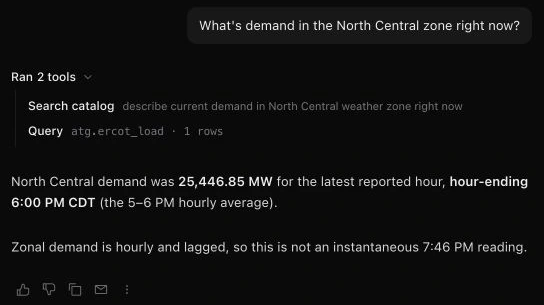
Citations connect an answer to the exact public report or catalog dataset behind it. If the required evidence is unavailable, cannot be aligned in time or units, or falls outside the active market, the agent says so instead of silently mixing grids or filling the gap.
Multi-step questions have room to recover from a failed lookup and continue, while broad investigations stop with a clear boundary when the available evidence is insufficient.
Try the APIs before writing code
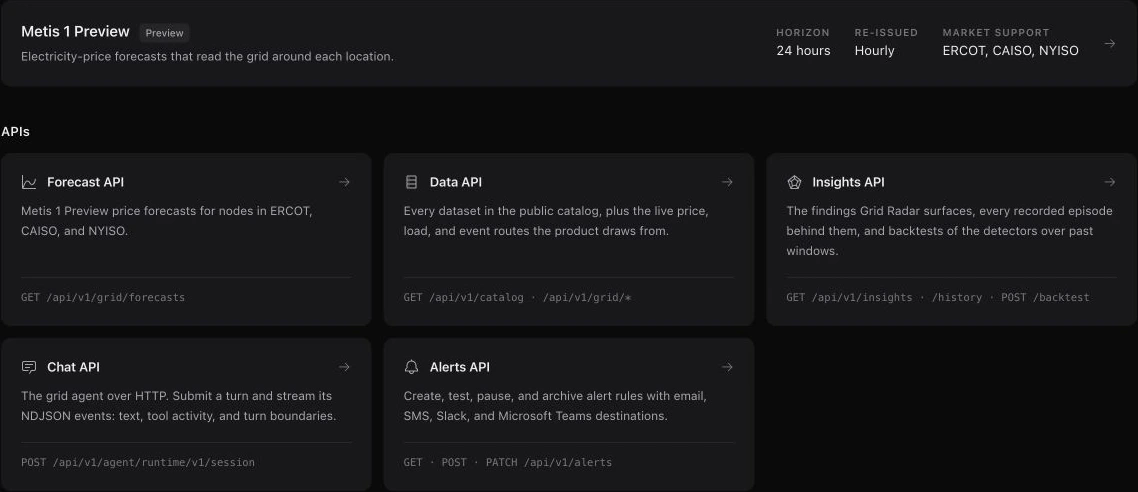
The developer console provides API-key management, request and usage history, generated reference documentation, and playgrounds that show the same response as a chart, table, raw JSON, and copyable cURL, Python, JavaScript, or PHP request.
Forecast returns probabilistic price paths with their model and issue metadata. Data exposes the source-aware catalog and live grid routes. Insights returns findings, recorded episode history, and historical detector evaluations. Chat exposes the grid agent, while Alerts manages monitoring rules and delivery destinations. The reference is generated from the API contracts; playgrounds use the signed-in session, and external integrations use separately approved API keys.
Use the same catalog from another AI client
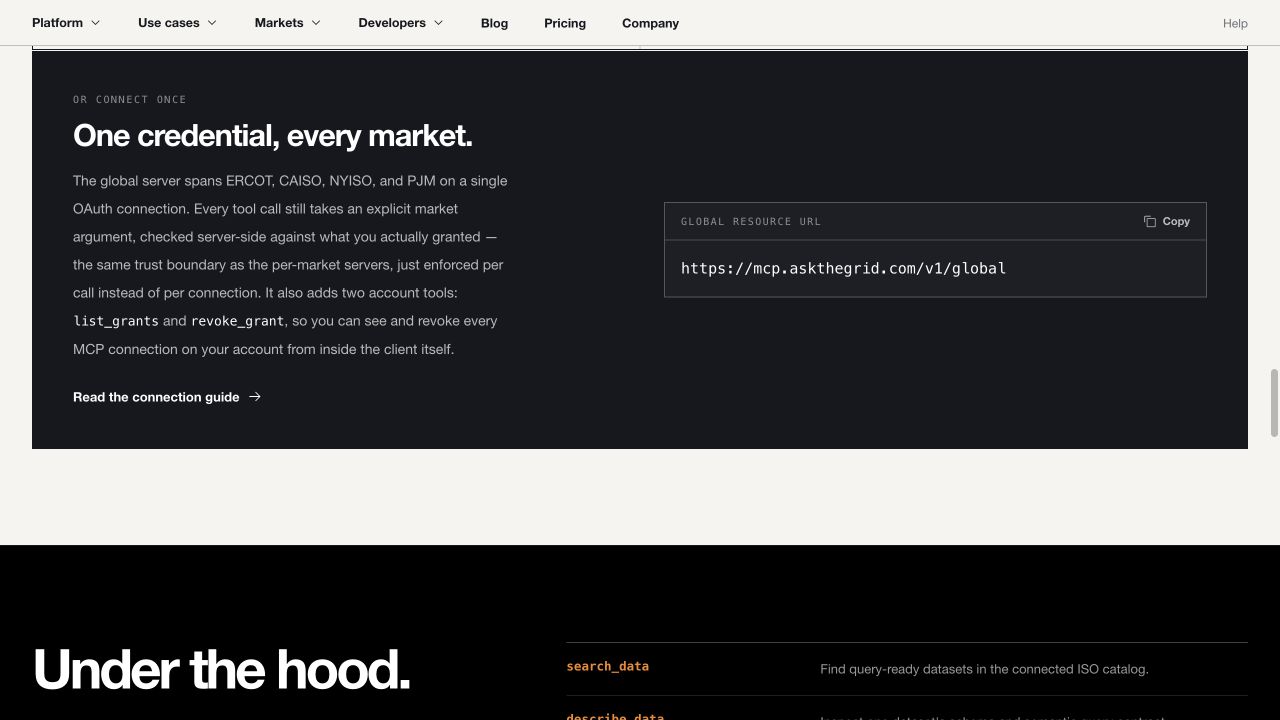
ChatGPT, Claude, Cursor, Codex, and other compatible clients can connect through OAuth 2.1 with PKCE. Dedicated market endpoints and the global resource expose typed, bounded tools without copied API keys.
Connected clients can also retrieve saved assets and portfolios, search the library, and manage membership through scoped actions and the client's confirmation boundary.
Turn a useful investigation into a repeatable brief
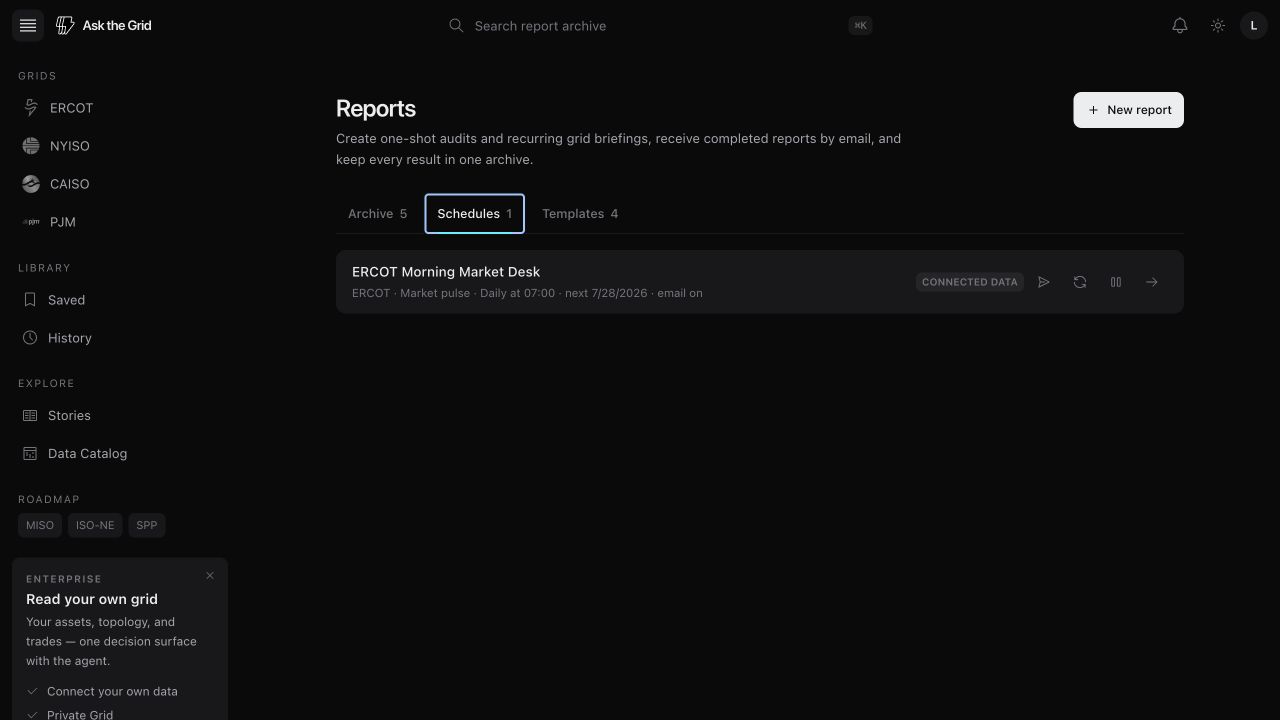
Reports can run once or on a recurring schedule, deliver completed work by email, and keep every issue together. The first public assessment applies that workflow to an operating ERCOT battery, with reconstructed gross value, dispatch benchmarks, peer context, sources, assumptions, and limits kept in the report.