Build against the market, not another API.

Point your own agents, research systems, and trading workflows at the live US power market — the same source-aware catalog, grid geography, events, and analytical tools Ask the Grid itself uses.

01

Query the market

Prices, forecasts, grid geography, events, and public records inside any ISO and time window.

02

Run the grid agent

Submit a turn and stream the agent's answer straight into your own product.

03

Keep the evidence

Source, timestamp, units, and method come back attached to every answer.

The Forecast API playground in the developer console, charting a p50 price path inside its p10 to p90 band for an ERCOT resource node, with the response status, latency, and point count above it.
The Forecast API playground — the same chart the product drawsAsk the Grid

Four APIs, and a console to try them in.

Open the developer console
01

Forecast

Probabilistic price paths from the Metiscast product line — nodal, zonal, and hub, each charted with its published p10–p90 band.

GET /api/v1/grid/forecasts

02

Data

Every dataset in the public catalog, plus the live price, load, and event routes the product itself draws from — every call a typed contract.

GET /api/v1/catalog

03

Chat

The grid agent, programmatically. Submit a turn and stream its NDJSON events: text deltas, tool activity, turn boundaries.

POST /api/v1/agent/runtime/v1/session

04

Alerts

Create and manage source-aware monitoring rules from your own systems, with delivery through email, SMS, Slack, and Microsoft Teams.

POST /api/v1/alerts

A reference that cannot drift.

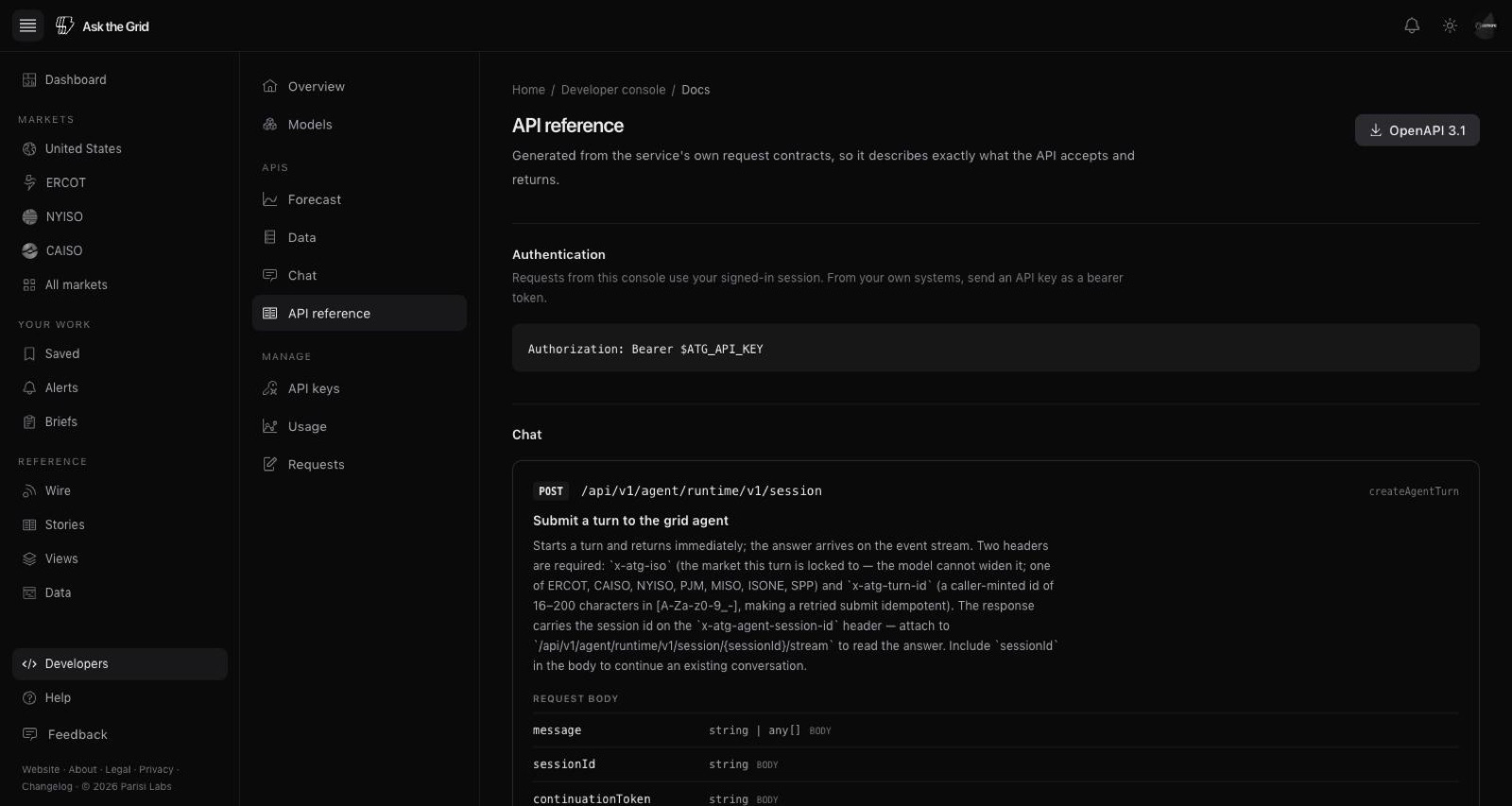
The documentation is generated from the service's own request contracts rather than written beside them, so it describes exactly what the API accepts and returns. The OpenAPI 3.1 document is published for your own tooling to read.

The generated API reference in the developer console, showing the bearer-token authentication block and the Chat endpoint with its request body fields.
Generated API reference, with the OpenAPI 3.1 document alongsideAsk the Grid

How a question runs.

What changed in ERCOT congestion over the last hour?

01

Market context

ISO · time · place · asset

02

Typed work

discover · query · calculate

03

Evidence out

source · timestamp · method

Discover, query, calculate, return evidence

4
01

Discover

Find the dataset that matches the market, entity, and interval. Inspect coverage and cadence before asking for values.

02

Query

Retrieve time series, grid geography, events, or public records inside a defined ISO and time window.

03

Calculate

Compare, aggregate, rank, and reconstruct with the analytical boundary kept explicit.

04

Return evidence

Carry source, timestamp, units, and method into the answer that follows.

Discovery is part of the answer.

A credible agent knows what data exists, where it came from, and how fresh it is — before it runs the query.

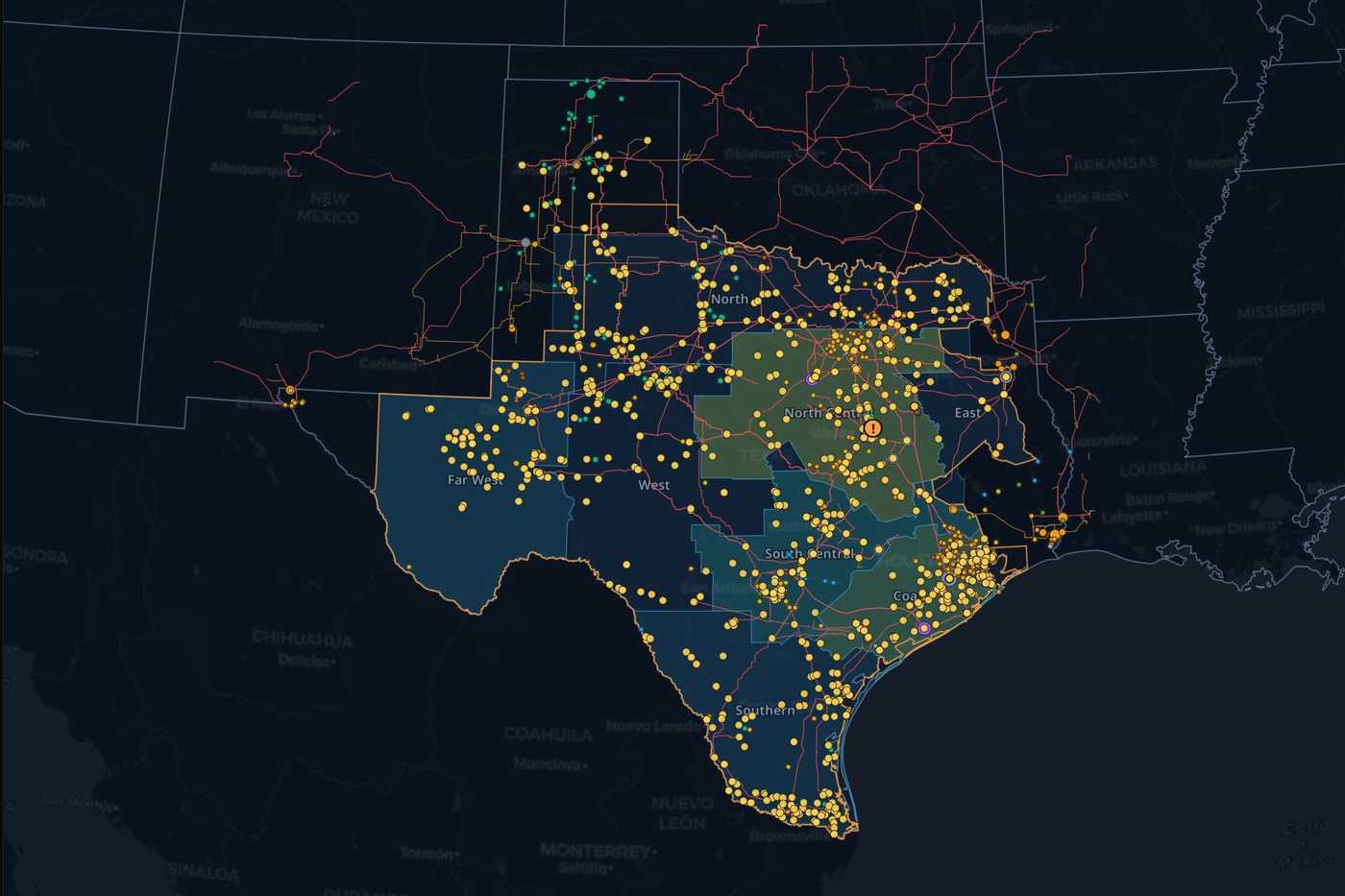
A sourced Ask the Grid answer beside the ERCOT map
Evidence out — a sourced answer beside the live mapAsk the Grid

Where the surface meets your work.

Private grid architecture
01

Research agents

Give an analytical agent a way to locate the right market record before it writes the answer.

02

Desk workflows

Bring recurring market checks, event reconstruction, and evidence gathering into the tools a desk already uses.

03

Private operations

Connect public market context to internal telemetry, topology, positions, and asset state inside a controlled boundary.

Give your agents the grid.

MCP is in private preview — no public endpoint yet. Access is scoped around a real client, market, and workflow.