PJM Proposes Ride-Through Rules After a 3.8 GW Load Transfer
Northern Virginia data centers transferred to backup power after a July line fault. PJM’s September proposal would require large loads to stay connected through specified disturbances.
PJM has proposed rules requiring large computational loads to remain connected through specified grid disturbances, following a July 22 event in which roughly 3.8 GW of data-center load transferred to backup power in Northern Virginia. The September 8 proposal addresses voltage, frequency and the recovery of electricity consumption after a disturbance.
The operating problem is what happens when a large amount of demand disappears without warning. Generation and consumption must remain balanced. A sudden load reduction can leave generation temporarily too high, requiring operators to reduce output while also managing the local voltage response. Keeping computers running on backup power and keeping the wider grid balanced are different tasks.
A cleared line fault became a large load transfer#
PJM and Dominion’s preliminary account describes a 230 kV line fault at about 7:56 a.m. Eastern on July 22. Protection cleared the fault correctly. Data centers transferred to backup power, and the resulting high-voltage conditions prompted additional transfers. PJM reported reducing generation and using reactive-power resources to control the imbalance and voltage.
The operator’s published account says the grid avoided significant reliability impacts. That outcome matters alongside the size of the disturbance: this was an event operators controlled, not evidence of an uncontrolled blackout. It nevertheless gave PJM a concrete example of the system consequences of many large customers changing their grid demand together.
The map provides regional context. It does not identify affected customer sites or reconstruct the second-by-second disturbance.
Nearly 4 GW is an approximation, not a site-by-site total#
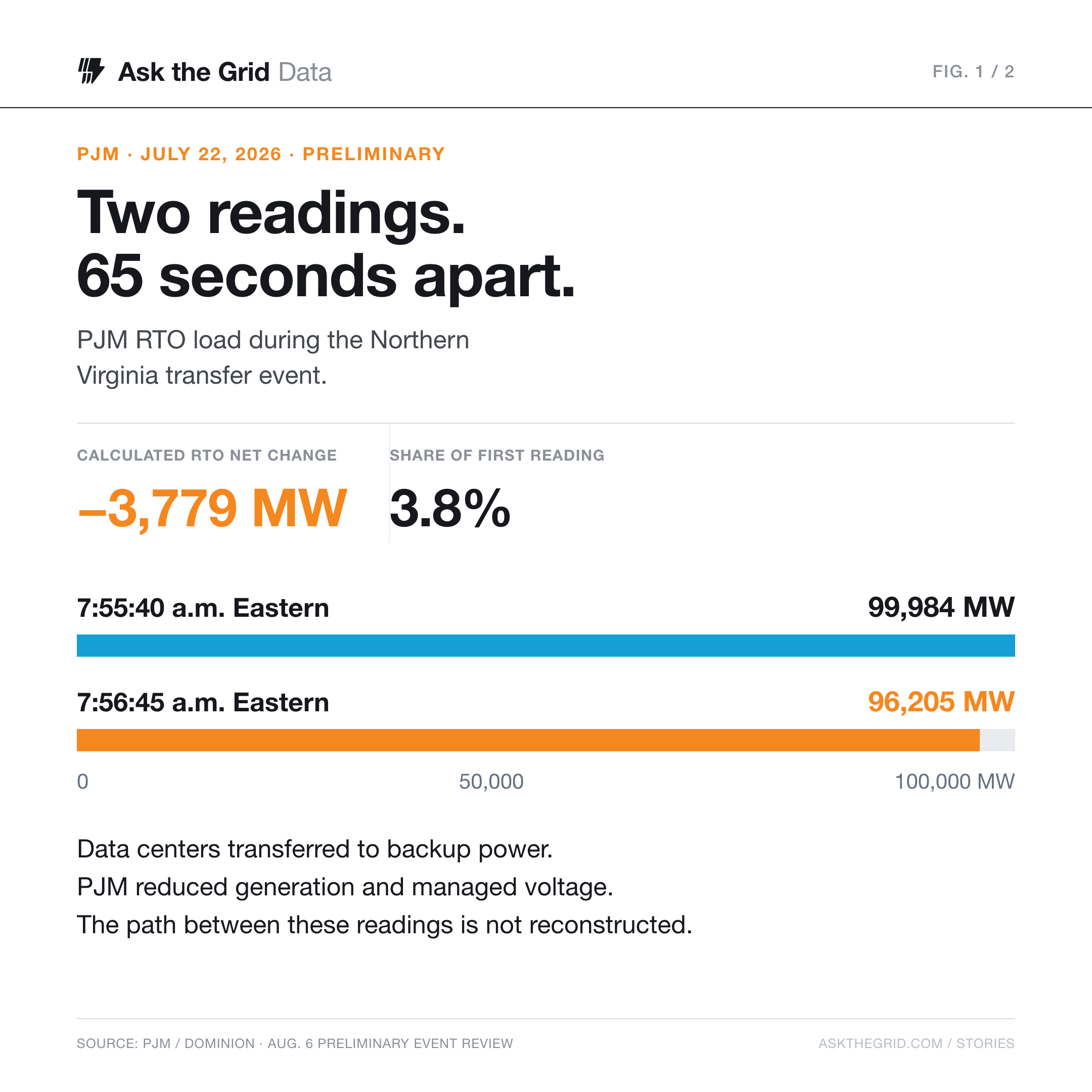
PJM’s event presentation marks RTO load at 99,984 MW at 7:55:40 a.m. and 96,205 MW at 7:56:45 a.m. The difference is 3,779 MW in 65 seconds, or 3.8 percent of the first reading. These are event measurements, not hourly averages.
| Measure | Reported value | What it describes |
|---|---|---|
| PJM RTO load, 7:55:40 a.m. | 99,984 MW | Before the transfer |
| PJM RTO load, 7:56:45 a.m. | 96,205 MW | 65 seconds later |
| Calculated RTO net change | −3,779 MW | Difference between those two readings |
| Dominion transfer approximation | 3,869 MW | Separate zone estimate |
| System frequency maximum | 60.092 Hz | Above the 60 Hz nominal frequency |
| BAAL excursion recovery | 9 minutes | Reported recovery, versus a 30-minute standard |
Dominion’s separate approximation is 3,869 MW. Its two reported transfer waves were 2,970 MW and 1,099 MW. Those wave estimates sum to 4,069 MW, but they should not replace the operator’s approximate event total: they describe different moments during a changing system response. The public material does not provide a reconciled meter-level inventory.
The useful conclusion is the scale and speed of the change. An hourly demand curve cannot reproduce a 65-second event, and a wholesale price chart cannot establish which customer protection settings triggered it. The preliminary event record supplies that chronology; public market averages answer other questions.
What staying connected would mean#
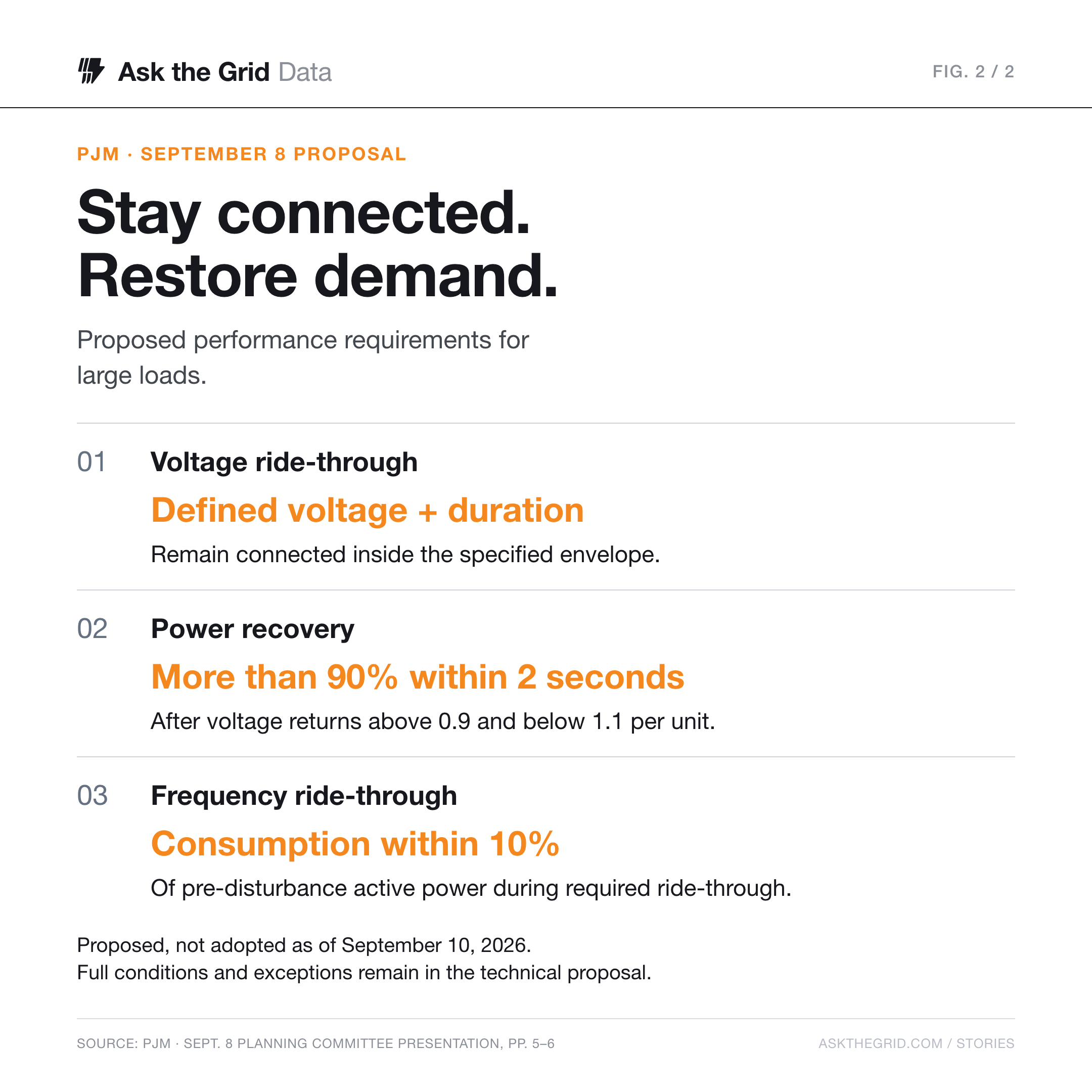
“Ride-through” means continuing to operate through a defined disturbance instead of disconnecting immediately. It does not mean remaining connected under every possible condition. PJM’s proposal specifies ranges of voltage and frequency, how long the load must tolerate them, and how consumption should recover afterward.
| Part of the September 8 proposal | Intended behavior |
|---|---|
| Voltage ride-through | Stay connected within a specified voltage-versus-duration envelope |
| Recovery after a voltage disturbance | Restore more than 90% of prior active power within two seconds after voltage returns inside the specified band |
| Frequency ride-through | Keep active-power consumption within 10% of the pre-disturbance level during required ride-through |
The recovery requirement matters because remaining physically connected does not necessarily preserve the same electricity demand. A facility that stays attached while sharply reducing consumption can still change the balance seen by the grid. The proposal therefore addresses active power—the electricity doing work—as well as connection status.
The rules were still being developed#
FERC’s June 18 order in docket EL26-67-000 questioned whether PJM’s tariff adequately specified continuing operational requirements for large loads. Page 45 identifies gaps concerning ramp rates, ride-through, controls and protection, and asks PJM to justify the existing arrangements or propose revisions. That is a regulatory process for changing requirements, not a finding that the July customers violated a new rule.
As of September 10, PJM planned a November filing and intended to work with existing facilities on a transition. The next consequential details were the final scope, compliance timetable and treatment of existing equipment. A proposed performance envelope is a design target to evaluate; its publication alone does not establish an enforceable deadline for every facility.
Sources and method#
This retrospective is dated September 10 and uses public material available by that date, reviewed September 20, 2026 UTC. Event figures remain preliminary. The 3,779 MW change and 3.8 percent comparison are calculated from the two RTO readings on page 4 of the August 6 presentation; no intermediate trajectory is interpolated. The map supplies regional context, not a reconstruction of affected sites.
The event involved operator-reported transfers to backup power. It is distinct from a requested demand-response reduction or authorization to operate backup equipment under an emergency order. Those categories require their own evidence.
Share this story#