DOE Is Keeping Three PJM Units Open for Two Different Reliability Problems
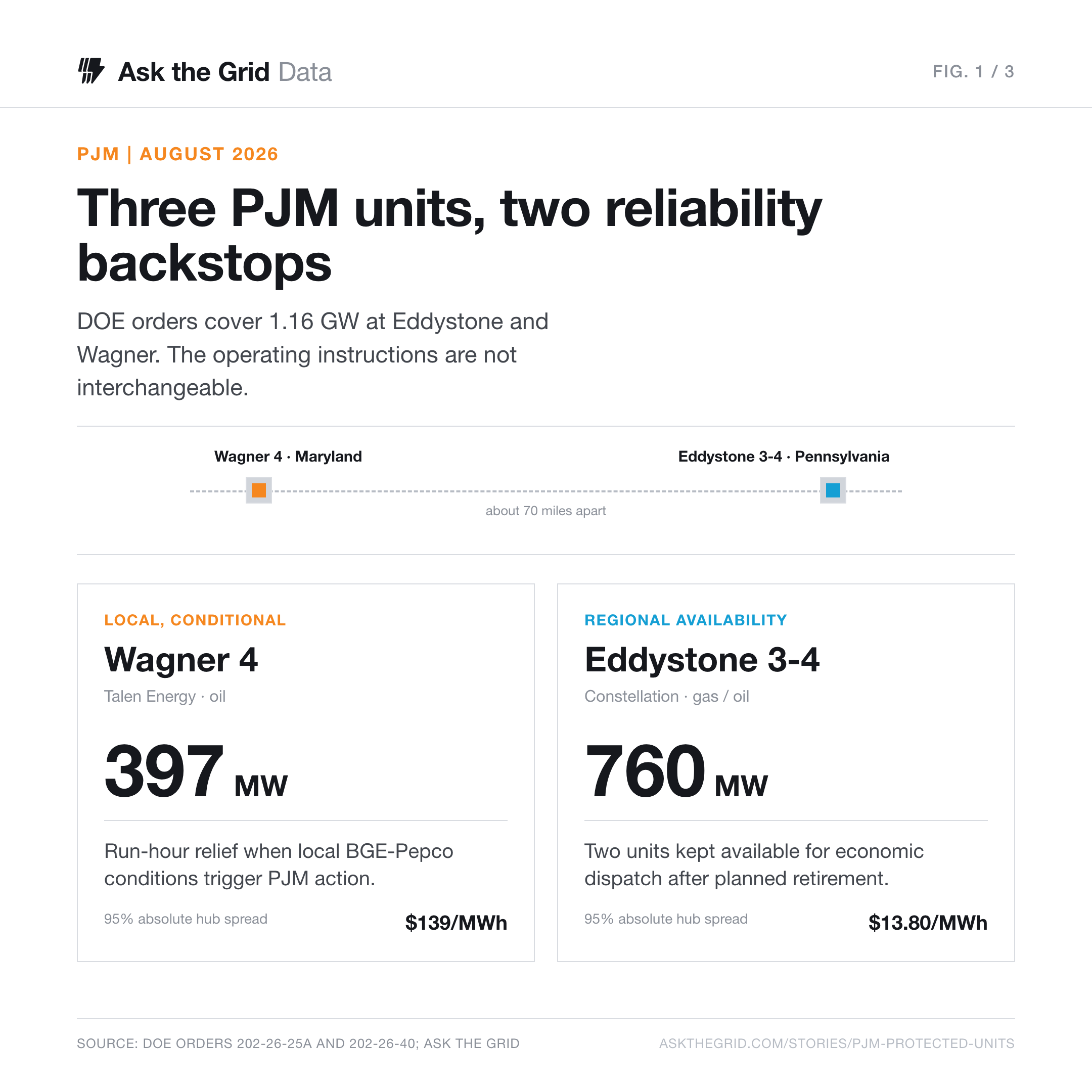
Orders covering 1.16 GW at Eddystone and Wagner use the same federal authority. Ask the Grid data shows one regional availability backstop and one local, conditional reliability resource.
Two Department of Energy orders issued 48 hours apart preserved 1,157 MW in PJM. On August 19, DOE renewed emergency operating authority for 397 MW Wagner Unit 4 in Maryland. On August 21, it issued a sixth consecutive 90-day order keeping Eddystone Units 3 and 4, totaling 760 MW, available in Pennsylvania.
The orders invoke the same section of federal law, but the operating instructions are different. Wagner is available under specified emergency and local transmission conditions after exhausting its permitted oil-burning hours. Eddystone is being held as a regional availability backstop under economic dispatch. Their operating records, congestion exposure and long-term pathways make the distinction measurable.
- Dispatch trigger
- Conditional local-reliability dispatch
- Grid function
- A local backstop for the BGE-Pepco area when heat, outages and transmission conditions coincide.
- Long-term path
- Planned transmission reinforcements are the durable exit. PJM's broader Brandon Shores-Wagner study found that modeled four-hour batteries plus reactive support did not eliminate the BGE-area need.
One federal tool, two operating instructions#
DOE Order 202-26-25A does not tell PJM to run Wagner continuously. It authorizes PJM, working with Talen Energy, to operate Unit 4 beyond the oil-burning hours allowed by its Maryland consent order when specified emergency or local transmission conditions arise. The renewal runs from August 20 through November 17.
Eddystone's order is broader. DOE Order 202-26-40 directs PJM and Constellation to keep both dual-fuel units available and use economic dispatch. It runs from August 23 through November 20. That is the sixth consecutive 90-day order since the units' planned May 31, 2025 retirement.
The market data separates the two cases#
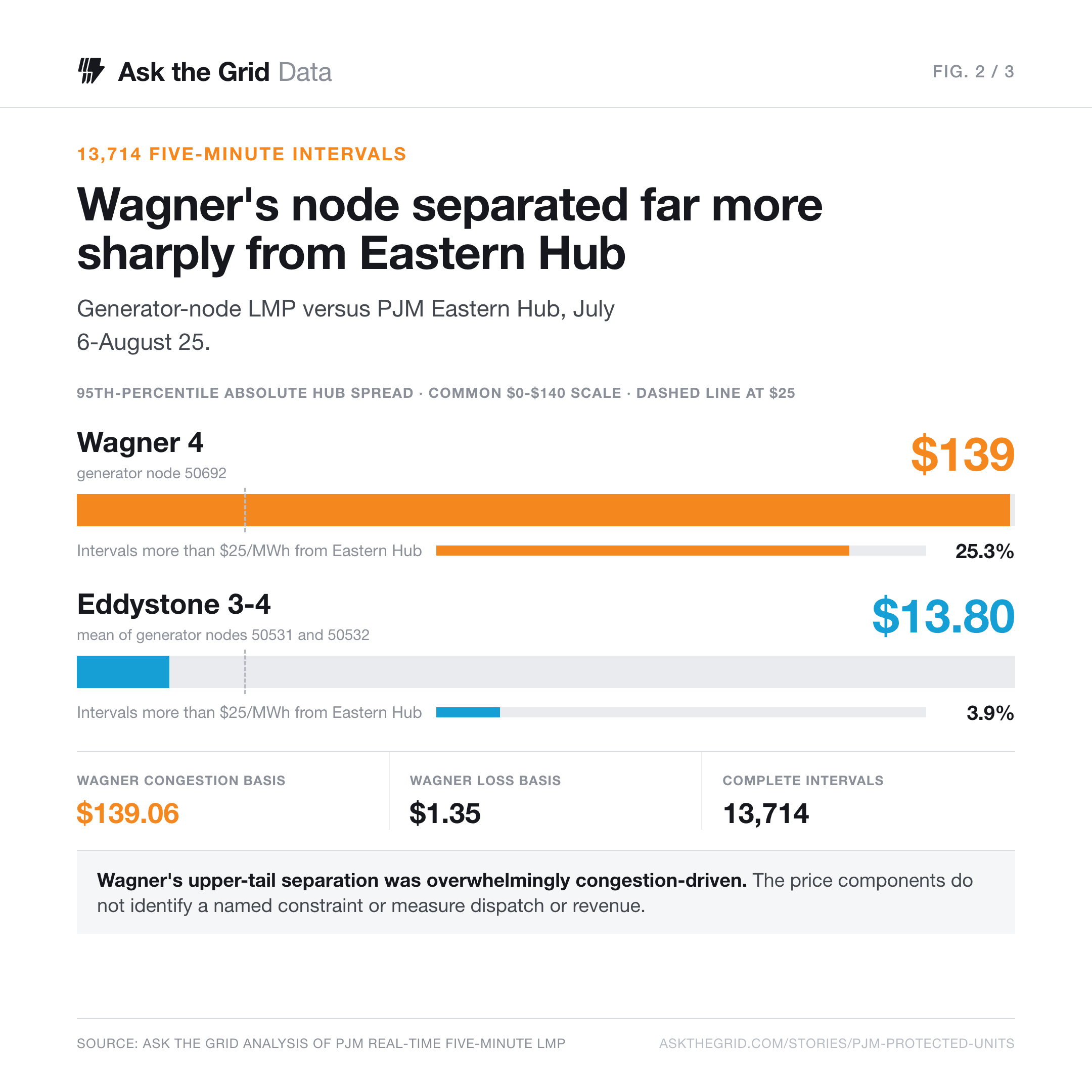
Ask the Grid compared each plant's published generator price node with PJM's Eastern Hub across 13,714 complete five-minute intervals from July 6 through August 25. The result is a locational fingerprint, not a dispatch estimate.
At Wagner, the 95th-percentile absolute difference from the hub was $139.23/MWh. Its node differed from the hub by more than $25/MWh in 25.3% of intervals and averaged a $22.52/MWh premium. At Eddystone, the same 95th-percentile measure was $13.80/MWh; only 3.9% of intervals cleared more than $25 away from the hub, and its average price was $7.84/MWh below it.
The component data sharpens that result. At Wagner, the 95th-percentile absolute congestion basis was $139.06/MWh, while the comparable marginal-loss basis was only $1.35/MWh. The separation was therefore overwhelmingly congestion-driven. That is consistent with the local transmission exposure described in PJM's filings, although nodal prices alone do not identify the named constraint, prove unit dispatch or measure revenue.
Wagner is an operating-limit problem attached to a transmission problem#
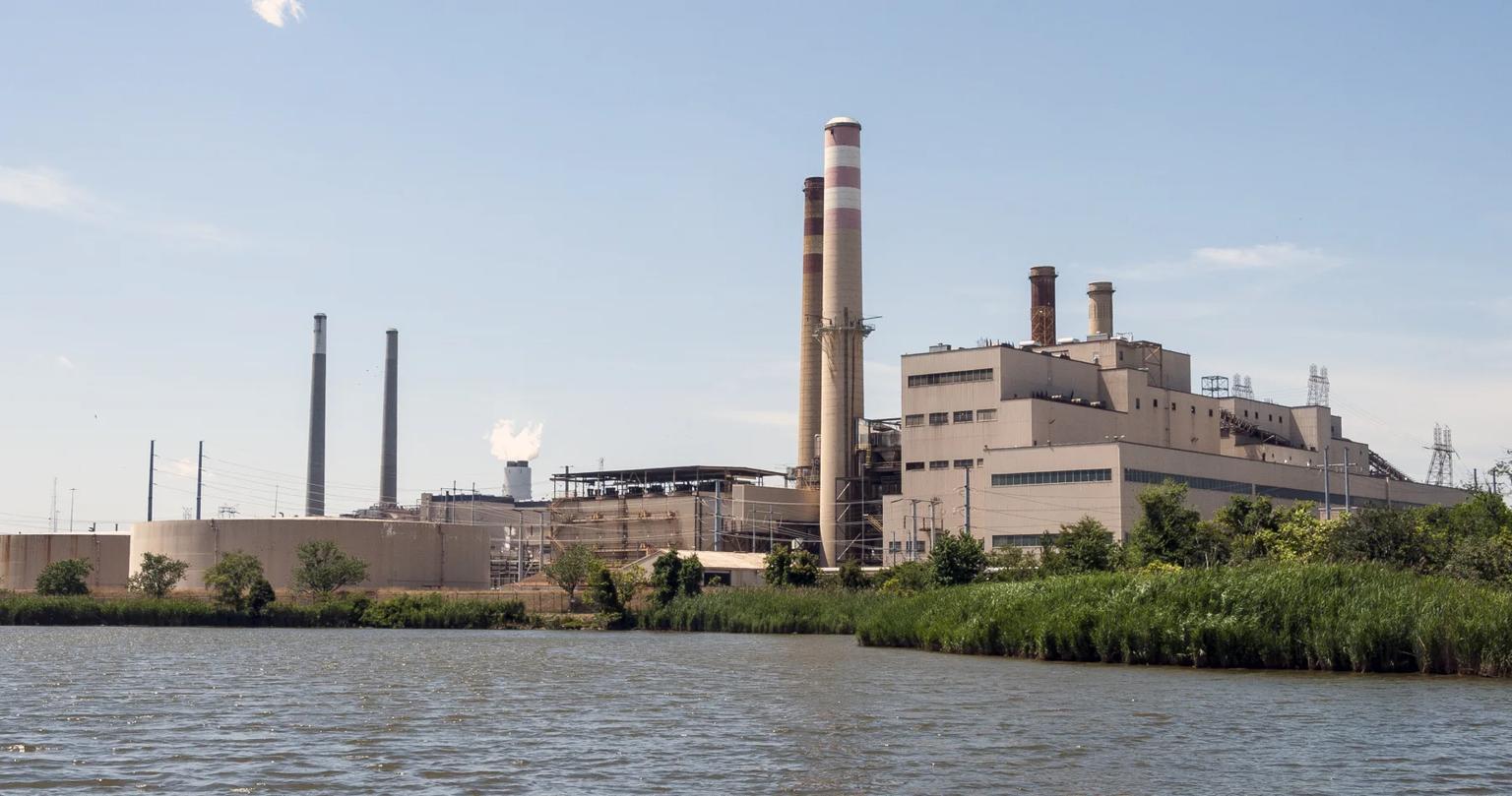
Wagner Unit 4 is a 397 MW oil-fired steam unit commissioned in 1972. Its state consent order normally limits fuel-oil operation to 438 hours a year. PJM's May application told DOE that fewer than 28 permitted hours remained. Its August renewal application said none remained.
The trigger PJM described was local and conditional. During hot weather around 92 degrees Fahrenheit, especially when generation or transmission outages overlap, loss of Wagner could affect service in the BGE and Pepco zones. In its May filing, PJM described a system already carrying more than 40 GW of reported generation outages while hourly load reached roughly 134-136 GW. DOE's order supplied an emergency exception to the environmental run-hour limit; it did not erase the network condition.
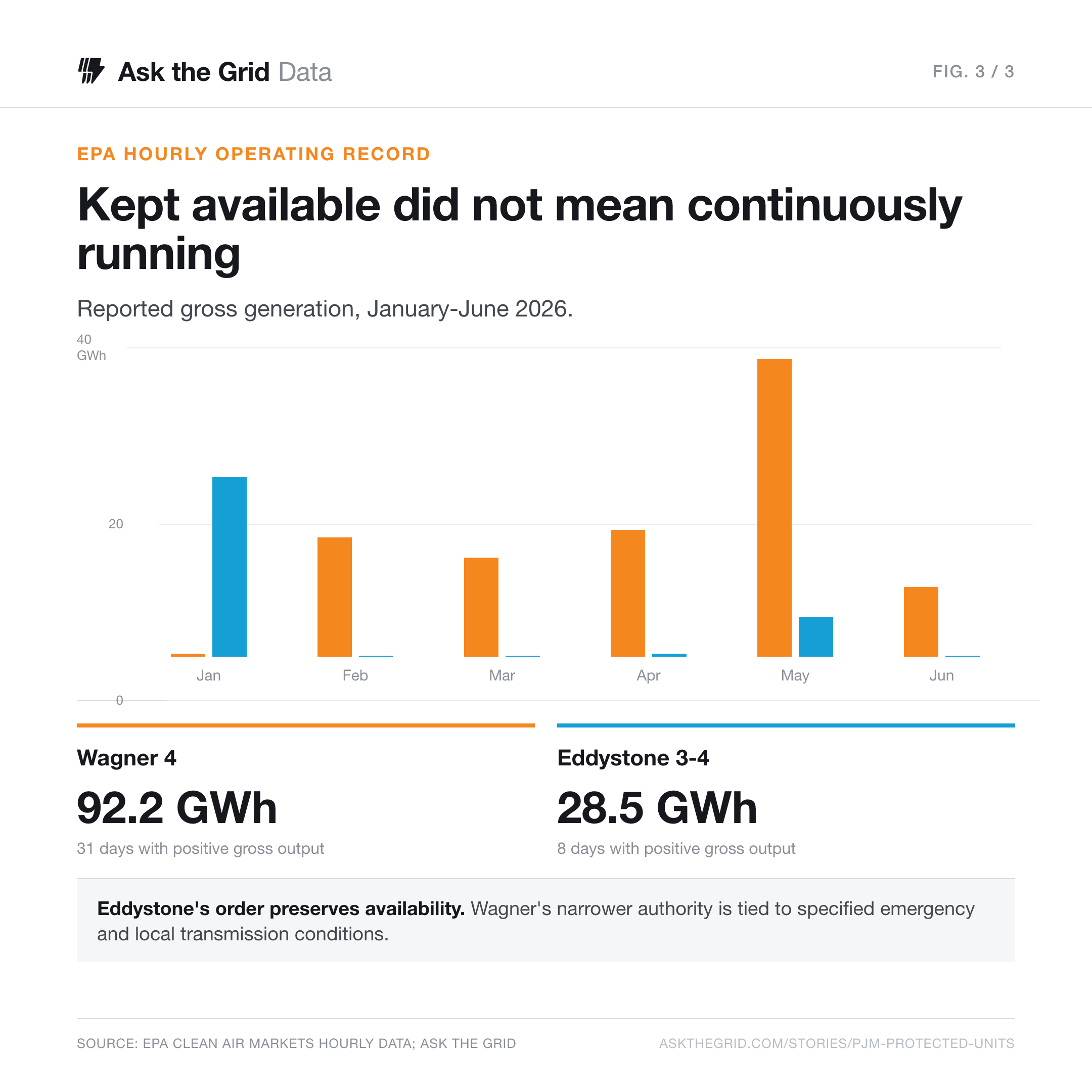
EPA's hourly record shows Wagner was not merely dormant insurance in the first half of 2026. Unit 4 reported 92.2 GWh of gross generation on 31 calendar days from January through June, including 38.4 GWh across 11 days in May. The plant's operating record is concentrated, which is consistent with a unit called for particular system conditions rather than steady energy production.
Eddystone is an availability order with limited measured use#
Eddystone Units 3 and 4 are each 380 MW subcritical steam units capable of burning natural gas or oil. Constellation had planned to retire them in May 2025. Instead, DOE has kept them available through six rolling orders, citing PJM's resource-adequacy concern as load grows and older generation retires.
Availability is not continuous production. EPA data shows the pair reported 28.5 GWh of gross generation on eight days in the first half of 2026. More than four-fifths came during January 26-29. They reported no positive gross output in February, March or June, and only brief operation in April and May.
That sparse record does not make the order irrelevant. A peaking or emergency resource can carry value while idle. It does mean the public case for Eddystone is about preserving optionality across the region, not supplying a continuous block of energy and not resolving the same recurring local price separation visible at Wagner.
The long-term pathways explain the difference#
Wagner's durable exit is transmission. PJM's 2024 study covered the broader Brandon Shores retirement and Wagner Units 3 and 4, not Wagner Unit 4 by itself. It modeled 600 MW and 800 MW four-hour battery configurations together with more than 2,000 MVAR of reactive support. Neither case eliminated the BGE-area reliability need before planned transmission reinforcements. Megawatts and duration were only part of the requirement; voltage support and network location mattered too.
Eddystone has a different corporate pathway. FERC approved a waiver allowing Constellation to transfer the units' capacity interconnection rights to the planned 835 MW Crane Clean Energy Center restart, targeted for 2027. That is a rights transfer, not an engineering finding that Crane will replace Eddystone's present reliability function. Eddystone remains physically available under the DOE order while the future resource advances through a separate process.
What to watch#
Both current orders expire in November. The next decisions are whether DOE renews either authority and whether PJM narrows or changes the operating instructions. For Wagner, the practical exit test is whether the BGE-area transmission work can be energized before another run-hour exception is needed.
For Eddystone, watch the units' measured operation under economic dispatch and the implementation of the Crane interconnection-rights transfer. Constellation's 2027 target matters commercially, but it should not be read as proof that the future plant supplies the same local or regional reliability service.
Ask the Grid's price analysis uses deduplicated real-time five-minute PJM LMPs at Wagner generator node 50692, Eddystone generator nodes 50531 and 50532, and Eastern Hub node 51217. Eddystone's two nodes are averaged by interval before comparison. Generation totals use EPA hourly gross load multiplied by operating time for January through June 2026. Capacity uses the units' summer ratings in the current DOE orders, rather than whole-plant nameplate totals. Figures are frozen at publication.
Inspect Wagner Unit 4 on the PJM map, open Eddystone or explore current PJM prices and transmission.