New York Contracted 950 MW of Batteries Across Eight Projects
The first bulk-storage awards span the Bronx, Long Island, the Hudson Valley and western New York, with four- to eight-hour systems expected by 2030.
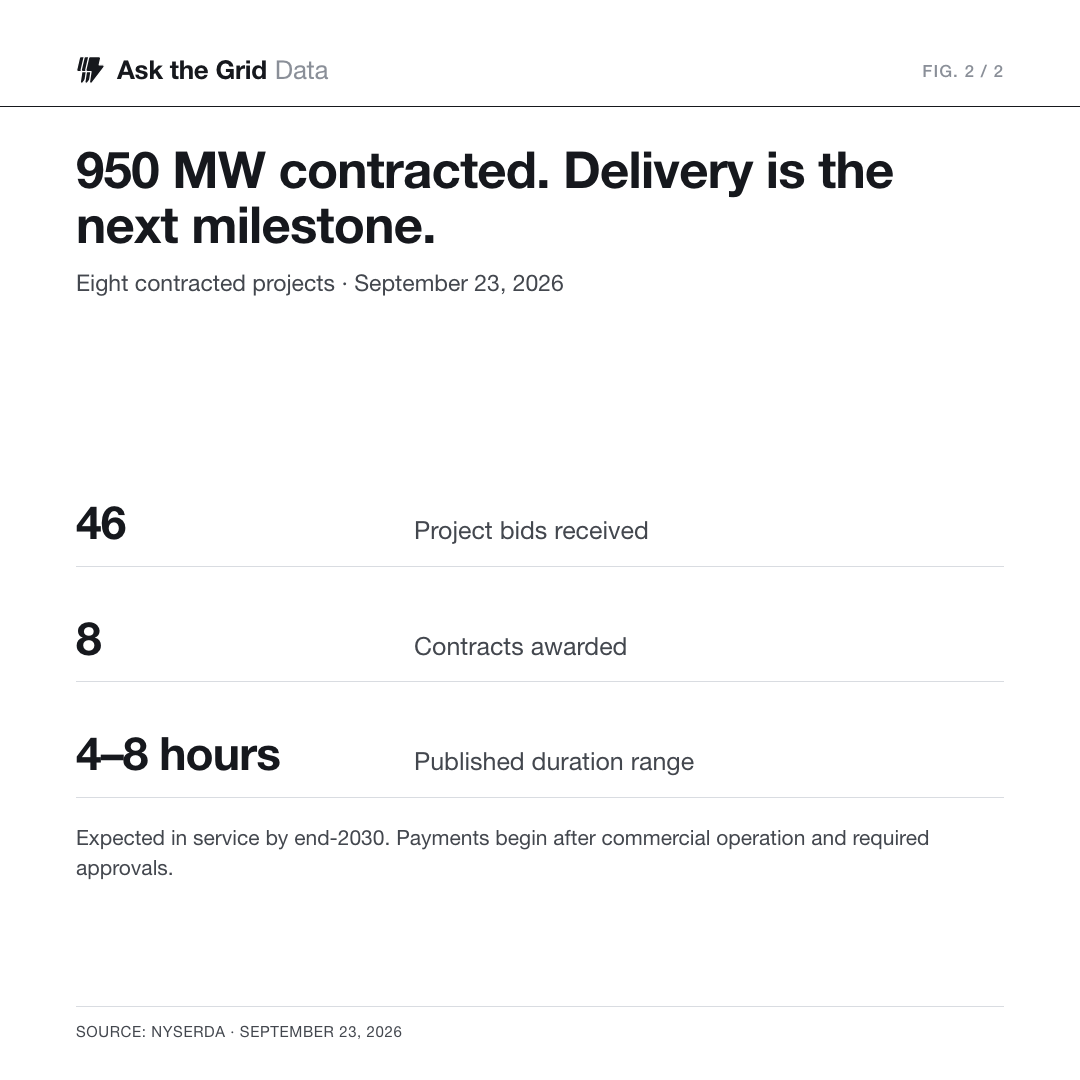
New York awarded contracts for 950 MW of bulk battery storage on September 23, selecting eight projects from 46 proposals totaling approximately 6 GW. The winners range from Chautauqua County to the Bronx and Long Island, with storage durations between four and eight hours.
The award is a development milestone with a defined delivery path. NYSERDA says payments begin after commercial operation, required permits and local approvals remain necessary, and all eight projects are expected in service by the end of 2030. The central question is now how this selected portfolio moves through those milestones in six different counties.
The geography is broader than a single downstate buildout#
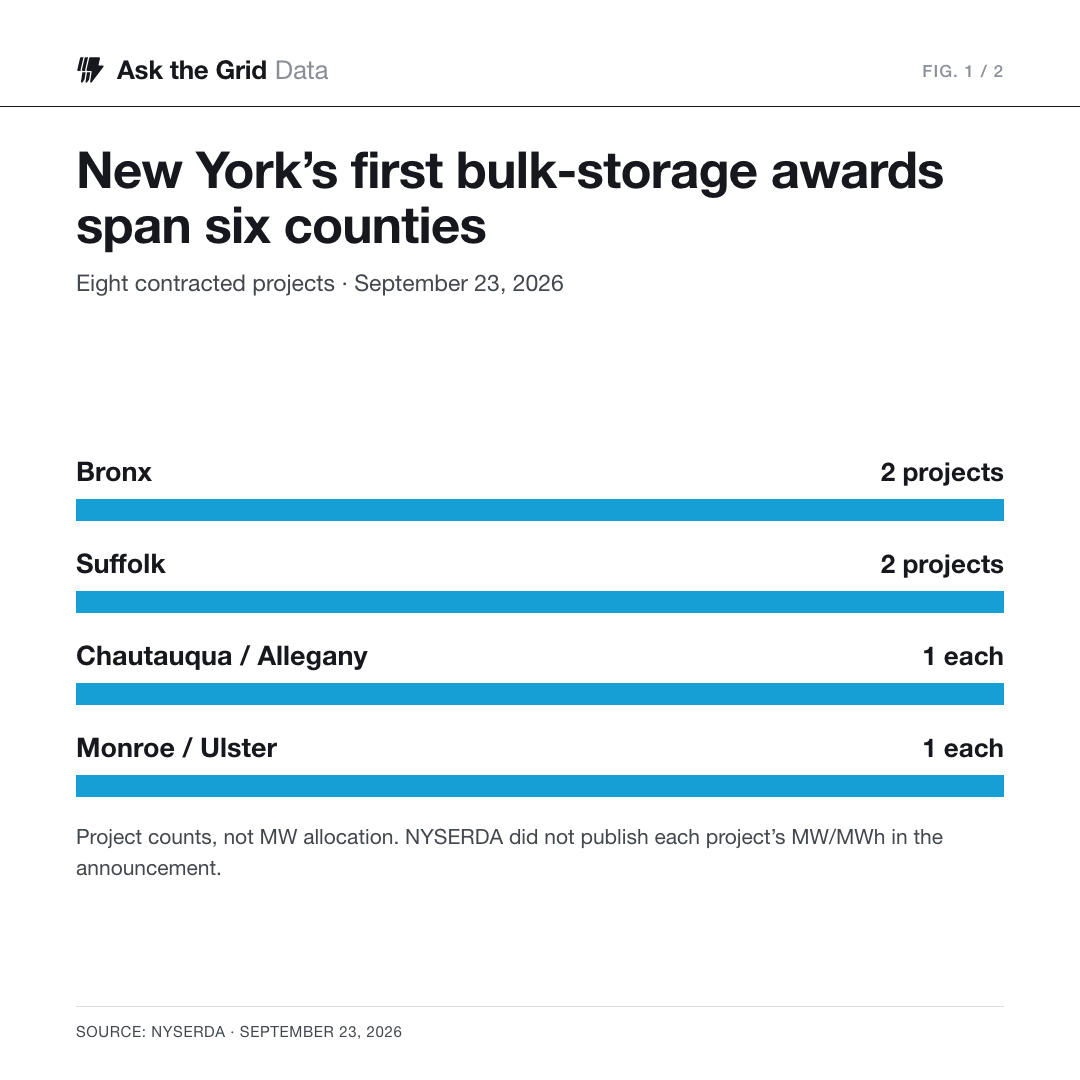
| County marker | Project | County / region |
|---|---|---|
| 1 | Lighthouse Energy Storage | Chautauqua · Western New York |
| 2 | Zenobe Burns | Allegany · Western New York |
| 3 | Eastwater Energy Storage | Monroe · Finger Lakes |
| 4 | KCE NY 5 | Ulster · Hudson Valley |
| 5 | Blue Spruce Storage | Bronx · New York City |
| 5 | Palladium Storage | Bronx · New York City |
| 6 | Holtsville Energy Storage | Suffolk · Long Island |
| 6 | KCE NY 37 | Suffolk · Long Island |
Four of the eight contracts are in the Bronx and Suffolk County: two projects in each. The other four are spread across Chautauqua, Allegany, Monroe and Ulster. Counting contracts gives a 50% downstate share by project count, but it does not establish a 50% share of megawatts. The announcement does not assign individual MW or MWh totals to each named project.
That distinction matters when looking at the map. A project in a high-priced area may have a different size, duration, interconnection limit or operating agreement from a project elsewhere. County location supplies geographic context; it cannot establish the precise node at which a battery will settle or the network service it can provide.
The selection narrowed a much larger bid pool#
Eight contracts represent 17.4% of the 46 submitted projects, calculated from NYSERDA’s counts. The approximate 950 MW award is about one-sixth of the roughly 6 GW offered. The agency’s rounded bid-pool capacity supports an approximate capacity comparison, not a precise acceptance rate by megawatt.
| Measure | Published value | Status |
|---|---|---|
| Storage proposals received | 46 projects · approximately 6 GW | Bid pool |
| Storage contracts awarded | 8 projects · 950 MW | Contracted |
| Storage duration | 4–8 hours | Range across selected projects |
| Separate renewable awards | 13 projects · more than 719 MW | Solar, wind and hydroelectric |
| Storage commercial operation | By end of 2030 | Expected; permits and approvals required |
| Contract payments | After commercial operation | Not at award |
A bid pool measures interest under a solicitation’s rules. It is not an inventory of projects that can all be built at the same cost or on the same schedule. Selection creates a supported portfolio; it does not tell us whether an unselected project will withdraw, seek another contract or proceed through a different route.
Four to eight hours changes the service being purchased#
A megawatt measures discharge power. Duration determines how long a battery can supply that power under its rated conditions. A four-hour project and an eight-hour project with the same MW rating have different stored-energy capacities and can cover different operating windows.
NYSERDA’s duration range makes that variation material, but the agency has not published a project-by-project energy-capacity allocation in this announcement. Assigning all 950 MW a single duration would invent a portfolio MWh total. The next useful disclosure is each project’s contracted power, usable energy, delivery schedule and operating obligations.
For grid planning, those details determine whether a portfolio is suited to an evening ramp, a longer peak period or a particular local reliability requirement. For project finance, the payment structure and commercial-operation conditions determine when a signed contract can begin supporting cash flow.
A contract still has to become an operating asset#
The projects must obtain required approvals and meet updated storage safety requirements. NYSERDA says the lithium-ion systems are contractually required to follow the storage safety codes effective January 1, 2026. Those conditions belong in the development timeline alongside interconnection, construction and commissioning.
The state announced a separate set of 13 renewable-generation contracts totaling more than 719 MW on the same day. Combining the two portfolios produces the approximately 1.7 GW headline, but the generation projects produce energy while the storage projects shift it. Their contributions and delivery risks should remain identifiable.
What to watch before the next solicitation#
NYSERDA expects a second annual bulk-storage solicitation by year-end. Before that round, the most useful progress evidence for these eight projects will be project-level ratings, completed permitting steps, interconnection agreements and financing milestones. Those records will show how much of the contracted portfolio has moved closer to energization.
The award list and county grouping above are frozen from NYSERDA’s September 23 announcement. Calculations use project counts only where individual capacity allocations are absent. Geographic markers represent counties, not inferred facility locations. Explore New York’s grid and compare the development geography with our New York heat-wave account.