Portland General Electric Began Trading in the West’s Expanded Day-Ahead Market
The October 1 entry moves PGE’s regional market participation beyond real-time balancing, with customer savings still a projection.

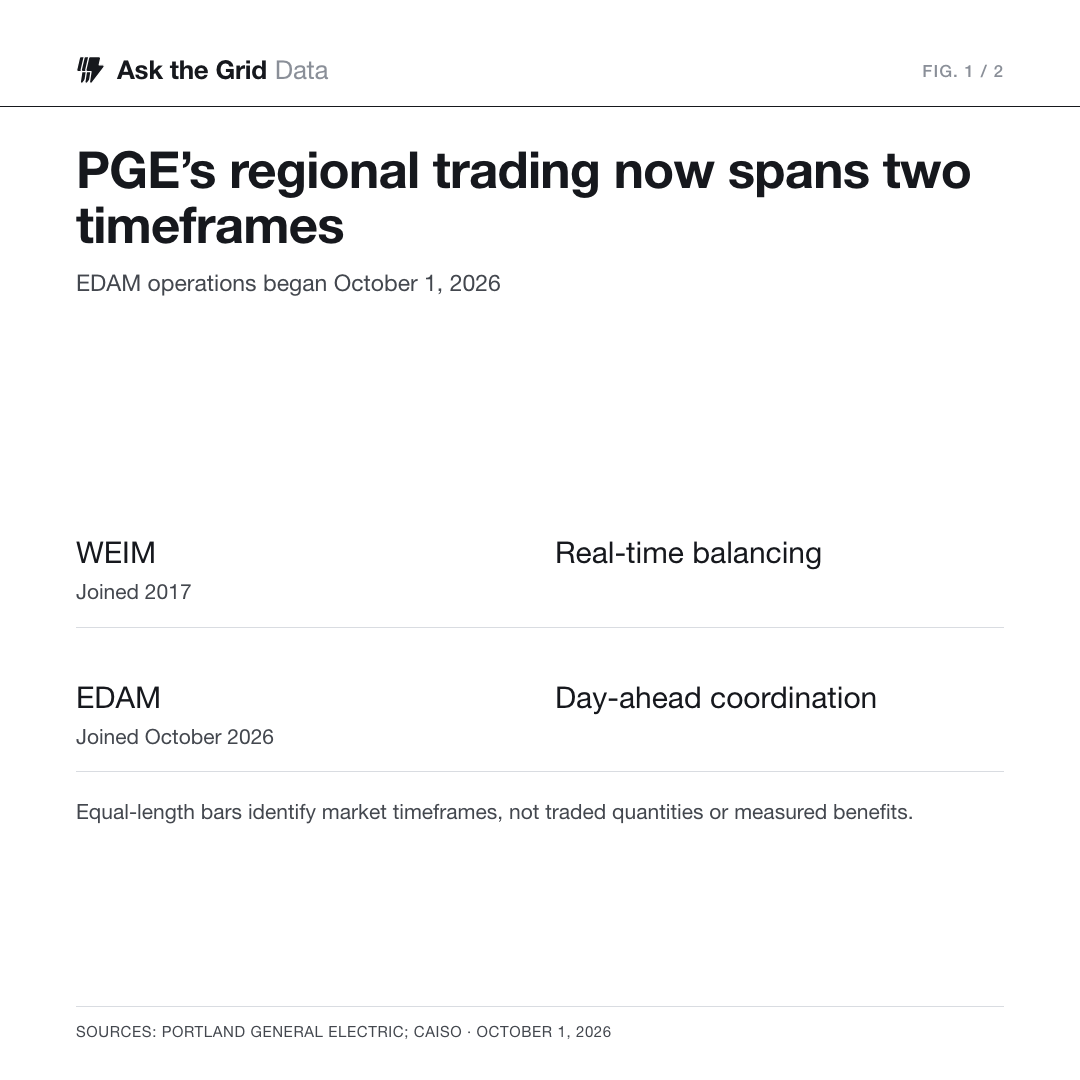
Portland General Electric began buying and selling electricity through the Extended Day-Ahead Market on October 1. The operational entry adds Oregon’s largest electric utility to a market designed to coordinate energy and flexibility across a broader western footprint before the operating day.
The physical transmission links already existed. What changed was the framework for scheduling and optimizing market transactions over those links. PGE had participated in the Western Energy Imbalance Market since 2017; the new step extends its organized regional trading into the day-ahead timeframe.
A day-ahead schedule adds another layer of coordination#
| Market | PGE participation | Function |
|---|---|---|
| Western Energy Imbalance Market | Since 2017 | Real-time balancing of supply and demand |
| Extended Day-Ahead Market | Operations began October 1, 2026 | Day-ahead energy trading and regional coordination |
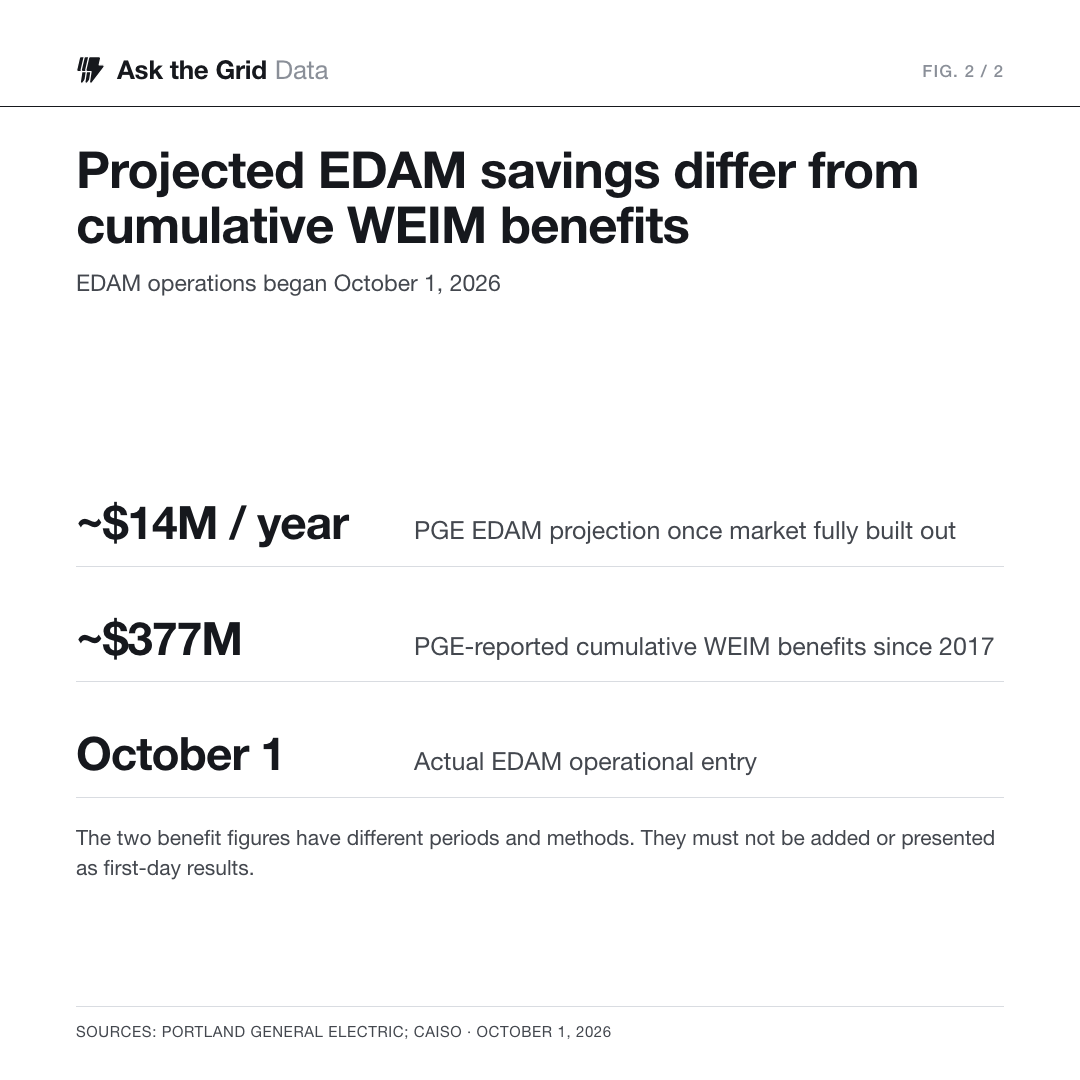
| EDAM annual benefit estimate | Approximately $14 million once fully built out | PGE projection, not observed savings |
| WEIM cumulative benefits | Approximately $377 million | PGE-reported cumulative benefit since joining |
A real-time imbalance market helps reconcile differences between planned and actual supply and demand close to delivery. Day-ahead coordination can organize a larger share of expected energy needs earlier, using forecasts, offers, resource limits and available transmission. Real-time balancing remains necessary because those expectations will not match every operating interval.
CAISO’s announcement says EDAM allows participating utilities to access a more diverse set of western resources, including Pacific Northwest hydro and wind and California and desert Southwest solar. That diversity can create trading opportunities when the regions’ demand or output patterns differ.
The regions exchange energy at different hours#
| Condition | Potential exchange | Evidence needed |
|---|---|---|
| Strong midday California solar | Energy exports toward neighboring areas | Scheduled transfers and contemporaneous prices |
| California morning / evening ramp | Imports and upward flexibility | Transfer schedules, reserve products and limits |
| Northwest hydro and wind availability | Supply offered across the regional market | Actual generation and availability |
| A binding transfer limit | Prices can remain separated | Area prices and transfer-constraint records |
CAISO’s August EDAM report describes California exporting during strong midday solar production and importing during morning and evening ramps. PacifiCorp East became a more significant net exporter during July and August, while PacifiCorp West remained a net importer overall. Those results predate PGE’s entry and establish the market’s operating context.
The pattern explains why a map of physical connections is only the beginning. The value of a transaction depends on resource availability, price differences and transmission capability at that hour. A connection does not guarantee that an import is available during every regional stress event.
The savings claim is prospective#
PGE estimates that participation could save customers approximately $14 million annually once the market is fully built out. That is a forward-looking company estimate. It is not a measurement of October 1 savings, a guaranteed annual payment or a result already demonstrated by PGE’s first days of EDAM participation.
The company separately reports approximately $377 million in cumulative WEIM benefits since joining in 2017. That historical cumulative estimate covers a different market and period. Adding it to the annual EDAM projection would combine incompatible measures and suggest a benefit total that neither announcement reports.
Market entry creates a new comparison window#
PGE’s entry supplies a concrete date for tracking schedules, prices and operating outcomes. A useful baseline would compare similar hours and conditions while preserving changes in weather, gas prices, demand, outages and transmission availability. A simple before-and-after price difference would absorb those influences along with any market effect.
CAISO’s broader August account is a reminder of that distinction: demand and wholesale costs increased even as the operator described sufficient capacity and valuable regional support. Reliability performance, market costs and modeled savings can move differently because they answer different questions.
What to watch after go-live#
The next informative releases will show PGE’s actual transactions, transfer limitations, settlement outcomes and any published benefit assessment. Those data can establish whether the market is using regional resources in the ways its design anticipates. They can also identify implementation or settlement issues requiring attention.
For customers, the practical test is how benefits are measured and reflected in utility costs over time. For market participants, it is the new set of opportunities and constraints in the day-ahead schedule. The October 1 milestone makes those questions observable; it does not settle them on launch day.
Sources and method#
Operational entry and PGE’s benefit figures are attributed to the utility and CAISO’s October 1 announcements. Earlier transfer patterns are from CAISO’s September 28 August report. The map provides regional geography without drawing unverified transaction paths or inferred new lines. No first-day savings or causal price result is estimated. Explore western prices through CAISO or read the August market reconstruction.