PJM’s Capacity Price Fell While Its Reserve Shortfall Grew
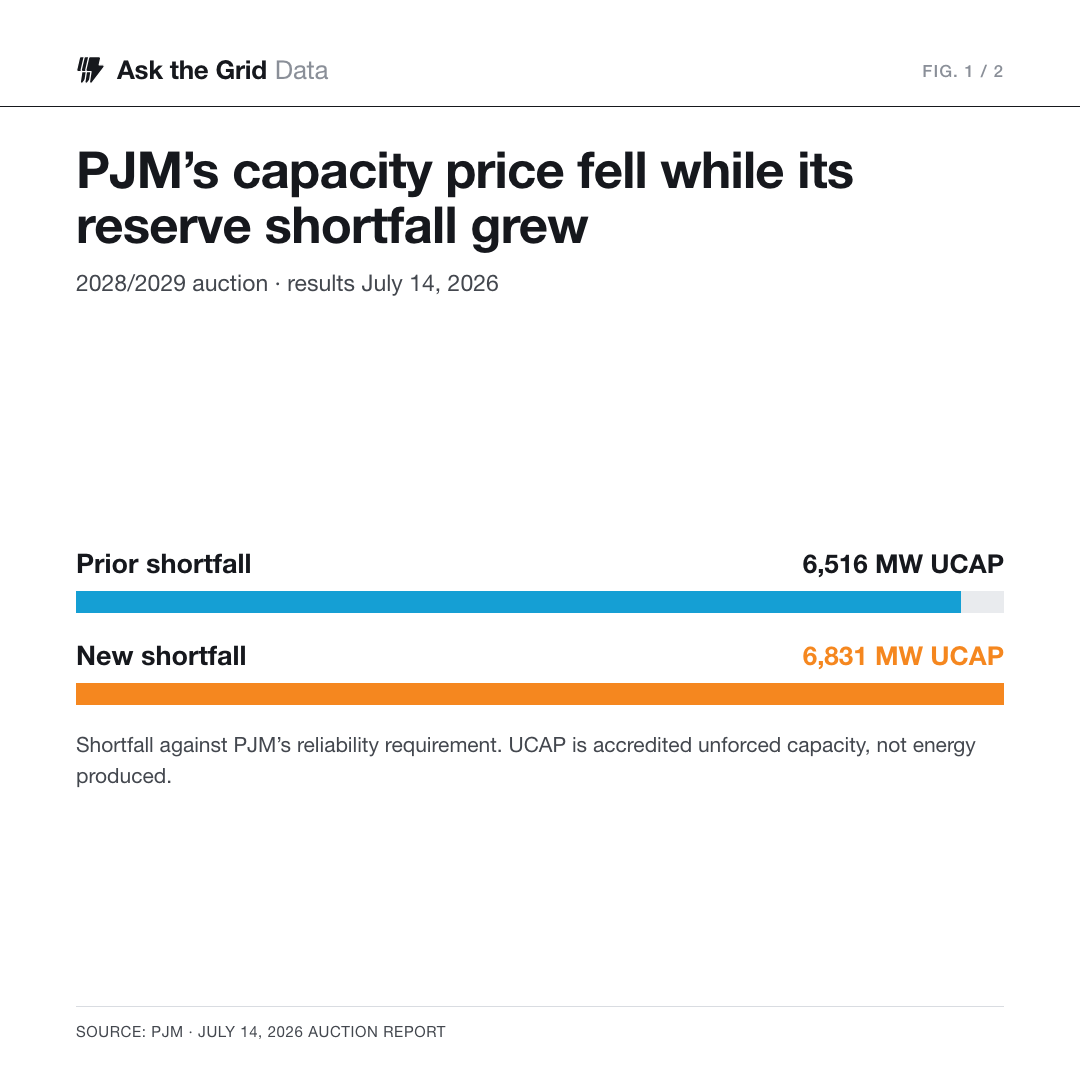
The July auction cleared at $325/MW-day and finished 6,831 MW below its reliability requirement for 2028/2029.

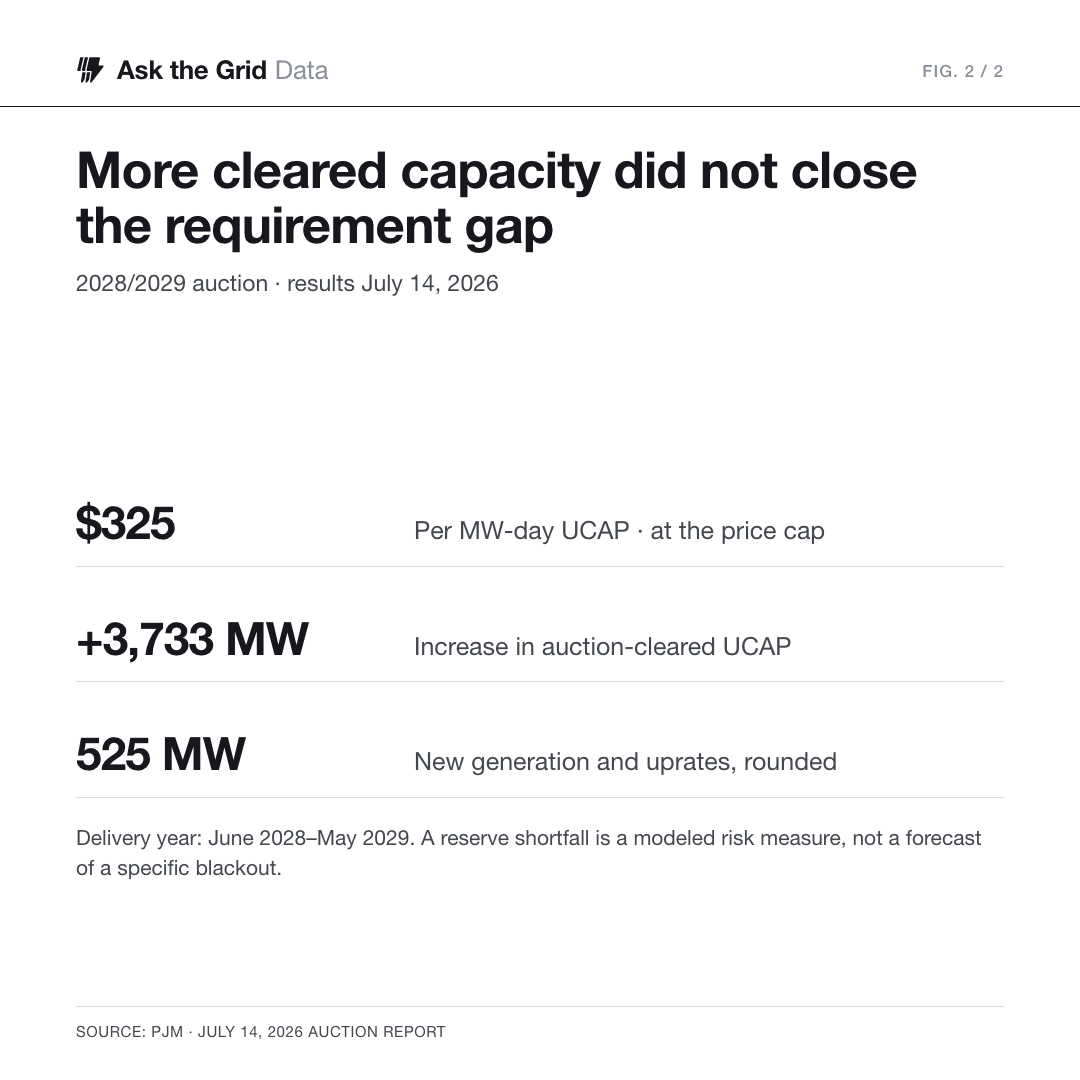
PJM’s July 14 capacity auction produced a lower price and a larger reserve shortfall. The 2028/2029 delivery-year price cleared at the $325/MW-day cap, down 2.5% from the previous auction, while committed capacity finished 6,831.3 MW below the regional reliability requirement.
More capacity cleared than in the prior auction. The gap still widened because the requirement and the supply being measured changed. A capped clearing price, a quantity of accredited capacity and a reserve standard each describe a different part of the procurement. Reading only the price would miss the auction’s central result.
A lower clearing price did not mean looser conditions#
| Metric | 2027/2028 auction | 2028/2029 auction | Change |
|---|---|---|---|
| Clearing price, $/MW-day UCAP | 333.44 | 325.00 | −2.5% |
| Capacity shortfall, MW UCAP | 6,516.0 | 6,831.3 | +315.3 MW |
| RPM cleared, MW UCAP | 134,584.6 | 138,317.8 | +3,733.2 MW |
| Offered supply, MW UCAP | 136,147.6 | 139,594.6 | +3,447.0 MW |
The previous auction cleared at $333.44/MW-day; this one cleared at $325 across the modeled areas. Both outcomes were at their applicable caps. The $8.44/MW-day decline therefore reflects different administrative ceilings as well as the auction outcome. It cannot establish that underlying supply conditions became less constrained.
PJM reports 138,317.8 MW of unforced capacity, or UCAP, cleared in the Base Residual Auction. UCAP adjusts a resource’s capacity for its expected contribution to reliability. It is not the same quantity as the MW printed on a generator’s nameplate, nor is it the electricity the resource will produce in a particular hour.
The shortfall survived an increase in cleared supply#
| Component | MW UCAP | Treatment |
|---|---|---|
| Base Residual Auction | 138,317.8 | RPM auction-cleared supply |
| Fixed Resource Requirement | 10,863.8 | Separate self-supply commitments |
| Total | 149,181.6 | RPM plus FRR |
| Reliability requirement | 156,012.9 | Total plus reported 6,831.3 MW shortfall |
| New generation and uprates | 524.7 | Subset of auction supply, not added again |
Auction-cleared supply increased 3,733.2 MW UCAP from the previous delivery-year auction. Separate Fixed Resource Requirement commitments added 10,863.8 MW, taking the total to 149,181.6 MW. The reported gap of 6,831.3 MW implies a reliability requirement of 156,012.9 MW UCAP on that accounting basis.
The shortfall grew by 315.3 MW, or about 4.8%, from the previous 6,516 MW. PJM says this does not necessarily mean the system will be unable to serve load in the delivery year. It means slimmer reserves and a higher level of modeled risk than the reliability target.
Only a small part of the auction was new generation#
PJM reports 524.7 MW UCAP of new generation and uprates. That equals roughly 0.38% of the auction’s cleared capacity, calculated from the published totals. Uprates improve an existing resource’s capability, so the whole figure should not be described as new power plants.
Most of the procurement therefore concerns the future availability of an existing resource base. Higher offered or cleared capacity can also reflect accreditation changes and previously unoffered resources entering the auction. Those changes matter for the reserve calculation, but they do not all represent newly built equipment.
The payment buys future availability#
The delivery period runs from June 1, 2028 through May 31, 2029. A capacity payment compensates a resource for a future availability obligation under the market rules. Day-ahead and real-time markets separately price the energy it produces and the operating services it supplies.
PJM puts the sum of cleared capacity multiplied by clearing prices at approximately $16.4 billion, unchanged from the previous auction. That is an auction procurement value, not a forecast of every customer’s electricity bill. Retail effects depend on utility procurement, contracts, cost allocation and regulatory treatment.
What the next procurement has to resolve#
The operator’s report identifies work on reliability backstop procurement and large-load additions. For planners, the key question is which resources can meet an obligation in the delivery window. For developers, interconnection, equipment delivery, financing and commissioning must all fit that timetable.
The next observable tests are an adopted procurement design, qualified resources and delivery milestones. A project queue can identify potential supply, but a queued MW is not automatically an accredited MW available for the 2028/2029 auction year.
Sources and method#
All auction quantities and prices are from PJM’s July 14 report. Calculations are 325/333.44−1 for price, 6,831.3−6,516 for the shortfall change and 524.7/138,317.8 for new generation and uprates as a share of auction-cleared UCAP. No later backstop outcome is assumed. Explore PJM or read the separate account of PJM’s governance and energy-price debate.