SPP Won Approval to Reconfigure Existing Lines for Economic Benefits
The August 19 decision adds a congestion-management process built around changing the network configuration.
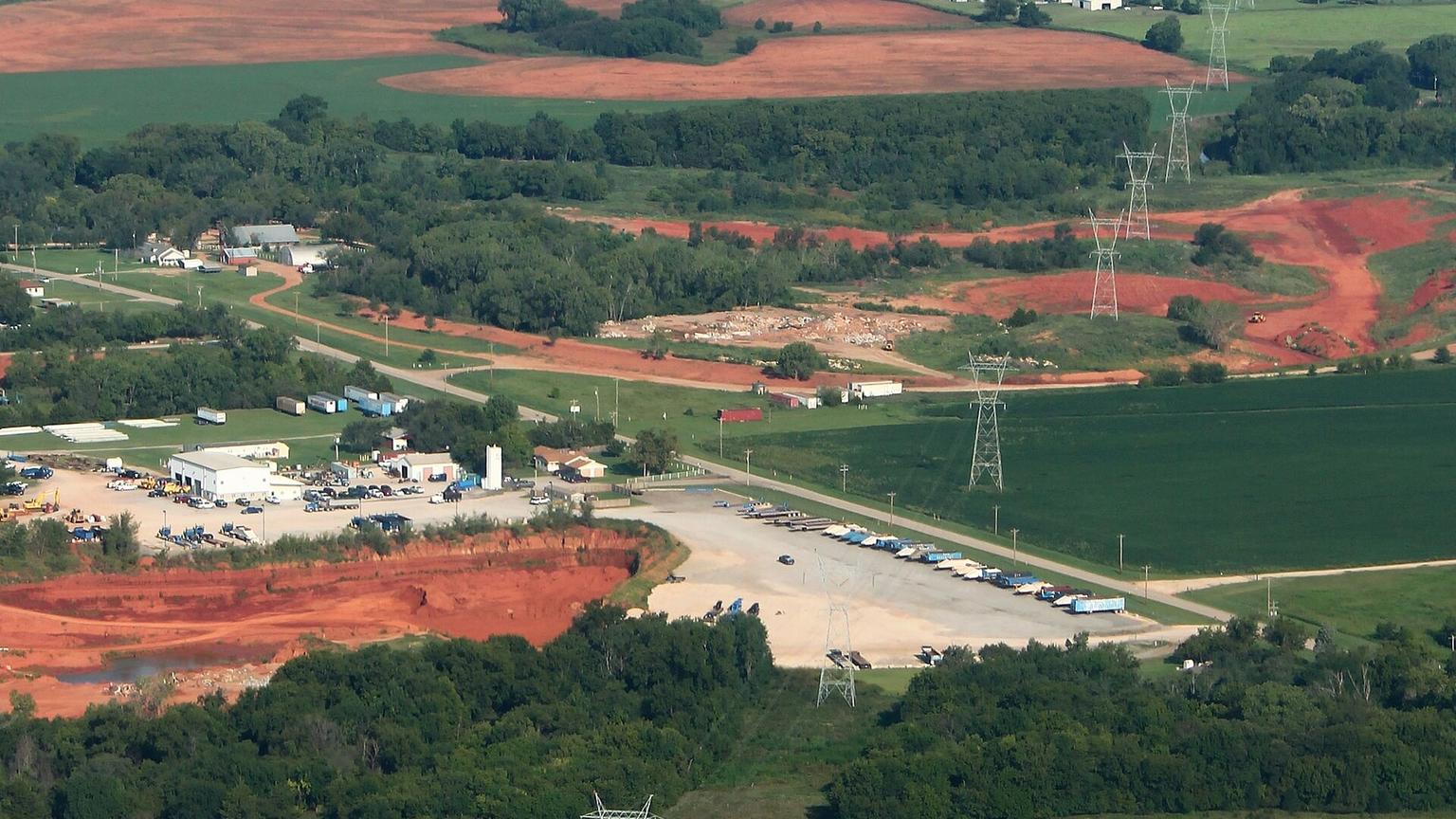
Federal regulators approved SPP’s process for economic topology reconfiguration on August 19. It gives the operator and market participants a route to propose changes in how existing transmission equipment is connected, with the aim of relieving congestion and lowering market production costs.
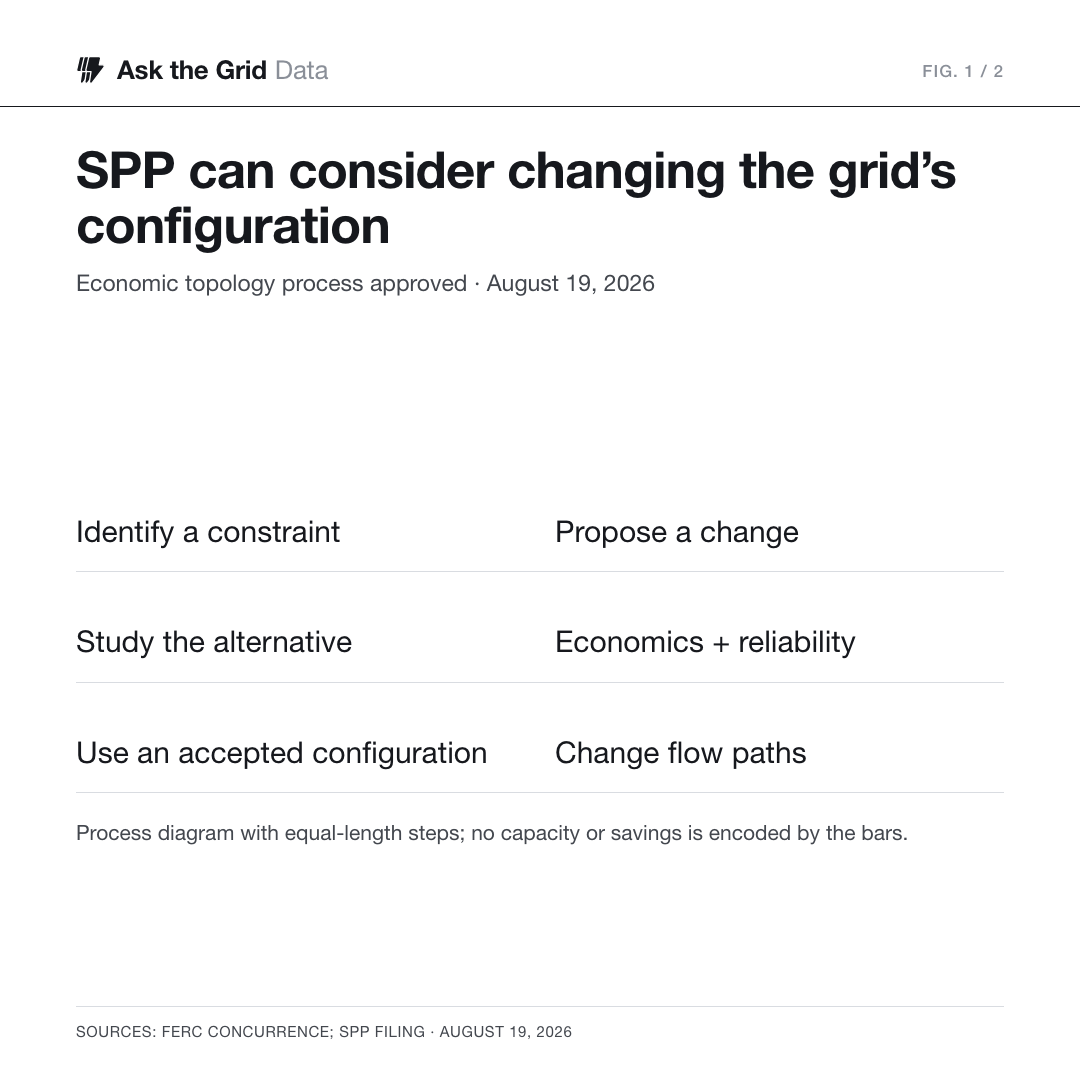
The intervention is operationally specific. A transmission network’s configuration determines the paths available to electricity. Opening or closing selected connections can redistribute flows, allowing the market to use generation differently while remaining within reliability requirements. SPP must study whether a proposed configuration meets the relevant economic and reliability criteria.
The network configuration becomes part of the decision#
| Step | Action | Decision it supports |
|---|---|---|
| Identify | Participant or SPP proposes a reconfiguration | An outage or constraint creates an opportunity |
| Study | SPP assesses economic and reliability effects | Whether the market benefits and criteria are met |
| Implement | An accepted network configuration is used | Power-flow paths change within reliability limits |
| Evaluate | Compare outcomes against the modeled case | Savings depend on system conditions |
Operators commonly manage a binding network limit by changing generation dispatch. If a lower-cost generator cannot deliver more power across a constrained path, a more expensive resource elsewhere may have to increase output. A reconfiguration changes the network conditions underlying that dispatch problem.
The effect is not equivalent to adding a fixed amount of transmission capacity. A switch can ease one condition while changing flows elsewhere. Its value depends on the outages, dispatch, load and contingencies represented in the study, which is why the operator’s assessment is part of the process.
The approval has a measurable congestion backdrop#
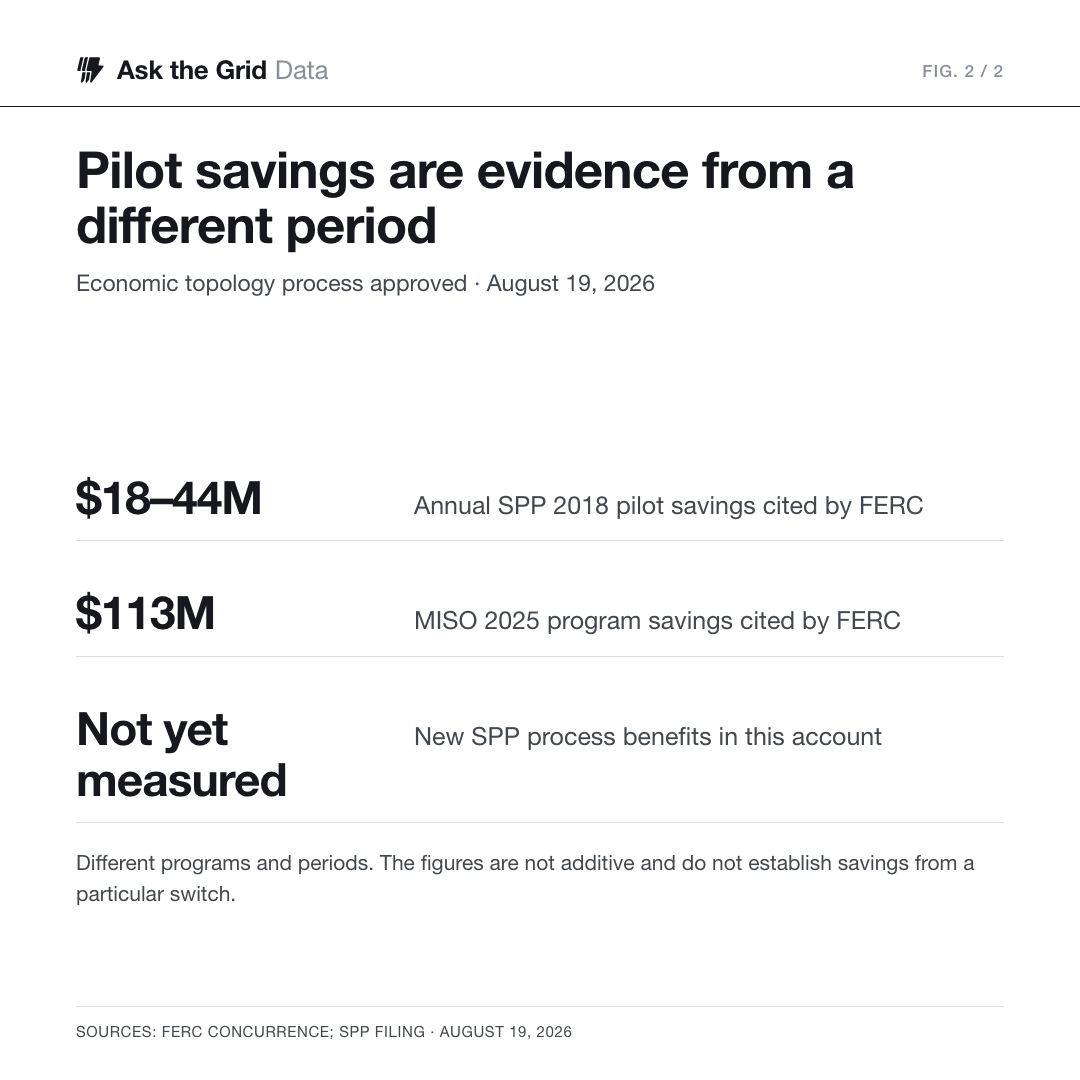
| Program / period | Reported benefit | Evidence basis |
|---|---|---|
| SPP 2018 pilot | $18–44 million annually | Pilot results cited in FERC concurrence |
| MISO program, 2025 | $113 million | Separate operator’s program cited by FERC |
| New SPP process | Not measured here | Approval is not an observed savings result |
Commissioner David Rosner’s concurrence cites annual congestion savings of $18 million to $44 million from SPP’s 2018 pilot and $113 million in 2025 from MISO’s separate topology program. Those examples establish a history of potential and reported benefits; they do not measure savings from the newly approved SPP process.
The concurrence also cites SPP’s average annual congestion costs above $1.6 billion. That figure puts the pilot range in context, but dividing it into a universal savings rate would assume the same conditions, eligibility and operating opportunities across years.
A binding constraint is an economic signal with a precise meaning#
| Source constraint | Binding / breached observations | Maximum shadow-price magnitude |
|---|---|---|
| TP1218_33098 | 1 | $1,500.00/MWh |
| TMP764_33249 | 96 | $1,500.00/MWh |
| TMP524_25655 | 286 | $1,499.72/MWh |
| TP1191_32124 | 93 | $1,499.67/MWh |
| TMP128_29363 | 79 | $1,498.55/MWh |
| TMP721_29543 | 13 | $1,497.99/MWh |
| TMP336_31246 | 74 | $1,489.87/MWh |
| TMP526_32666 | 47 | $1,488.88/MWh |
ATG inspected SPP’s published real-time constraints for the August 19 Central-time operating day. In the eastern footprint, the limit labeled TMP524_25655 appeared in 286 binding or breached observations, with a maximum shadow-price magnitude of $1,499.72/MWh. This is one source-labeled modeled constraint; it is not a physical-line identity resolved from its name.
SPP publishes these real-time shadow prices with a negative sign. The table compares their magnitudes after filtering binding and breached statuses. A $1,500/MWh shadow-price magnitude is the marginal value of relaxing a modeled limit under those conditions. It is not a $1,500 invoice, a line-loading percentage or the savings available from a particular switch.
That distinction keeps the operational data useful. Persistent priced constraints can identify periods deserving investigation, but a candidate reconfiguration still needs a network study. Multiplying a shadow price by an assumed flow change would invent a benefit that the observed constraint table does not establish.
What would demonstrate success#
SPP’s filing requested an October 1 effective date, allowing staff time to develop and test the process. Approval and an effective tariff create a route to action. Evidence of success comes later through evaluated proposals, implementation records and transparent estimates of production-cost effects.
For market participants, the practical question is whether a recurring constraint offers a reliable reconfiguration opportunity. For ratepayers and planners, the comparison is the cost and benefit of that operational option alongside redispatch, maintenance coordination and new infrastructure. Each addresses a different part of the network problem.
Sources and method#
The policy account uses SPP’s May 21 filing in ER26-2592 and the August 19 FERC concurrence. Savings remain attributed to the cited programs. The constraint extract is frozen from October 14 with eastern/western footprint and binding status preserved; it ranks absolute real-time shadow prices. No specific switching configuration or incremental savings is modeled. Explore SPP transmission and prices or read our Montana interconnection-seam analysis.