Texas Pauses Data-Center Approvals After ERCOT's 205-GW Preliminary Large-Load Screen
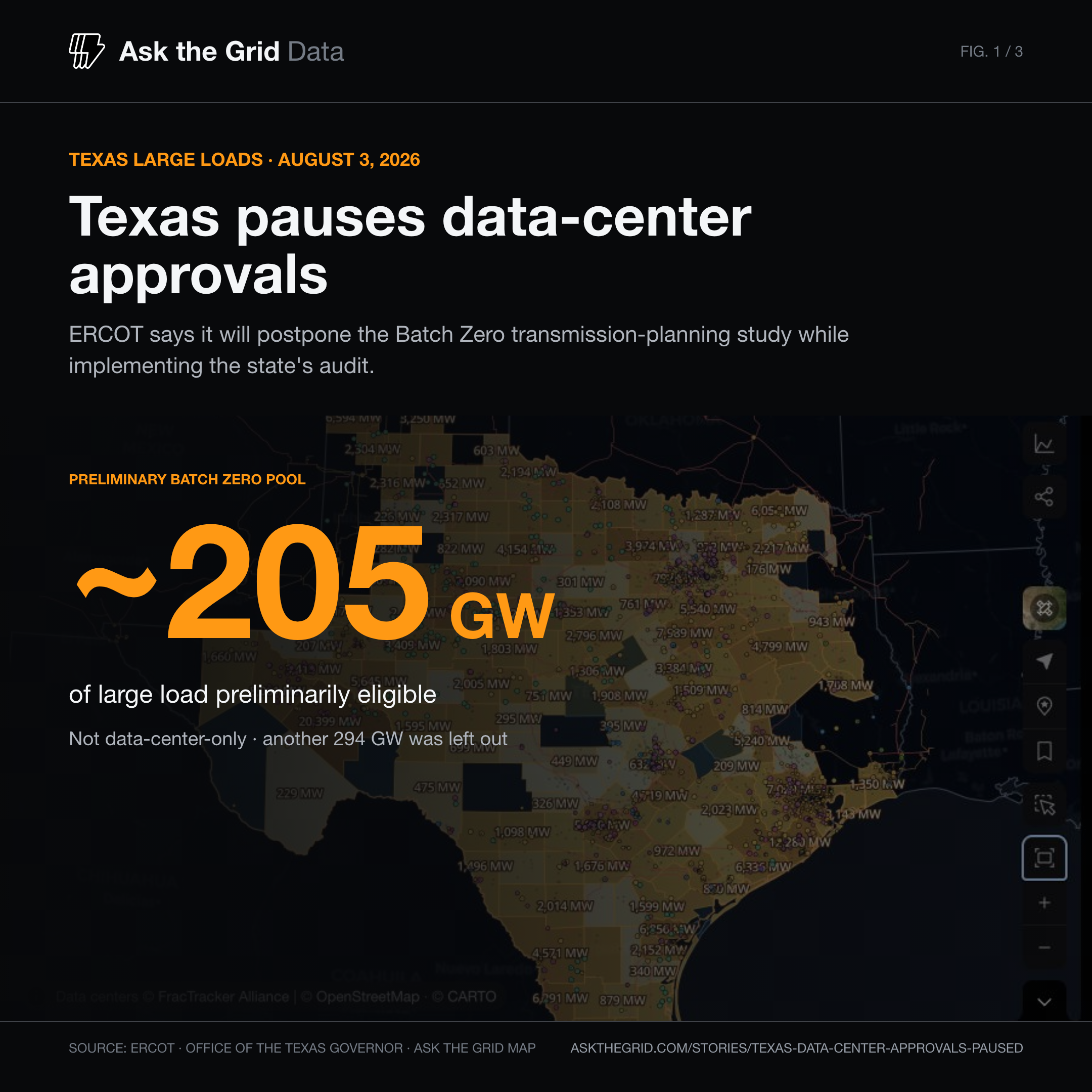
ERCOT's July 28 snapshot put about 205 GW of large load in the preliminary Batch Zero pool and left about 294 GW out. The pool is not data-center-only; Abbott's audit is. ERCOT says it will postpone the Batch Zero transmission-planning study while implementing the directive.
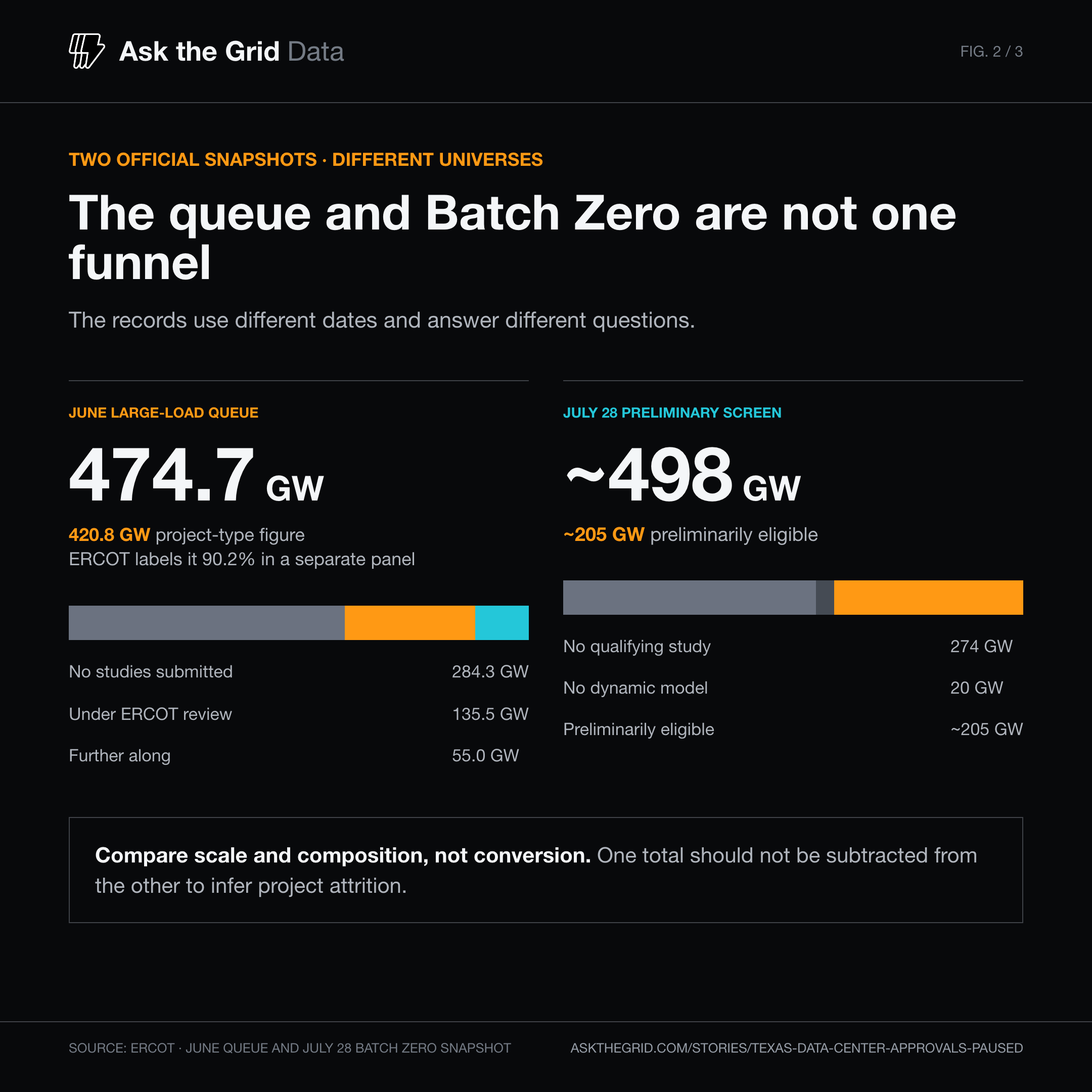
Preliminary screen. ERCOT reported about 205 GW of large load preliminarily eligible for Batch Zero. Another 274 GW lacked a qualifying study and 20 GW lacked a dynamic model. After Texas ordered a data-center audit, ERCOT said it would postpone the Batch Zero transmission-planning study.
ERCOT's July 28 snapshot showed approximately 205 GW of large load preliminarily eligible for inclusion in Batch Zero based on existing studies. The pool covers large loads broadly, not only data centers, and ERCOT has not published its project-type composition. Another 274 GW was not included because it lacked a qualifying study, while 20 GW was not included because no required dynamic model had been submitted.
On August 3, Governor Greg Abbott directed the Public Utility Commission of Texas and ERCOT to audit every data center advancing through the interconnection process before any additional project is approved to move forward. The audit asks projects to document public assistance, electricity use and self-supply, water and cooling, community protections, and ownership and controlling interests. Projects that fail to comply must be denied a grid connection.
ERCOT subsequently said it would postpone the Batch Zero transmission-planning study while implementing the directive. It has not clarified whether the pre-directive August 7 classification notices will still be issued or how the postponement affects the previously scheduled September 2 study start and April 9, 2027 report date.
Batch Zero and the audit test different dimensions of project credibility. Batch Zero applies to large loads broadly and tests study, modeling and commitment criteria for coordinated grid analysis. Abbott's directive applies specifically to data centers and adds broader operating, resource, financial, community and ownership verification.
ERCOT's June presentation reports a 474.7 GW large-load status inventory. A separate project-type graphic identifies 420,812 MW as data centers and labels that amount 90.2 percent. Those figures do not arithmetically reconcile to the same denominator, so this analysis treats them as separate official measures. The two figures are 5.2 times and 4.6 times, respectively, ERCOT's preliminary integrated-hour demand record of 91,089 MW on July 22. That comparison establishes scale, not probability.

The charts are deliberately adjacent rather than connected. The June queue is a 474.7 GW status inventory. ERCOT's July 28 Batch Zero snapshot covers a separate, approximately 498 GW eligibility universe. Its displayed categories include 114 GW of allocated load, 25 GW awaiting a base-versus-allocated classification and 65 GW of base load. Rounded components sum to 204 GW; ERCOT describes the eligible total as approximately 205 GW.
The 205 GW is a large-load total, not a data-center total. ERCOT has not published the project-type composition of the preliminary Batch Zero pool. Abbott's audit applies to data-center projects within the interconnection process, while Batch Zero covers qualifying large loads more broadly.
Eligibility is not permission to energize. Projects of 75 MW or more that pass the screen were scheduled to enter a coordinated study that would allocate reliable peak demand by year, identify transmission upgrades and estimate financial security for those upgrades. ERCOT now says that transmission-planning study will be postponed.
The 205 GW still needs project-level semantics#
One campus can carry several honest MW numbers. Galaxy Helios carries a 200 MW energized-campus record, an 800 MW approved-and-contracted gross-power record and about 1.63 GW of approved utility-service capacity. Riot's Corsicana campus reports 400 MW energized and 1 GW approved. Core Scientific's Pecos campus reports 300 MW currently used, another 300 MW contracted for expansion and a 1.5 GW long-term target.
All of those records can be accurate without being interchangeable. A useful project register needs the capacity value and unit, whether it is requested, studied, approved, contracted, authorized to energize, energized or operating, the building or campus phase it covers, the annual and peak profile, the point of interconnection, utility or transmission provider, as-of date and source document. For phased campuses, the register also needs parent and child project identifiers so expansions are not counted as separate projects or collapsed into one undated number.
The new audit is broader, but its pass-fail rules are still open#
The governor's directive requires records on public assistance; annual and peak electricity use; grid dependence and on-site generation; water use and cooling; community protections; and ownership and control. It says the audit should cover all data centers advancing through ERCOT's interconnection process before additional projects are approved, and that noncompliant projects must be denied a connection. Abbott said the audit was necessary in part because some data centers failed to comply with a state survey measuring their water and power use.
The directive defines the fields, not the thresholds. After the directive, ERCOT said it would work with the PUCT to implement the order, including postponement of the Batch Zero transmission-planning study. ERCOT has not yet clarified whether the August 7 classification notices will still be issued or how the postponement affects the previously scheduled September 2 study start and April 9, 2027 report date.
The directive also does not define a passing water, community or financial record, say whether the project register will be public, or explain how ERCOT should treat phased expansions, duplicate requests and affiliated project entities. The public record does not yet establish when the broader state audit will be complete.
A separate 70-site record tests the audit schema#
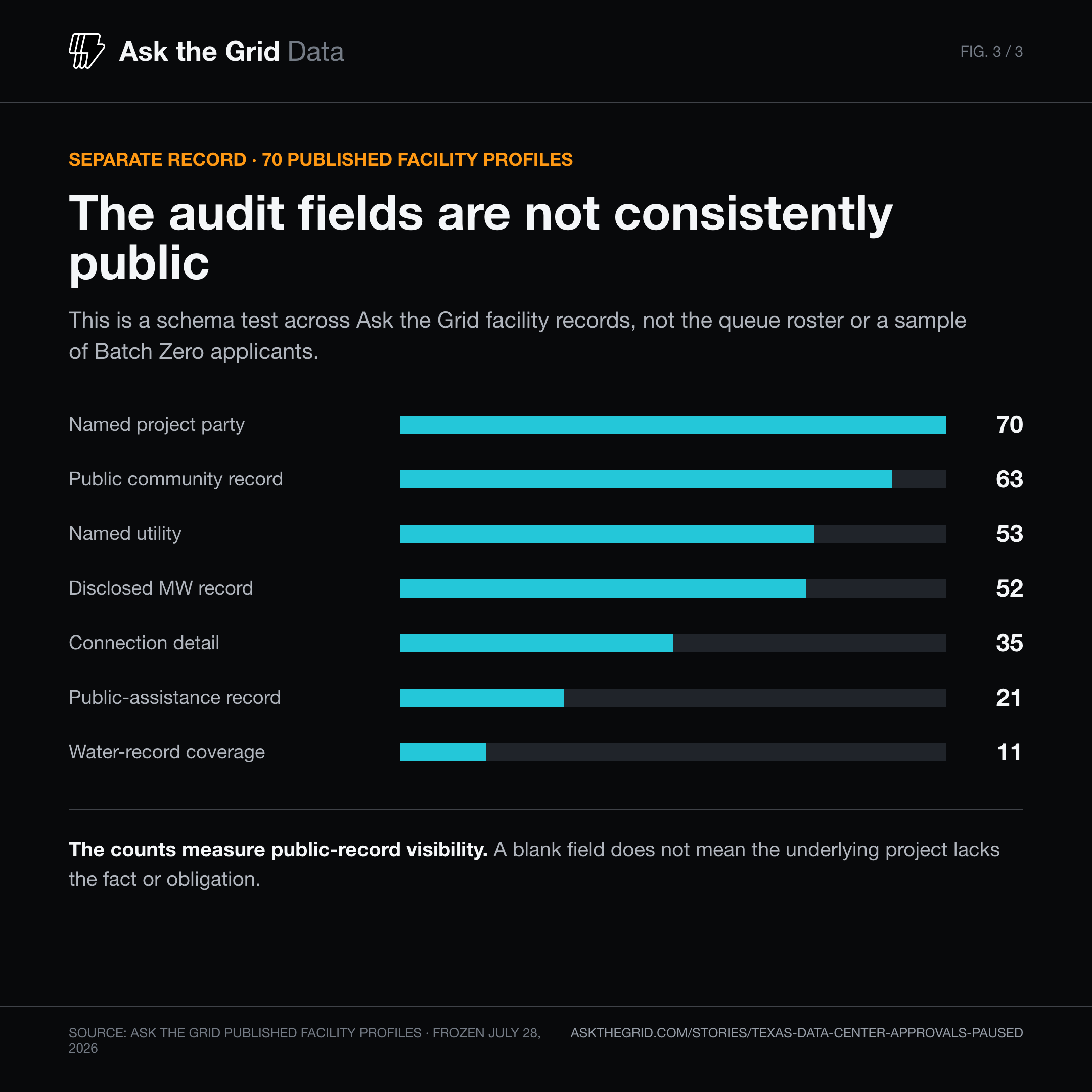
Ask the Grid froze 70 canonical, source-backed ERCOT data-center facility profiles on July 28. This is a different universe from ERCOT's queue and is not a sample of Batch Zero applicants. It includes existing facilities and expansions. Its role here is to test how consistently the audit's requested fields can be reconstructed from published project records.
All 70 profiles identify a named project party, but that is not the same as verified ownership and control. Fifty-three name an electric utility, 52 carry at least one disclosed megawatt record and 35 identify a connection point, substation or voltage. The public trail becomes thinner outside the electrical record: 21 contain a public-assistance record and 11 contain a water-source, permit or consumption detail.
The counts measure public-record visibility. A blank means the qualifying detail was absent from the sources cited by that profile, not that the underlying project has no utility, water use, incentive or community record. The result is still operationally useful: it shows where Texas will need standardized fields and source documents if the audit is meant to support comparable project decisions.
The audit is geographic before it is arithmetic#
A statewide total cannot tell an operator which projects share a transmission corridor, where a substation upgrade is implicated, or which local water and emergency-response systems support several campuses. The map rings the four facilities in the MW comparison from Core Scientific COT2 in Reeves County to Riot Corsicana east of Dallas. Proximity on the map is context, not proof of a specific interconnection or available capacity.
What changes for the decision-makers#
For developers, passing the technical screen may no longer be enough. The interconnection file now needs to function as an operating case: typed power obligations, on-site supply, reducible demand, cooling and water requirements, public assistance, community protections and the entities that own and control each phase.
For ERCOT and utilities, the first decision is data architecture. A stable project identifier and dated status history would let planners distinguish requested, studied, approved, contracted, energized and operating load without losing the relationships between a campus and its phases. That is the difference between a queue headline and a system that can support transmission, water and community decisions.
For communities and power buyers, the useful output is a project register that can be filtered by county, utility, requested peak, service status, on-site supply, water source, incentives and controlling entity, with dates and source documents attached. The state has now specified many of those fields. The unresolved question is whether it will publish a record that lets the market inspect them.
The Ask the Grid profile analysis is frozen at the latest published profile release on July 28, 2026, while the official ERCOT and state record is current through August 3. It deduplicates a retired Compass Red Oak identifier into the canonical facility and counts fields only when the published profile contains a qualifying value. “Connection detail” means a named point of interconnection, substation or voltage. “Water-record coverage” means a named source, permit, annual consumption or peak-day consumption. “Public community record” means a published hearing, benefit or opposition item. Power records retain their reported asset, building, phase or campus scope and their operating, energized, contracted, approved, reported or target status; they are not summed. Open the ERCOT data-center directory or put data centers, substations and transmission on the map to inspect the underlying facility views.
Share this story#
Checking your subscription…