Data-center site selection: what public grid records can tell you about power
A first-pass diligence example for site-acquisition analysts: investigate a 40 MW first phase and a 100 MW campus, and prepare specific questions for the utility.
October 14, 20267 min read
A parcel sits beside a transmission line, and the seller describes room for a 100 MW data-center campus. Your acquisition team needs 40 MW for the first phase. Before treating the site as a power solution, you need to establish which entity would serve it, what has been studied, and which documents support the requested timing.
For a site-acquisition analyst, public grid research is most useful as preparation for that conversation. It can resolve identities, reveal the scope of a published project record, and expose a mismatch between a campus announcement and the capacity assessed in a study. The commercial value is a better screening decision and a more precise utility inquiry.
Follow a hypothetical site seeking 40 MW initially and another 60 MW later. The parcel and figures are illustrative; the ERCOT records discussed below are real published examples of what to read. Use the record selector to see how the question changes as evidence becomes more specific.
What does each record establish?
Follow a hypothetical site from a map pin to service terms. Choose a record.
What the record supports
A location to investigate
The parcel, serving utility, and nearby infrastructure establish the setting.
The next service question
What connection configuration would serve this load?
Illustrative research workflow. A mapped asset or project request does not establish available power service.
In this article · 6 sections
01
Start with the 40 MW the first building needs
The first useful document is a demand brief. For this example, write 40 MW of total facility demand at the connection for the initial phase and 100 MW at full buildout. Record requested dates, the ramp between phases, and whether the operation can tolerate interruption. Keep total facility power separate from IT load, which excludes supporting equipment.
A site may have documentation for one phase while a sales presentation describes the whole campus. If an assessment covers 40 MW, carrying its conclusions into a 100 MW acquisition model leaves the expansion’s service requirements unexplained.
Give the parcel a stable identity as well: coordinates, county parcel identifiers, project names, and the legal entity in each document. A sponsor’s name, a campus brand, and a utility request can refer to the same development under different labels. Keep the original identifiers so a colleague can repeat the search.
02
A line on the map gives you a question to investigate
Use the site coordinates to identify mapped substations, transmission facilities, and nearby generators. Record each source and date, plus reported ownership and voltage where available. Then confirm the serving entity using authoritative utility or service-territory records; proximity to a line does not identify the party that would arrange service.
For nearby generation, EIA-860 is a concrete starting point. Its generator inventory lets you distinguish reported operating and proposed equipment and retain plant and generator identifiers. That helps resolve what a mapped plant represents. Its nameplate MW does not establish firm service capacity for the parcel.
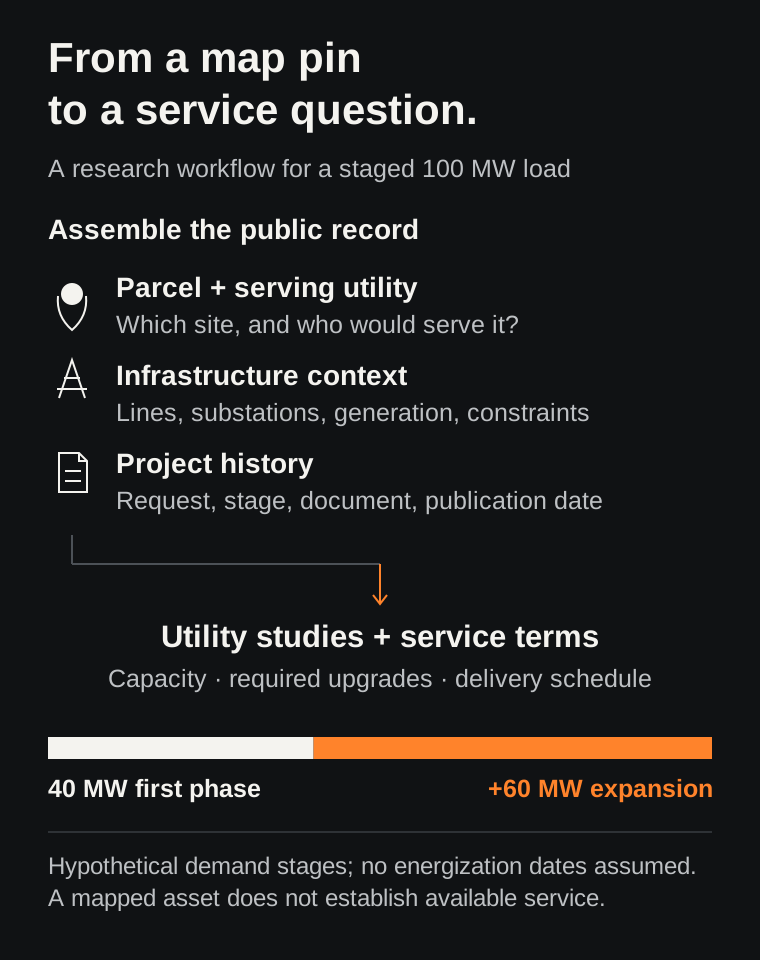
For the hypothetical acquisition, the map should produce an annotated question: which connection configuration would serve the first 40 MW, who owns the relevant facilities, and what upgrades would be required? An engineer or utility can assess that configuration against network conditions and reliability requirements.
03
Read an actual ERCOT record by its scope
ERCOT’s Large Load Integration page provides published process materials and forms. As reviewed on October 14, 2026, it includes separate Batch Zero eligibility materials and energization documents. Select the applicable process with the serving entities rather than assuming a new site belongs in an existing batch.
One useful reading exercise is the Load Type Studied verification reference guide, version 1.1 published September 19, 2026. Its site-control section asks for the property interests supporting the planned facility. For an acquisition analyst, the practical check is whether the parcel in the power discussion matches the land covered by the supporting documents.
On page 13 of that guide, question IFS-1 asks for peak demand in the most recent Load Commissioning Plan. Compare that demand and plan version with the campus capacity in the acquisition presentation. A mismatch is a request for clarification, not proof of available expansion capacity.
The guide applies to a specified Batch Zero eligibility path and says the RIOO portal’s RFIs are controlling. It is a public reference for understanding the evidence requested; it is neither a completed record for our hypothetical site nor a universal checklist for every U.S. utility. Customer-specific submissions may be protected, so expect to obtain project evidence from the authorized project team.
04
Keep the 100 MW announcement separate from the 40 MW assessment
Suppose the seller supplies an announcement describing a 100 MW campus and a study whose assessed case is 40 MW. Both belong in the packet. Record 100 MW as the sponsor’s stated full-buildout plan and 40 MW as the study’s assessed demand, along with its date, assumptions, and conditions. The remaining 60 MW needs its own documented path.
Next, inspect service agreements for the applicable capacity, obligations, upgrades, and remaining conditions. An executed agreement provides terms to examine; energization is another milestone to verify. ERCOT’s integration page separately lists an Energization Request for New Standalone Large Load, illustrating why eligibility, study work, and permission to energize should remain distinct in the chronology.
This separation changes the acquisition discussion. The team can evaluate a first-phase opportunity while explicitly carrying the expansion as unresolved. Calling the entire parcel “100 MW ready” would collapse several different claims into one.
| Document in the example | What to record | Follow-up |
|---|---|---|
| 100 MW campus announcement | Sponsor, date, stated full-buildout plan | Which project records support each phase? |
| 40 MW study | Assessed demand, date, assumptions, upgrades | What conditions support the initial phase? |
| Service agreement | Capacity scope, obligations, remaining conditions | What must occur before energization? |
| Expansion materials | Additional 60 MW and applicable milestones | Which studies and facilities cover expansion? |
05
Use the right queue and the right price
A nearby cluster of proposed generation is context for the network, not a register of data-center load. Berkeley Lab’s Queued Up database covers generation and storage seeking transmission interconnection. Search the relevant utility or operator’s load materials for demand requests, and retain request identifiers and dates when they are available.
Wholesale prices answer another useful but separate screening question: what operating exposure might the site face? At 100 MW of constant consumption, a $10/MWh change for one hour represents $1,000 of wholesale energy exposure. At the initial 40 MW phase it is $400. Both sensitivities precede retail-contract effects and other charges.
Use the prospective procurement location and actual load profile before extending that calculation. A low price at a nearby generator’s node can motivate further investigation, but the delivered tariff, connection capacity, and service date each require their own evidence.
06
Leave the first pass with a question the utility can answer
For our illustrative parcel, the packet now contains a site map with source dates, a 40 MW-to-100 MW demand brief, a register connecting project names to documents, and a milestone chronology. Each material statement points to its source page or is marked as an open question.
The initial inquiry can be specific: “For this parcel and attached demand profile, what configuration and conditions would support 40 MW at our requested date? Which studies or facilities would the later 60 MW require, and which documents establish the current status of each phase?” Attach the requested dates rather than treating them as commitments.
Use Ask the Grid’s data-center directory and grid map to organize the location and asset context. The result of the first pass is a defensible screening memo: what is documented, what remains unresolved, and which entity can answer it. That gives the acquisition team something concrete to evaluate before relying on the parcel’s full advertised capacity.