The California energy crisis and the market it changed
A history of California ISO from deregulation and the 2000–01 electricity crisis to nodal pricing, renewable power and the Western day-ahead market.
November 18, 20269 min read


The California energy crisis brought rolling blackouts and soaring wholesale electricity prices in 2000 and 2001. A tight supply, rising natural gas costs and rules that left utilities exposed to short-term prices all played a role. Traders including Enron exploited those rules. The California Independent System Operator (CAISO) later rebuilt the market around a much more detailed model of the grid.
That crisis sits in the middle of a longer history. California first separated grid operations from the companies that owned the lines. CAISO then rebuilt the wholesale market, adapted it to a grid with abundant solar power and offered parts of that market to utilities across the West. The distinction between running the grid and running a market explains how all of that could happen within the same institution.
01
Before CAISO, utilities ran their own systems
For most of the twentieth century, California’s major investor-owned utilities generated power, moved it over their transmission networks and delivered it to customers. The California Public Utilities Commission (CPUC) regulated their retail rates. Utilities also bought and sold power with one another, and municipal systems such as Los Angeles operated their own networks. A customer’s address generally determined which utility supplied the power.
The Pacific Northwest and desert Southwest already mattered to California’s grid. A utility could buy surplus hydroelectricity from another region if it could arrange the sale and find capacity on the lines. A prospective supplier needed access to the same network its prospective utility customer owned. That made open transmission access central to the argument for a competitive wholesale market.
The CPUC began a restructuring proceeding in 1994. California policy makers wanted more competition in generation while keeping the wires regulated. At the federal level, the Federal Energy Regulatory Commission (FERC) issued Order 888 in April 1996. It required utilities subject to the order to offer nondiscriminatory wholesale transmission access. An independent operator gave utilities a way to administer access under common rules across multiple networks.
02
California split the grid from the power exchange
Governor Pete Wilson signed Assembly Bill 1890 in September 1996. The law provided for a nonprofit independent grid operator and a separate power exchange. FERC conditionally authorized California’s proposed restructuring in October 1997. CAISO and the exchange began operating on March 31, 1998.
CAISO coordinated the participating high-voltage network, reviewed schedules to see whether the grid could carry the power and bought last-minute electricity to keep supply and demand in balance. Owners kept their lines and equipment. The California Power Exchange, usually called CalPX, ran the main day-ahead auction where sellers offered electricity and buyers submitted demand for the next day.
The law also opened retail supply to competition and set up a transition for regulated utilities to recover earlier investments. The major investor-owned utilities initially relied on the exchange to buy power for most of their retail customers. Their options for locking in prices ahead of time were narrow. Retail rates for customers served by PG&E and Southern California Edison stayed frozen during the transition.
That arrangement depended on the gap between wholesale and retail prices. If wholesale prices stayed low, utilities could use the difference to pay down past costs. If they rose above the frozen rates, those same utilities would buy electricity at a loss. That was the exposure California carried into 2000.
Sources
- California ISO’s account of the original market and its redesign
- California ISO’s report on its first year of market operation
- FERC’s account of the ISO and exchange approvals
- EIA’s explanation of the original restructuring provisions
- GAO investigation into California’s wholesale market design
- California Energy Commission’s history of the Moss Landing plant
03
Why wholesale prices soared and blackouts followed
By summer 2000, demand had grown faster than supply. Low water levels in the Pacific Northwest cut hydropower imports, natural gas grew more expensive and some California plants were out of service. Path 15, a major transmission corridor from Southern to Northern California, sometimes filled up even when there was power available farther south. More supply somewhere in the West could help only if the lines could deliver it where the shortage was.

Buyers had to compete for the remaining megawatts at short notice. The U.S. Government Accountability Office’s price series puts the average at about $33 per megawatt-hour in the market’s first two years, then at $317 per megawatt-hour for December 2000. Those figures combine prices on the exchange and CAISO’s last-minute purchases. They measure the rise in the cost of buying power wholesale.
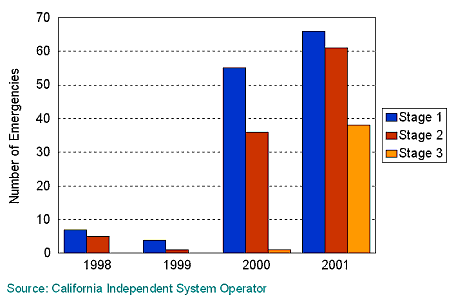
Reserves also ran low. On June 14, 2000, rolling blackouts hit the San Francisco Bay Area. The Energy Information Administration counted 38 Stage 3 emergency notices through May 22, 2001, up from one in all of 2000. At Stage 3, the grid operator may have to cut power to some customers to keep the system stable.

The cost hit customers and utilities in different ways. In San Diego, the retail rate freeze had already ended, and customers saw a sharp rise in bills during the summer of 2000. PG&E and Southern California Edison still faced frozen rates. They were paying increasing wholesale costs and accumulating debts. Suppliers became more reluctant to sell to financially distressed utilities, making it harder for those utilities to secure power.
04
How Enron exploited the market
The market’s timeframes and boundaries created openings for abuse. A utility needed enough electricity to serve customers in real time even if its day-ahead purchases came up short. When the grid operator had to buy additional power near delivery, suppliers with available generation could have much more influence on the last-minute price.
In one strategy FERC described, called Ricochet, traders bought power in California’s day-ahead market, scheduled an export and resold the power to CAISO. Treating it as imported power exposed it to different price rules. Investigators also found other strategies involving false schedules and payments tied to transmission congestion.
FERC staff traced the crisis to supply shortfalls and flawed market design, which made manipulation easier. The findings explain why stopping a particular trading strategy could remove one source of inflated prices while the state still needed adequate generation, imports and transmission.
05
How California got through the crisis
In December 2000 the U.S. Department of Energy ordered specified suppliers to sell to CAISO when the operator could find too little power to meet demand. FERC lifted the requirement that major utilities buy through the exchange and later imposed broader price mitigation across the West. The exchange stopped trading in January 2001. CAISO kept dispatching the grid.
The state began buying power for financially distressed utilities and gained authority to sign long-term contracts in February. Those contracts gave the state a way to secure supply without making every purchase at current market prices. PG&E filed for bankruptcy on April 6, 2001. California subsequently established resource adequacy requirements to make load-serving entities arrange enough dependable capacity ahead of time.
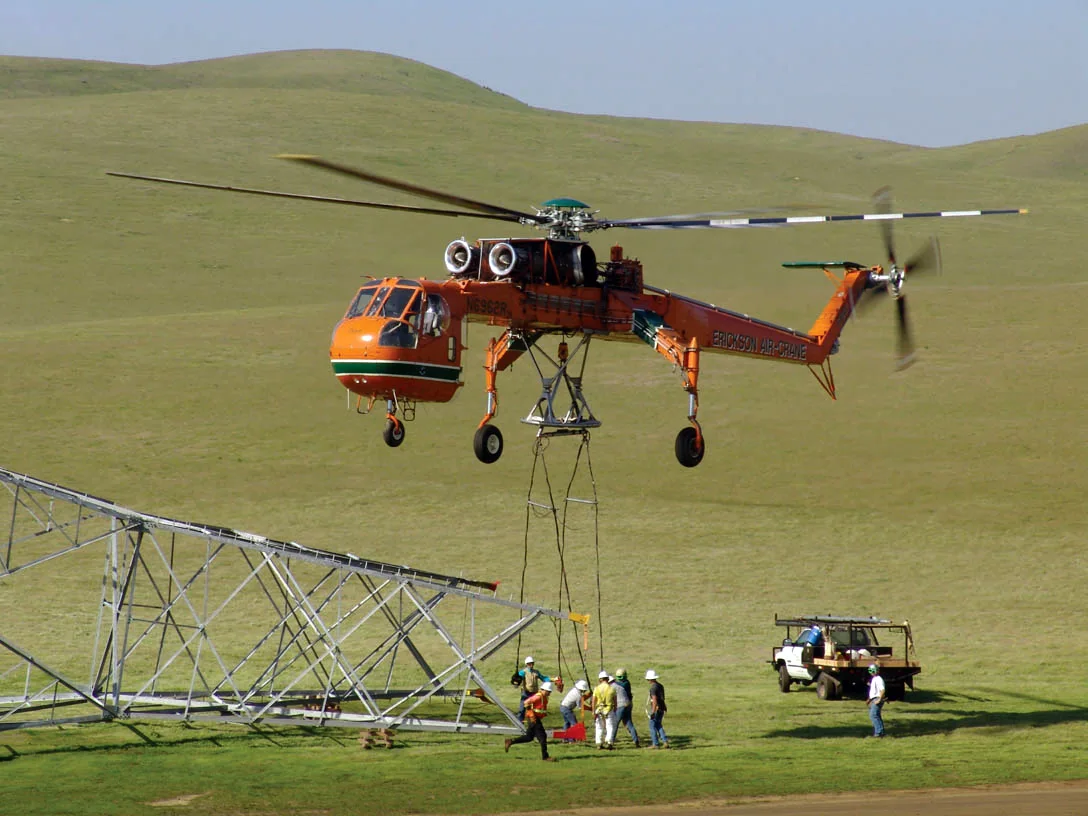
There was also a physical bottleneck to fix. The Western Area Power Administration and its partners added an 84-mile, 500-kilovolt line between Los Banos and Gates to expand Path 15. Grid operators energized it in 2004. That gave operators more room to move power between regions when supplies ran short in one of them.
06
How CAISO rebuilt the market
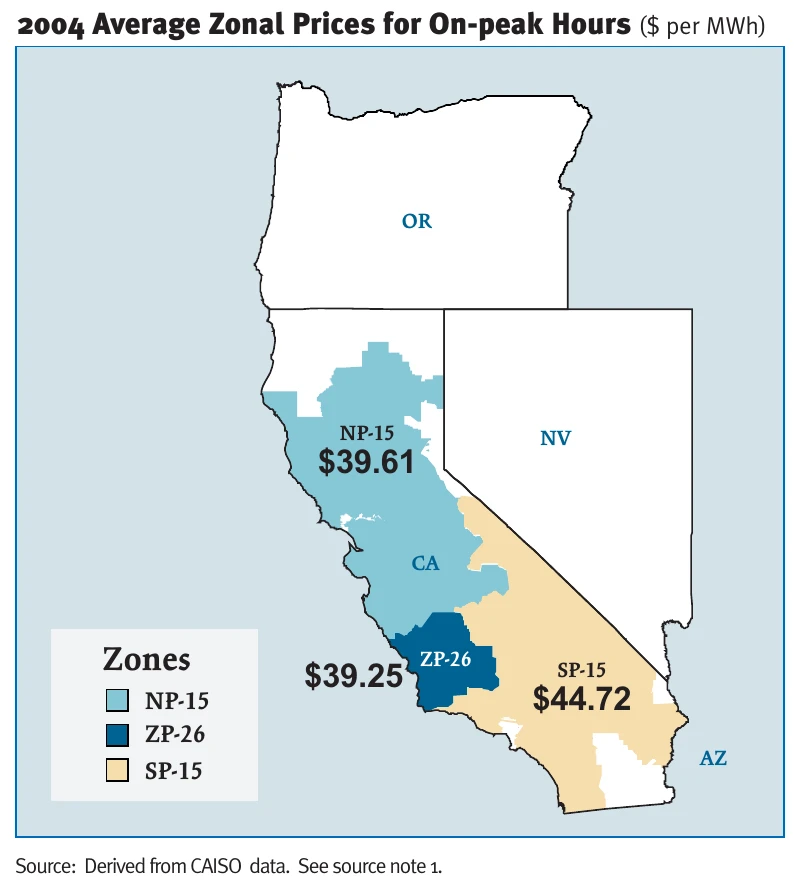
The old market priced power in three broad zones. FERC’s map of the 2004 market shows how it grouped prices around the major transmission corridors. Two locations in the same zone could face a local bottleneck that the zonal price would miss. CAISO still had to manage that constraint in operations.
CAISO’s Market Redesign and Technology Upgrade began operating for the April 1, 2009 trading day. An integrated day-ahead auction returned for CAISO’s area. The new market calculated prices at thousands of points and used a detailed network model to reflect transmission limits while scheduling energy for the next day. CAISO also procured reserves and could commit extra capacity if cleared schedules fell short of forecast demand.
Suppose a low-cost plant normally serves a city across a transmission line. If that line fills up, a more expensive plant near the city may need to run. With nodal prices, the city’s price can rise while the cheaper plant’s price stays low. Each price reflects the cost of serving one more increment of demand at that point. That is what a price map can reveal about the grid on a given day.
The redesign gave buyers a second planning horizon, too. A buyer could schedule the electricity it expected to need in the day-ahead market, then settle differences against real-time prices as actual demand, weather and outages became known. The grid operator had a network-aware way to make both decisions under its own tariff.
07
Solar changed the hardest hours to serve
As California added solar, the harder operating problem shifted toward the evening. Solar production covers a growing share of demand at midday. Other generators then have less demand to serve. Later, as the sun sets and people come home, the remaining generation has to rise quickly.
CAISO’s duck curve made that shift visible. The line shows net load, which is total demand minus wind and solar generation. The midday dip resembles the duck’s belly. The climb at sunset is its neck. Grid operators need resources that can back down at noon and provide more power in the evening. Sometimes CAISO also has to reduce renewable output because there is too much generation for demand and exports.
Batteries give the market a way to shift some of that electricity within the day. They can buy and store power while solar generation is abundant, then supply it during the evening ramp. Trading across a larger area can also help find buyers for surplus power and give CAISO access to imports when local supply tightens.
08
CAISO took its markets west
On November 1, 2014, CAISO and PacifiCorp launched what became the Western Energy Imbalance Market, or WEIM. A utility still set up its own schedules and balanced its own area. The regional spot market gave it a way to trade for short-term differences, such as extra electricity when demand came in above forecast. The market could match resources across the footprint when transmission was available.
A lot of grid decisions happen before real time. A slow-start generator may need to know the night before that it will be needed the next afternoon. The Extended Day-Ahead Market, or EDAM, takes that earlier planning across multiple balancing areas. It schedules energy and needed reserves using more of the region’s available generation and transmission. WEIM can then adjust for changes close to delivery.
EDAM began on May 1, 2026, with the California ISO area and PacifiCorp’s East and West balancing areas. Portland General Electric began trading on October 1. It already participated in WEIM. Each service has its own footprint, so an area can use CAISO’s real-time market without participating in the day-ahead market. Participation in either market leaves responsibility for each balancing area with its local operator.
09
Who writes the rules for a Western market?
A market spanning several states needs rules those states and utilities can accept. CAISO’s own Board of Governors is appointed by California’s governor and confirmed by the state Senate. As more entities joined its Western markets, regulators and stakeholders began the West-wide Governance Pathways Initiative in 2023 to give regional participants a stronger role in setting market rules.
The first change took effect in July 2025. The Western Energy Markets Governing Body gained primary authority over tariff rules that apply to WEIM and EDAM after Public Service Company of New Mexico signed an EDAM participation agreement. The change concerned market-rule authority. CAISO continued to run the markets and operate its own balancing area.
California enacted Assembly Bill 825 in September 2025 to allow a further transfer of market governance. As of November 18, 2026, CAISO and stakeholders were working toward a handoff of rulemaking for WEIM and EDAM to the independent Regional Organization for Western Energy. State law allows implementation starting January 1, 2028, subject to conditions, including findings by the ISO’s board and FERC acceptance of tariff changes. The plan leaves CAISO as the market operator. That distinction goes back to the original restructuring, when California gave different institutions responsibility for different parts of the electricity system.