Why Does Texas Have Its Own Power Grid?
From wartime power sharing to the Midnight Connection and Winter Storm Uri, here’s how ERCOT and the Texas power grid took shape.
November 18, 20269 min read

Texas has its own power grid because utilities connected across the state, then kept that network electrically separate from the larger grids around it. Sharing power made the Texas utilities more useful to one another. Keeping the network within the state also put most of its wholesale electricity sales and transmission outside federal rate regulation.
ERCOT stands for the Electric Reliability Council of Texas. It is the nonprofit operator that balances the Texas Interconnection and runs wholesale markets for roughly 90% of Texas electricity use. The council was founded in 1970, decades after utilities started connecting. The distinction matters because three different decisions shaped the system that Texans use today. Utilities built the network, regulators determined who oversaw it, and the state later decided how companies could buy and sell power on it.
01
How local grids became the Texas Interconnected System
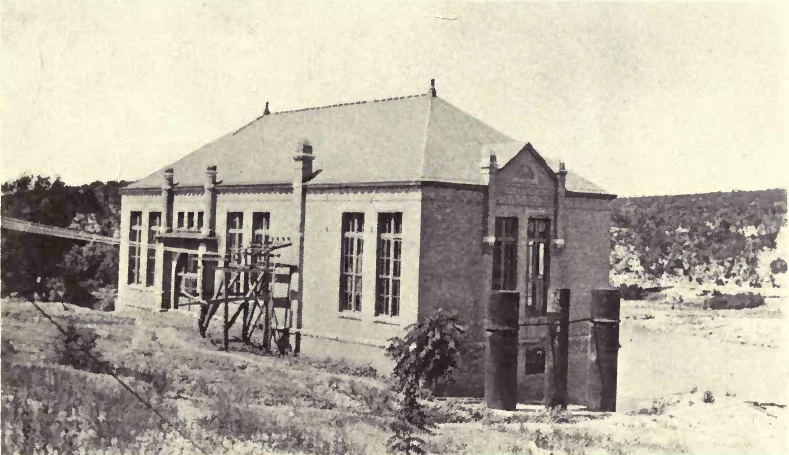
Early electric companies built around places that could use the power. Austin put a powerhouse beside a dam. In other cities, electric companies built steam plants near their customers. By the 1920s utilities could connect their separate systems and carry larger amounts of power over longer distances. West Texas Utilities and Texas Electric Service connected in 1924. Houston Lighting & Power built a tie with Gulf States Utilities in 1928 for emergencies. A 1938 Texas Planning Board map records lines and generating plants before wartime coordination expanded.
The 1935 Federal Power Act gave the Federal Power Commission authority over interstate transmission and wholesale sales. West Texas Utilities opened its connections with Public Service Company of Oklahoma in 1935 to avoid that jurisdiction, a later district court found. The court found no evidence that the major Texas utilities agreed on a common strategy in 1935. Individual utilities made choices about which connections to keep, and those choices shaped the network that resulted.
By 1941, Texas utilities were sending excess generation to Gulf Coast factories that needed large amounts of power to smelt aluminum for the war effort. ERCOT’s own historical account traces the Texas Interconnected System to that cooperation. Formal coordination took longer. The district court recorded that Houston Lighting & Power and Texas Power & Light built a direct link in 1962 and that the north and south systems joined formally in 1967. A link initially built for a specific need became part of a grid that could share reserve power all year.
02
Why ERCOT was formed in 1970
A connected grid shares problems as well as power. When one large generator fails, frequency drops throughout the system and other generators must respond. Following reliability reforms after the 1965 Northeast blackout, Texas utilities formed ERCOT in 1970 as a regional reliability council. Municipal utilities and rural cooperatives took part alongside the big companies. They could agree on operating standards and share information while individual utilities still ran their control areas. ERCOT’s regulatory history describes that transition.
03
The Midnight Connection challenged the boundary in 1976
On the night of May 4, 1976, West Texas Utilities energized a 69-kV connection with its Oklahoma affiliate, Public Service Company of Oklahoma. A connection between two companies changed the legal position of the rest of the pool as long as it stayed electrically connected to them. Some Texas companies promptly disconnected from West Texas Utilities and its affiliate Central Power and Light. The two companies asked federal regulators to assert jurisdiction over ERCOT members. The federal district court’s findings record the nighttime connection and the split that followed.
The Texas Public Utility Commission then ordered the companies to end interstate service and reconnect. The companies challenged those orders in state and federal court. In 1979 the Fifth Circuit upheld a decision to defer to the Texas courts while questions about the state commission’s authority were unresolved. In the separate antitrust case, the district court rejected the Texas utilities’ claim that their rivals had conspired to prevent interstate service. The later operating arrangement depended on a settlement involving limited direct-current interconnections. FERC’s account of its jurisdiction describes its authority over the two interstate links under that settlement and the narrower reach of its authority within ERCOT.
Bulk system coordination shifted from the Texas Interconnected System to ERCOT in 1981. After a cold-weather event the following winter, two security centers began coordinating the member utilities’ control areas in 1983. Those centers watched the shared system and helped the companies respond when a shortage in one area could cause trouble elsewhere. The FERC staff history distinguishes this reliability work from the competitive market Texas added later.
04
Is the Texas power grid connected to other states?
Yes, through limited connections. ERCOT runs its own alternating-current system in step at roughly 60 hertz. A back-to-back direct-current tie converts power from one grid’s alternating current to direct current and back to the neighboring grid’s alternating current. Each system keeps its own frequency and phase. Operators can schedule an exchange up to the tie’s limit without the two systems operating in synchronism.
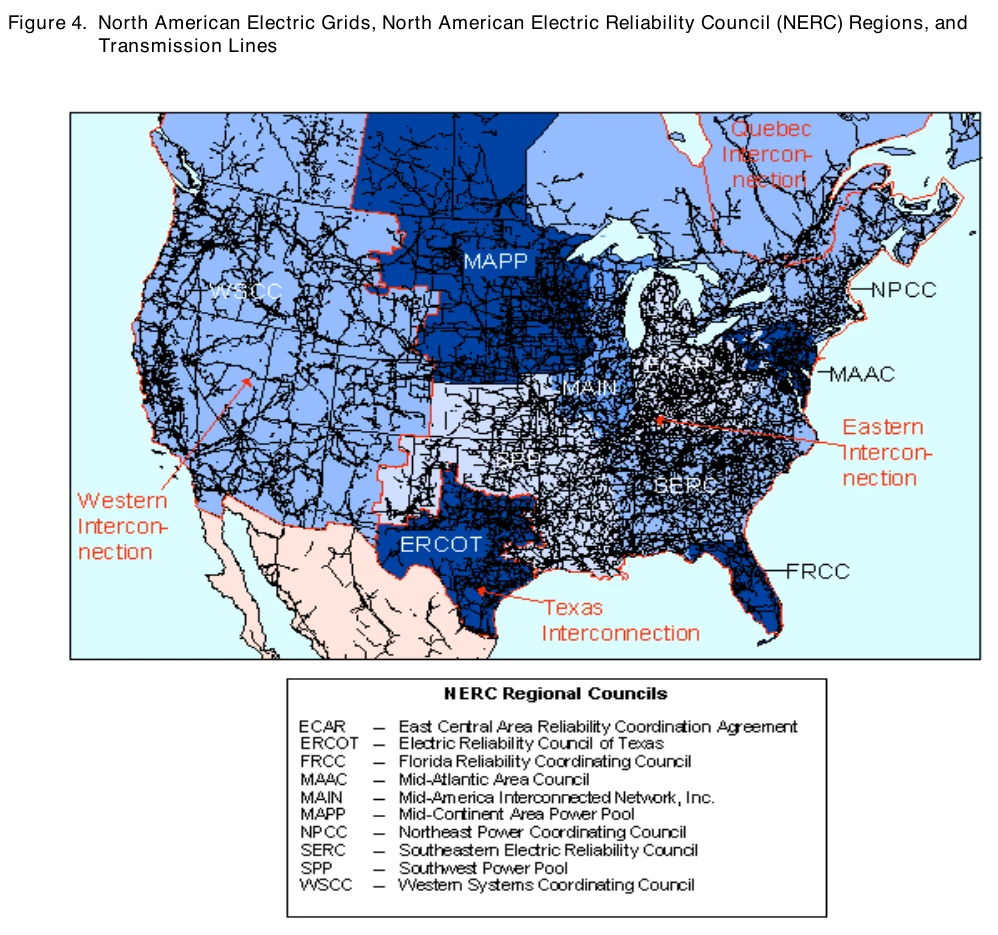
The Texas utility commission’s 2025 report describes two direct-current ties to Southwest Power Pool and two ties to Mexico, one of which uses a variable-frequency transformer. The links can help when neighbors have power to spare. If a cold front hits both sides, available generation on the other grid and the rating of the connection both limit what Texas can import.
05
How Texas opened its power market in 2002
In 1995 Texas lawmakers opened wholesale generation to competition. The Public Utility Commission designated ERCOT the independent system operator in 1996 so that generators seeking access to the wires would deal with an operator independent of the companies that owned them. In 2001 ten utility control areas consolidated into a single ERCOT control area. The operator’s timeline shows how operational control moved before customers could choose a supplier.
Texas passed Senate Bill 7 in 1999. In competitive areas it separated the old utility’s generation, retail sales and wire services. Customers could choose a retail electric provider beginning January 1, 2002. The local transmission and distribution utility still delivered power over the same poles and wires at regulated rates. Municipal utilities and cooperatives could choose whether to participate in retail choice. A household in the ERCOT footprint may therefore still have one retail option.
The law also used a transitional rate for eligible incumbent customers, the price to beat. It gave new retail providers a chance to compete while rates for many customers still had a regulated baseline. New retailers could offer contracts with fixed or variable prices and buy the electricity needed to serve them from generators. ERCOT handled scheduling, system balance and the financial settlement of the wholesale market.
06
What changed when ERCOT went from zones to nodes
The early market grouped the grid into broad congestion zones. That captured major limits between zones, but a statewide grid can also run into a bottleneck deep within one zone. When a local line was full, ERCOT could still call a plant out of the usual order to keep flows within limits. A broad zone price told a plant or a buyer less about what that local congestion was costing. FERC’s overview of the zonal market describes how the design handled those constraints.
On December 1, 2010, ERCOT began full operations in its nodal market. Location-specific prices show the cost of serving another unit of demand at a point on the grid. If a line is full, nearby points can have very different prices because a more expensive plant is needed on one side. The redesign gave ERCOT a more precise way to dispatch those resources and added a day-ahead market where buyers and sellers can schedule and settle power ahead of delivery. See ERCOT’s account of the December 2010 launch.
07
The 2011 freeze and Winter Storm Uri
A cold front in February 2011 exposed a supply problem that the new market alone could not fix. Frozen equipment took generators offline while homes and businesses needed more electricity. ERCOT interrupted up to 4,000 MW of customer demand on February 2, according to the FERC and NERC investigation. Its recommendations covered winterizing plants, preparing gas supply systems and coordinating the gas and electric sectors.
In February 2021, severe cold reached much of Texas and neighboring grids over several days. The joint investigation into Winter Storm Uri found that freezing and fuel problems caused most of the generator outages, reductions in output and failures to start across the affected region. ERCOT ordered as much as 20,000 MW of firm load shed at the worst point. The instructions began February 15 and, across the system, lasted nearly three days. That number measures how much load was interrupted at a moment. It does not measure total energy lost or how long any one customer waited.
Cold hurt both ends of the gas-to-power chain. Some electric plants needed gas that producers and pipelines could not deliver. Some gas equipment needed electricity during the same hours that utilities were cutting load. Meanwhile the connections to other regions could only carry a fraction of the missing supply. Our reconstruction of the Texas grid collapse follows those failures hour by hour.
08
What Texas changed after Uri
Texas enacted Senate Bill 3 in June 2021. It required weather preparedness for covered power plants and transmission facilities, with ERCOT inspections and enforcement by the state utility commission. The Railroad Commission adopted a separate rule for certain critical gas suppliers and pipelines. Texas also set up a joint effort to map where power supply and gas infrastructure depend on one another. In November 2026 ERCOT issued its checklist for winter inspections, including the protection of critical equipment at covered facilities.
ERCOT also changed how it buys flexibility. In June 2023 it added a contingency reserve that can respond within ten minutes. In December 2025 it began clearing energy and ancillary services together in real time and incorporated batteries’ state of charge. A battery with limited stored energy can now be scheduled with that physical limit in view when ERCOT decides whether it should deliver energy or keep some capability in reserve. The change affects how ERCOT uses the resources already on its system.
09
What parts of Texas are outside ERCOT?
El Paso is part of the Western Interconnection. Parts of the upper Panhandle and northeast Texas are in Southwest Power Pool, and Entergy Texas serves the Beaumont area within MISO. A state line and a grid boundary answer different questions. The Texas entry in our state grid finder identifies those splits. The live ERCOT map follows the interconnected lines, plants and substations inside ERCOT.