Grid events, on the grid.
When something happens on the grid, you see it where it happened — on the map, with the conditions around it and the record it came from.
See it where it happened
Notices, outages, weather, and market moves land on the map, beside the prices they moved.
Ask what happened
The agent rebuilds any event: the conditions before, the assets involved, the record behind it.
Turn it into an alert
Any event can fire a rule — grid-wide, or inside a radius you draw around one asset.
The event, with the situation attached.
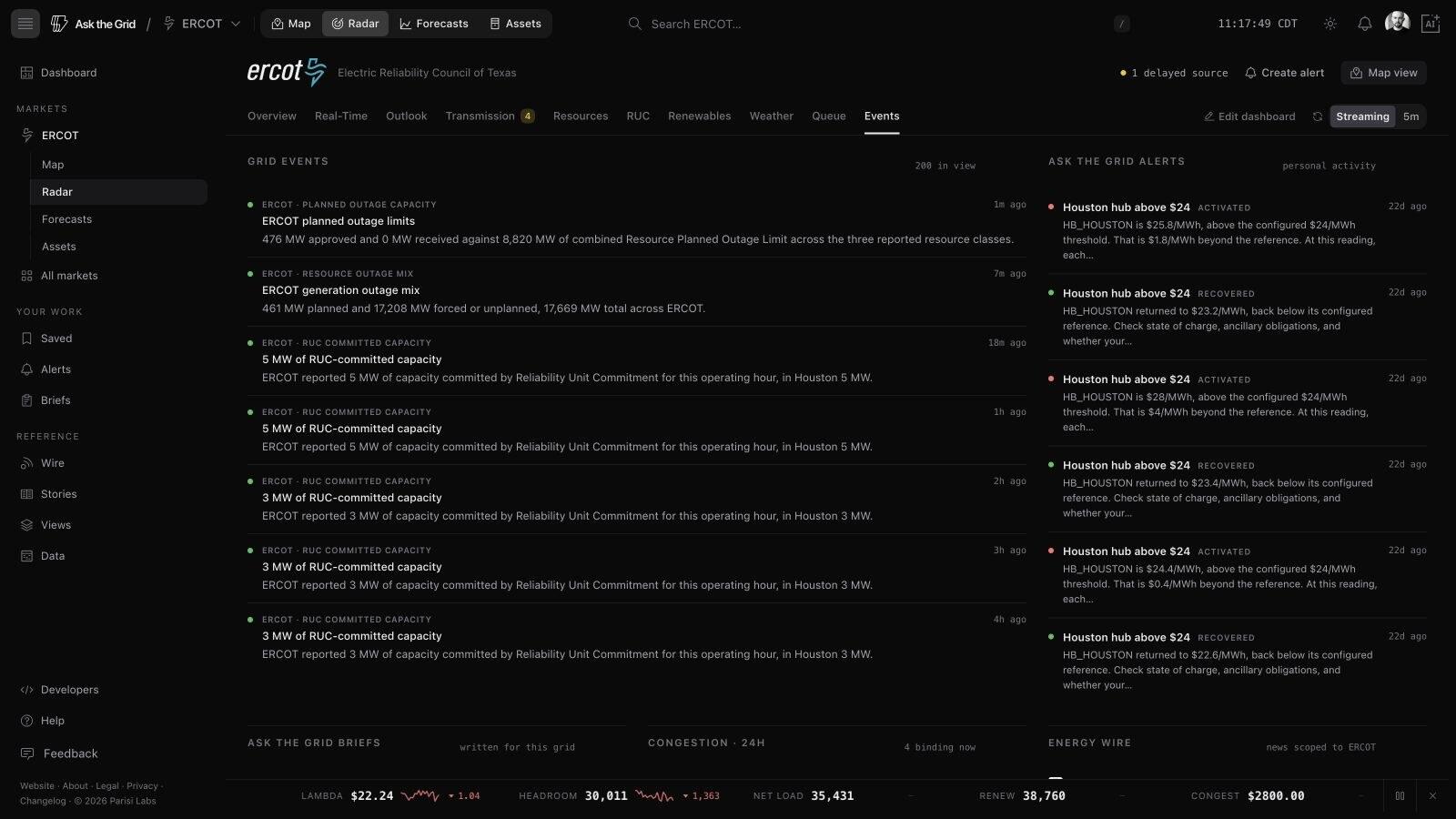
A real ERCOT grid event, with market and operating context in one view — nothing staged, nothing mocked.
What an event is.
An event is anything that changes how the grid is operating — placed on the physical surface so it reads in context, next to the prices, assets, and weather it touches. Each one carries the source record it came from, the window it is valid for, and when we learned of it.
ISO notices, outages, weather, and market events land on the same physical surface as prices — not in a separate feed. The where and the why arrive together, the agent can reconstruct any of them, and any event can become the trigger for an alert.
What lands on the map
4 kinds
- Operating notices
- Outages
- Weather
- Market events
What each kind carries4
Operating notices
ISO advisories, watches, and emergency operating notices — the operator's own words, on the map where they apply.
Outages
Reported unit and transmission outages that reshape the supply stack and the congestion picture.
Weather
Forecast and observed systems moving across the footprint — the driver behind most load and price surprises.
Market events
Price separation, scarcity conditions, and forecast divergence surfacing as they develop on the live grid.
Events are drawn from published notices and feeds — a missing feed renders as unavailable.
The agent picks up the thread.
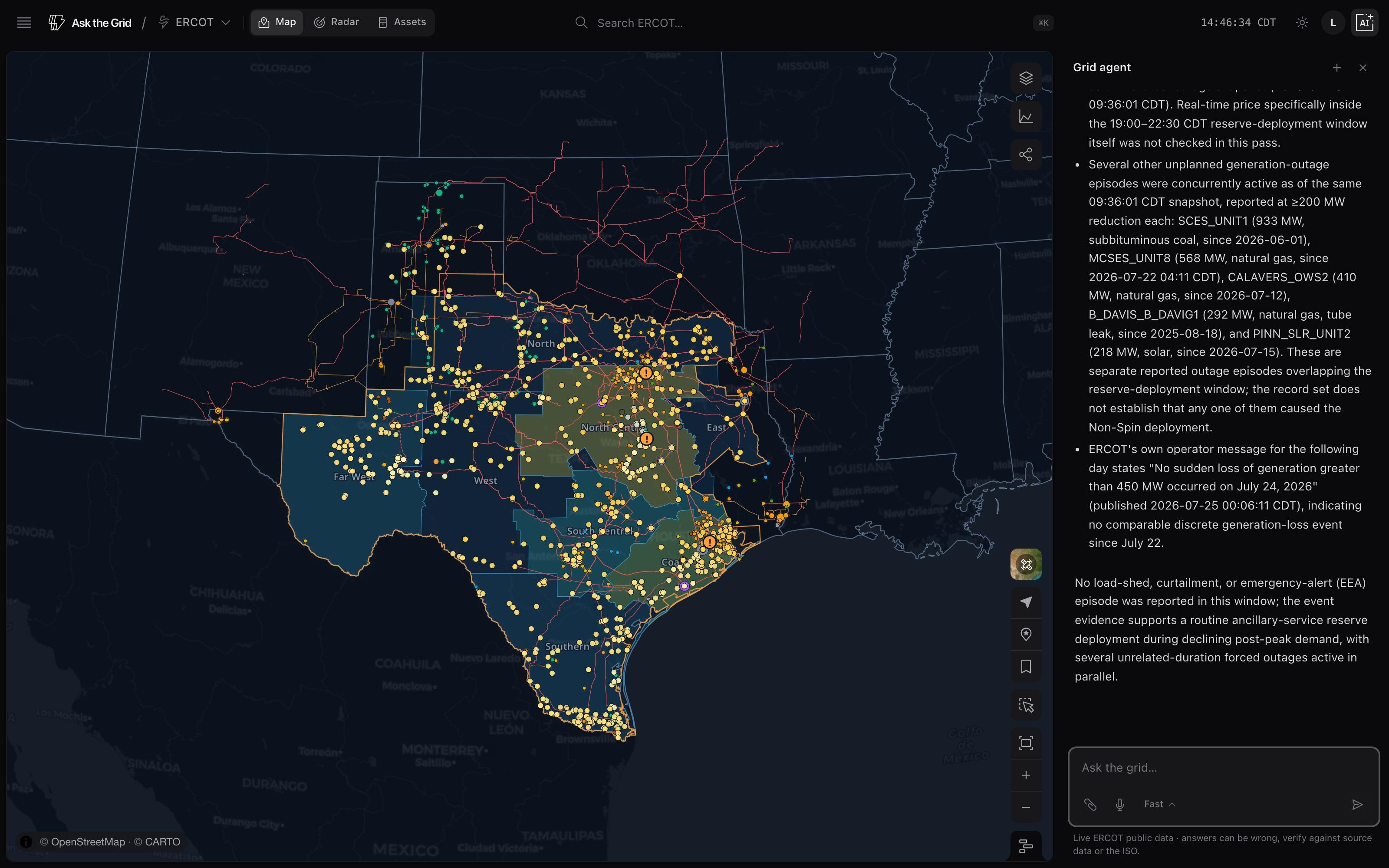
Ask about any event and the agent reconstructs it — the same working loop it runs for every question, with every step inspectable and every conclusion carrying its source.
The conditions before
What load, price, and reserves looked like in the intervals leading into the event.
The assets involved
Which nodes, units, and constraints the event touched — pulled from the physical surface, not a headline.
The public record behind it
The ISO notice, filing, or published series the event traces to — kept with its source and as-of time.
under the hood
waiting for the question…
—
Events become alerts.
The same live event spine drives alerting. A grid_event trigger fires on new events at the severities you accept — grid-wide, or inside a radius you draw around a specific asset.
What each severity level means4
Choose which severities count — an event rule fires only on the levels you accept.
See what the grid is doing right now.
Open the live surface and watch events land in context — then turn the ones that matter into alerts.