What can this connection support—and what is that flexibility worth?
Screen visible capacity margin, model battery savings under the tariff, and see what evidence the next decision requires.
For industrial landlords, property owners, asset managers, large-load teams, and energy developers.

The report, in three passes
First what happened, then what would have happened otherwise, then only the conclusions the evidence supports.
- 01
Establish what the site supports
Observed demand, contractual limits, battery charging demand, and unknowns kept separate.
Resolve the property, utility, tariff, and service context; treat queue MW as context.
- 02
Test what flexibility changes
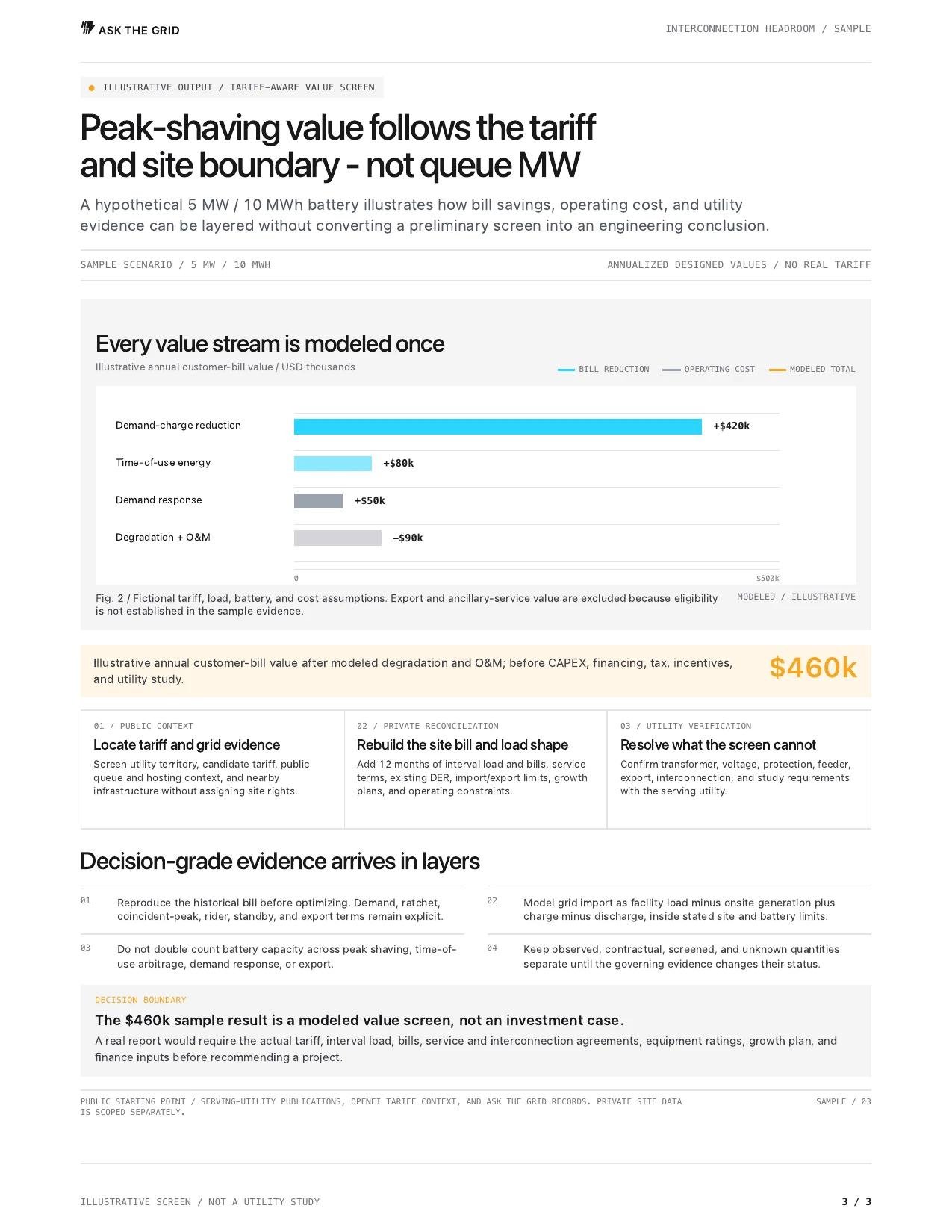
Peak shaving and eligible value streams under load, tariff, equipment, and battery limits.
Reproduce the bill first, then dispatch within the site boundary without double counting.
- 03
Show what moves to diligence
Sensitivity, finance outputs, and the utility evidence required for the next decision.
Observed, contractual, screened and unknown values stay labelled separately. Nothing is called verified until it is.
The evidence limits what the report can say.
Public records are enough for a first screen. A firmer answer needs your operating data.
- 01
Public screen
Property, tariff, utility, and grid context.
A preliminary site baseline.
- 02
Private reconciliation
Interval load, bills, service agreements, and operating plans.
Modeled savings and contractual margin.
- 03
Verified decision
Equipment ratings, utility studies, and finance inputs.
Decision-grade headroom and economics.
What the report will not claim
- —
Preliminary contractual margin is not verified system headroom.
- —
Queue MW is context—not approved, deliverable, or site-owned capacity.
- —
Export and ancillary value appear only with documented eligibility.
- —
Parcel-level engineering requires site and utility evidence.
What teams usually ask
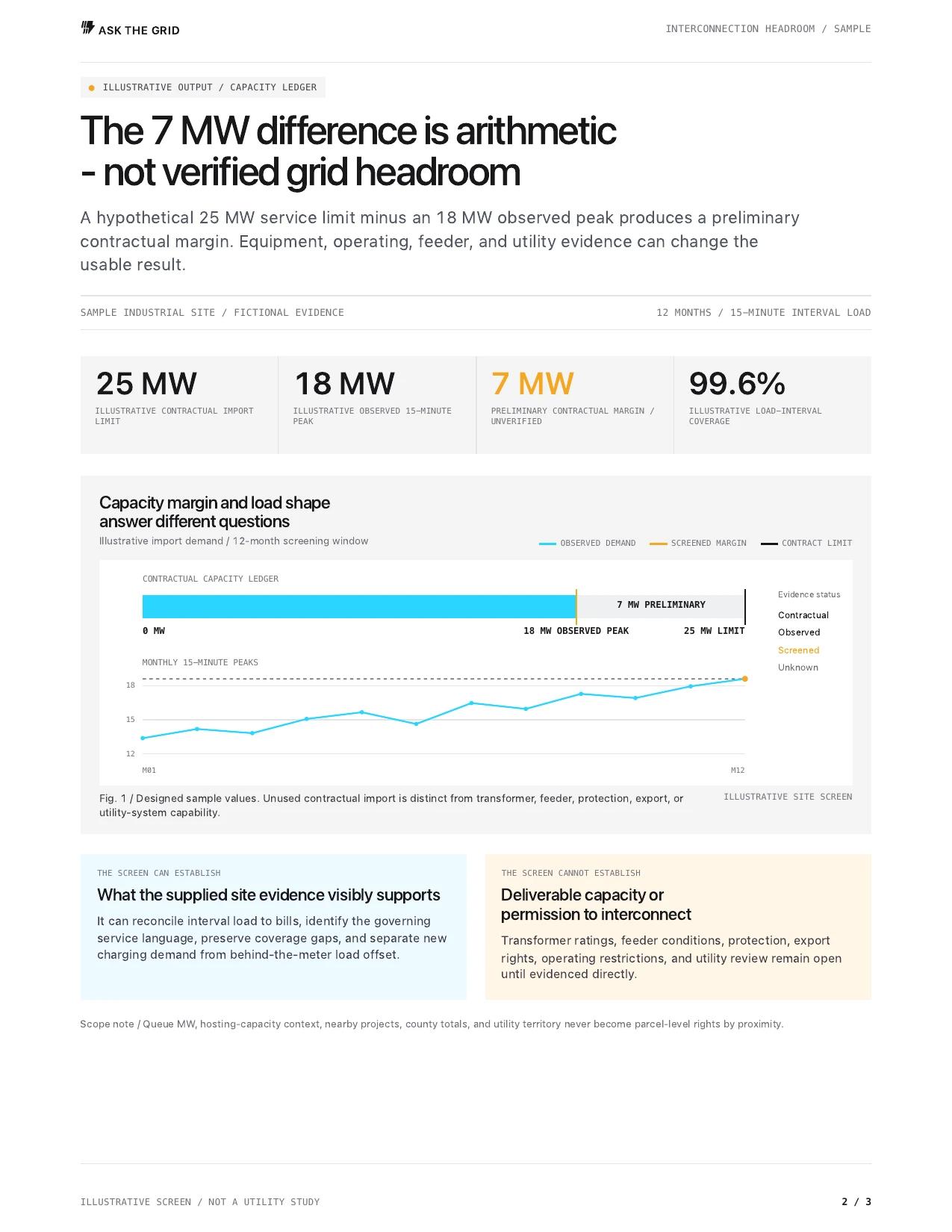
Is the 7 MW difference between a 25 MW service limit and an 18 MW peak verified headroom?+
No. It is a preliminary contractual margin. Equipment, demand shape, export rights, feeder conditions, and utility review can change it.
Can you calculate savings from one utility bill?+
One bill supports a first screen. Interval load and a year of bills are needed for demand peaks, ratchets, and seasonality.
Does nearby interconnection queue capacity establish site rights?+
No. Queue records add context; they do not establish deliverability, property rights, or unused service capacity.