AI Compute Futures and GPU Prediction Markets, Explained
What you can trade on GPU rental prices today, how Polymarket and Kalshi settle H100 and B200 contracts, where CME and ICE futures stand, and how much of a GPU-hour is electricity.
November 27, 20267 min read

AI compute futures are meant to track the cost of renting GPUs, usually quoted in US dollars per GPU-hour. Several related markets are already trading. In November, Polymarket's international platform opened contracts on average rental prices for NVIDIA's H100, H200, B200 and B300 chips. Kalshi lists similar questions under its own rules. CME Group and ICE have proposed dated futures, but neither had listed them by November 27.
So can a company that rents GPUs hedge its compute bill today? Only partly. The live contracts are small, fixed-payout bets on a published index, or a perpetual that is one day old. The futures that would scale with a real rental bill are still awaiting approval or a listing date. The most dependable way to fix a price is still a capacity reservation. This guide explains each of these, how the live contracts settle, and how much of a GPU-hour's cost is electricity.
01
Four ways to trade GPU compute
The products below can look alike on screen, and several reference the same rental index. They differ in what decides their value and what the buyer ends up holding. The Polymarket B200 screen shown above puts two of them on one page. The index reading is a rental benchmark. The curve to its right is inferred from event-contract prices.
| Product | Status on November 27 | What determines value | What the buyer receives |
|---|---|---|---|
| GPU prediction contract | Live on Polymarket and Kalshi | Whether the specified index crosses the strike under the contract rules | Fixed cash payout for the winning outcome |
| GPU perpetual | Live on Polymarket International since November 26 | Rolling GPU rental index, with funding and no expiry | Cash exposure for as long as the position is open |
| Dated GPU index future | Proposed by CME and ICE, not yet listed | Change in the GPU rental benchmark, scaled by contract size | Cash gains or losses tied to the benchmark |
| GPU capacity reservation | Available through providers and auctions | Agreed price, equipment, location, term and availability | Access to the contracted GPUs under the rental agreement |
02
How Polymarket's GPU rental markets settle
In the December 2026 H100 market, the hardware is NVIDIA's H100 SXM. The rules take the arithmetic mean of Ornn's finalized daily index values dated in December, round it to the nearest cent and compare it with each strike. A rounded average of $3.01 per GPU-hour resolves Yes at “Above $3.00” and No at “Above $3.10.” At exactly $3.00, the $3.00 threshold resolves No.
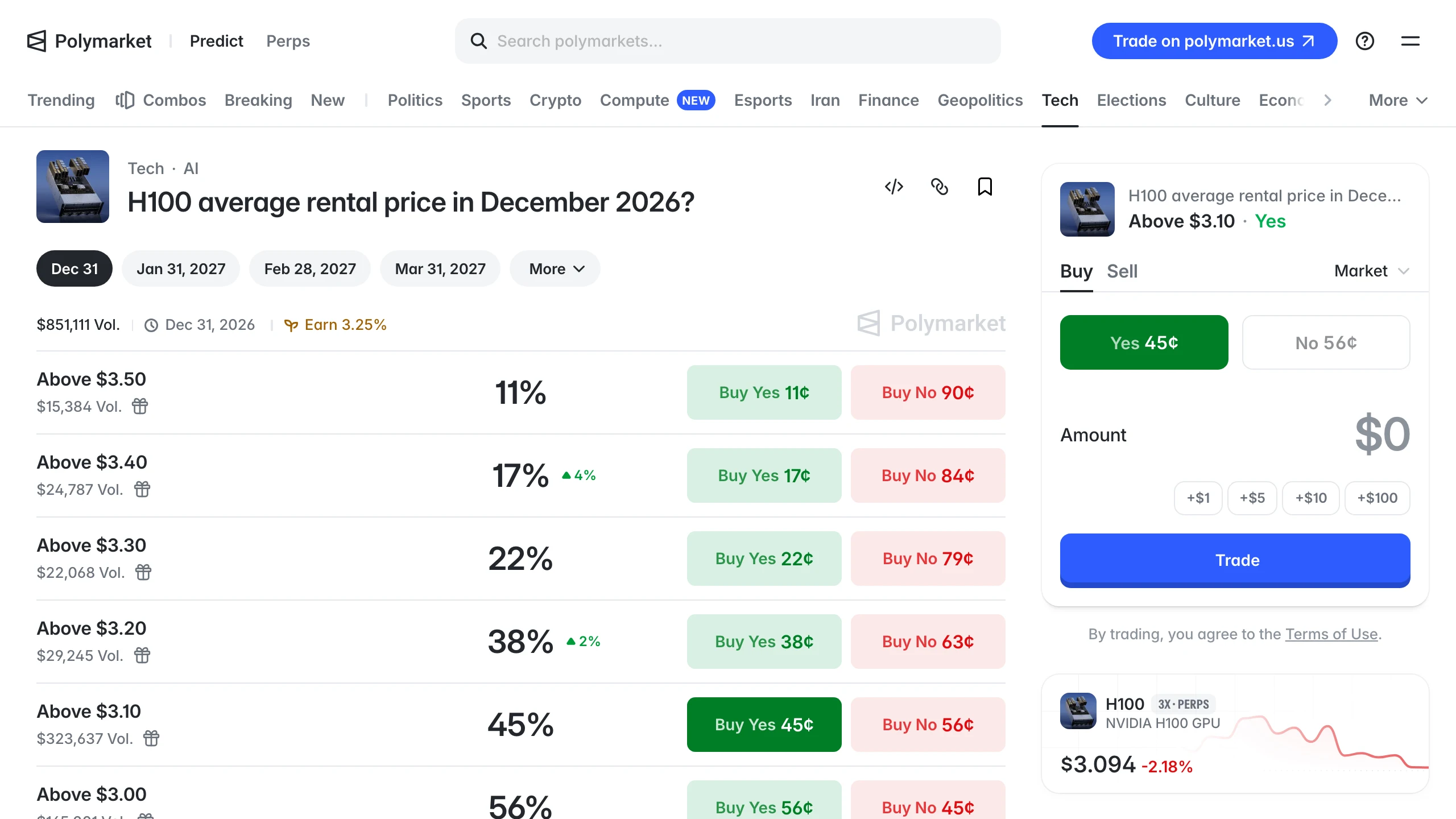
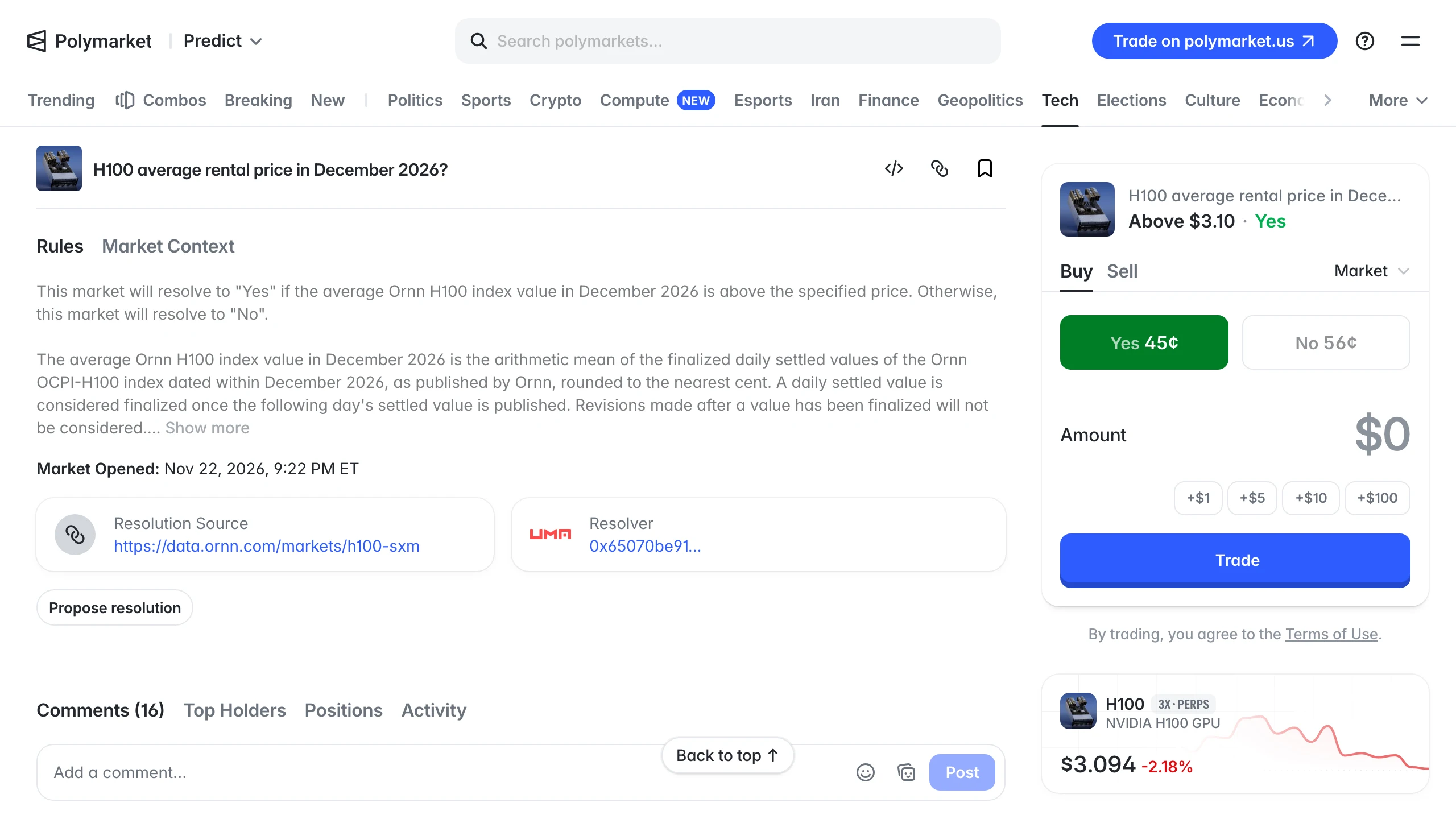
The same exchange, chip and month can still give two different answers. Polymarket's December H200 average market uses the full month's finalized daily values. Its end-of-December H200 market uses the December 31 value alone and settles into one price bracket. A late-month rise can put the final day in a high bracket while the monthly average stays below the equivalent threshold.
For each expiry on its compute dashboard, Polymarket combines bid–ask midpoints across strikes to estimate a rental price and a range. That curve is only as good as the quotes behind it. Check the spacing between strikes and the depth at each one before reading much into a small move, especially for expiries far in the future.
03
What Kalshi measures differently
Kalshi introduced implied compute curves for B200, H200 and A100 in July 2026. Its rules for the December H100 contract above $3.00 average Ornn's hourly values for the month, round to cents and exclude revisions made after expiration. Polymarket's matching contract uses finalized daily values. The publisher, chip, month and strike are identical, but the observations and the treatment of revisions are not, so the two contracts can settle differently.
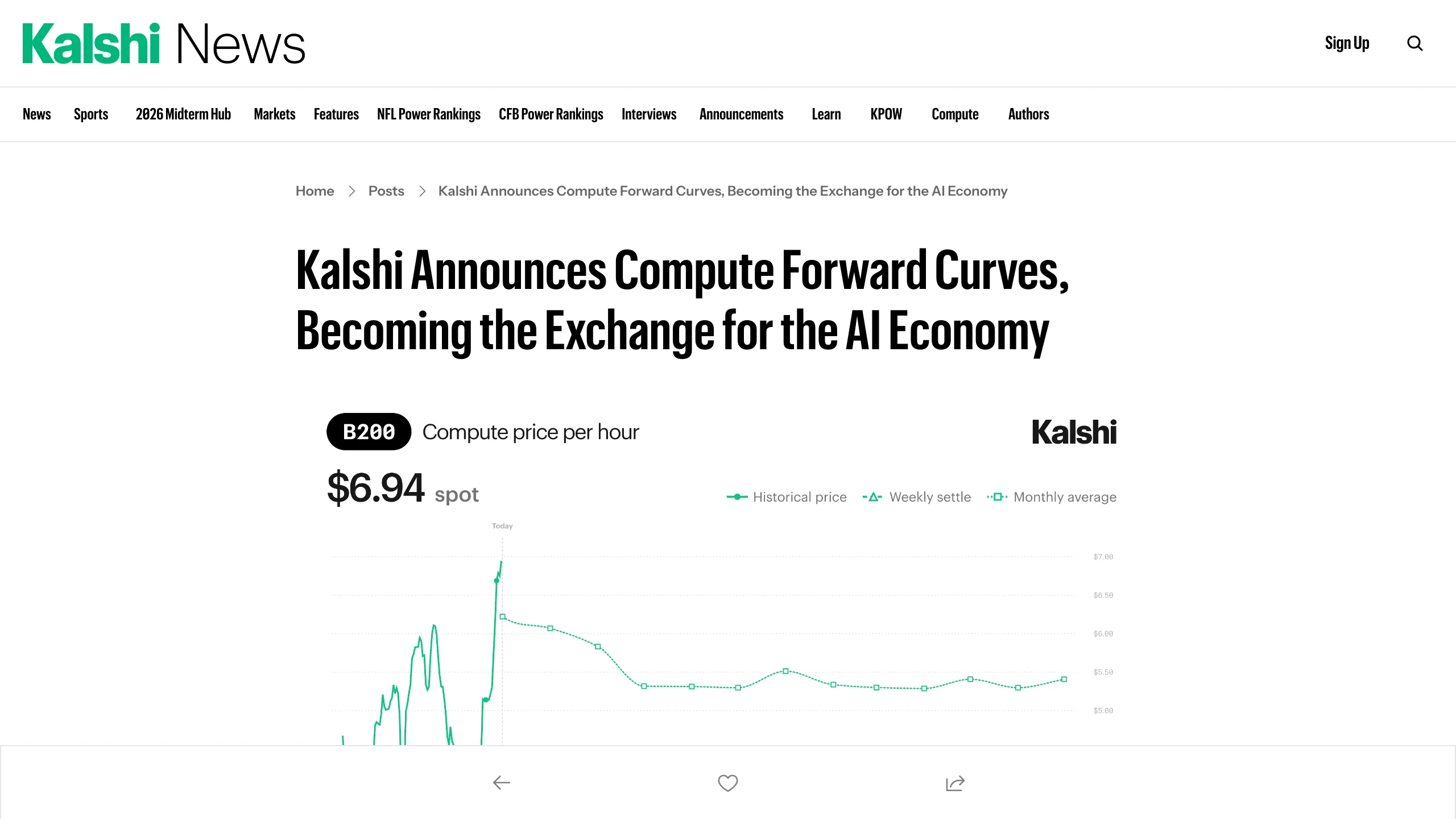
Trading is thin. Kalshi's trade record for its January 2027 B200 market shows a 150-contract fill at 55¢ on November 27. Each contract pays at most $1, so that whole fill could pay out less than $150. A buyer comparing the two exchanges needs a current quote and enough size at that price, not just the last trade.
04
What a GPU rental index measures
The Ornn Compute Price Index methodology describes an index built from prices paid for active on-demand GPU rentals across contributing providers. Each hardware series has its own dollar-per-GPU-hour price. Ornn publishes reserved and forward pricing separately. Its H100 SXM index page shows the benchmark and its history. A private quote for a dedicated cluster also reflects its location, interconnect, lease length, service terms and availability, so it won't match the index exactly.
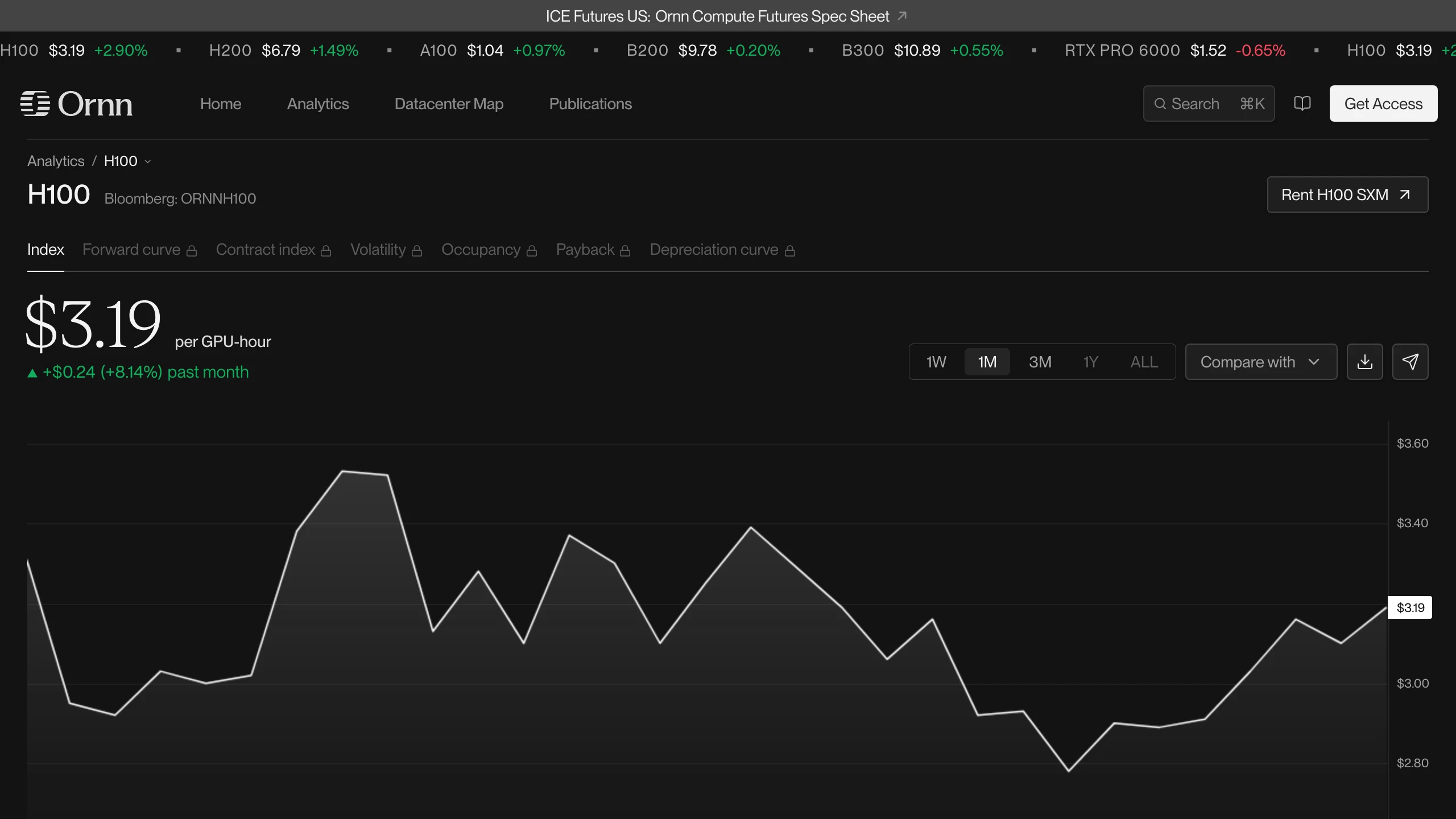
For scale, a 256-GPU cluster booked continuously for 30 days uses 184,320 GPU-hours. A $0.50 per GPU-hour difference in the contracted rate changes that bill by $92,160 before other charges. How much of that a financial contract would offset depends on how closely the index follows the buyer's own rate, and on whether the payout matches the size and timing of the bill.
05
How much of a GPU-hour is electricity?
Less than you might expect. NVIDIA rates an eight-GPU DGX H100 system at 10.2 kW maximum input, or about 1.28 kW per GPU at full load, including the server's processors and networking. Add an illustrative 30% for cooling and electrical losses and a fully loaded H100 draws about 1.66 kWh per GPU-hour at the facility meter.
At ERCOT North's November average of $31.48/MWh, from Ask the Grid's ERCOT real-time prices, that is about 5¢ per GPU-hour, under 2% of a $3.00 rental. Even at a sustained $100/MWh it is about 17¢. The $0.50 index move in the example above is roughly ten times a GPU-hour's entire power cost at November prices.
So in the short run, GPU rental prices are driven by chip supply and demand, not by wholesale power prices. Electricity matters more as a constraint on where new capacity can be built. The Dominion Hub in Northern Virginia, which Kalshi also lists prices power for the largest US data center market. There, the harder question for a new campus is usually whether it can get a grid connection on schedule, not what each MWh will cost.
06
CME, ICE and the status of GPU compute futures
CME Group's proposed H100 and B200 futures use Silicon Data's on-demand rental indexes and specify 730 GPU-hours per contract, so a $0.50 per GPU-hour change would be worth $365 per contract before costs. In a November 4 letter filed with the CFTC, CME's NYMEX agreed to a conditional review extension through January 8, 2027. The CFTC listings still showed approval pending on November 27.
ICE Futures U.S. has named H100 and B200 futures based on Ornn. Its September 29 exchange notice set October 5 for reference data and hypothetical settlements but gave no listing date. Nodal Exchange and Compute Desk have announced cash-settled products based on Compute Desk's blended daily rental indexes. The CFTC's August request for comment sets out what the agency wants to know about the underlying market before more contracts are listed.
One design is already live. Polymarket International's H100 perpetual launched November 26. It has no expiry, settles in cash and references a rolling average of 24 consecutive hourly Ornn values, according to the compute perpetual specifications. Polymarket US is a separate venue with its own GPU event-contract filing.
07
What a GPU buyer can do now
If you need certainty on price and access, reserve capacity. Compute Exchange has scheduled a December 2 GPU capacity auction for 12-month reservations on dedicated eight-GPU B200 and B300 nodes, with service starting April 1, 2027. Matched bids and offers are binding, with one clearing price per contract. Compare the result with other reservations on similar terms, and use the on-demand index as a reference for short-term rentals rather than a price for a year-long commitment.
Use the live prediction contracts as a read on where the market expects the index to go, not as a hedge. At $1 per contract and with thin books, they can't offset a bill the size of the 256-GPU example. Watch the CME and ICE filings if you want an index future that scales with real usage. Read the settlement rules of any contract you use, because the averaging window and the treatment of revisions decide the payout.
If your question is about the power behind the compute, use the grid evidence. Our guide to electricity prediction markets applies the same settlement checks to hub-price contracts, and the data center site research guide shows which public grid records indicate whether a site can actually get service.