Electricity Prediction Markets on Kalshi and Polymarket
How to read Kalshi’s ERCOT, PJM and MISO power-price contracts and Polymarket’s grid emergency markets, with five checks to run before trusting the number on screen.
November 27, 20267 min read

On November 27, 2026, one Kalshi electricity market asked whether the real-time wholesale price at ERCOT North Hub would average above $35 per megawatt-hour (MWh) for November. An earlier Polymarket grid emergency market asked whether Texas’s grid operator would declare a serious grid emergency, an Energy Emergency Alert (EEA) at Level 2 or 3, by the end of September. Both show a Yes price. One is settled by a month of price data and the other by an operator’s notice.
This guide is for anyone looking at one of these contracts, whether to trade it, to hedge a power bill, or to read it as a forecast. Electricity prediction markets put very different grid questions behind the same Yes and No buttons. The five checks below tell you what a given contract actually pays on. The rest of the guide applies them to the power contracts listed in November 2026.
01
Five checks before you read the price
You should be able to state a contract’s settlement rule in one sentence. If you can’t, the Yes price doesn’t tell you much yet. Work through these in order.
- Location and publisher. Which hub, zone or operator, and whose published number settles it: ERCOT, PJM Data Miner, MISO, or an exchange’s own source.
- Time window. A day, a week or a month, with a start and end time and a time zone. The weekly PJM and MISO contracts below run from 5 p.m. to 5 p.m. Eastern, not midnight to midnight.
- Average or single observation. A monthly average dilutes a spike. A contract that pays on any single print rewards it.
- Threshold and units. Dollars per MWh, and whether the strike is strict. A $35 threshold is usually “above $35,” so exactly $35.00 settles No.
- Quote depth. Read the bid and ask together, and check when the last trade happened. A wide spread or a stale trade means the percentage on screen is weaker evidence than it looks.
- For an event contract, replace the first four checks with two questions: which authority has to act, and what exact action counts.
02
What electricity prices does Kalshi track?
Kalshi’s Power catalog, shown above, listed weekly and monthly real-time price markets for ERCOT North, Houston and West, PJM AEP-Dayton, Dominion and Western, and MISO Indiana. Each event groups several thresholds for one hub and period. Thresholds are in dollars per MWh, Yes quotes are in cents per contract, and each winning contract pays $1.
The November ERCOT North Hub contract rules specify a simple average of ERCOT’s 15-minute real-time settlement point prices for HB_NORTH, from midnight Central on November 1 up to midnight Central on December 1. Negative prices are included, and the four 15-minute intervals repeated when clocks fell back on November 1 count separately. An average of exactly $35.00 after rounding resolves the $35 threshold No.
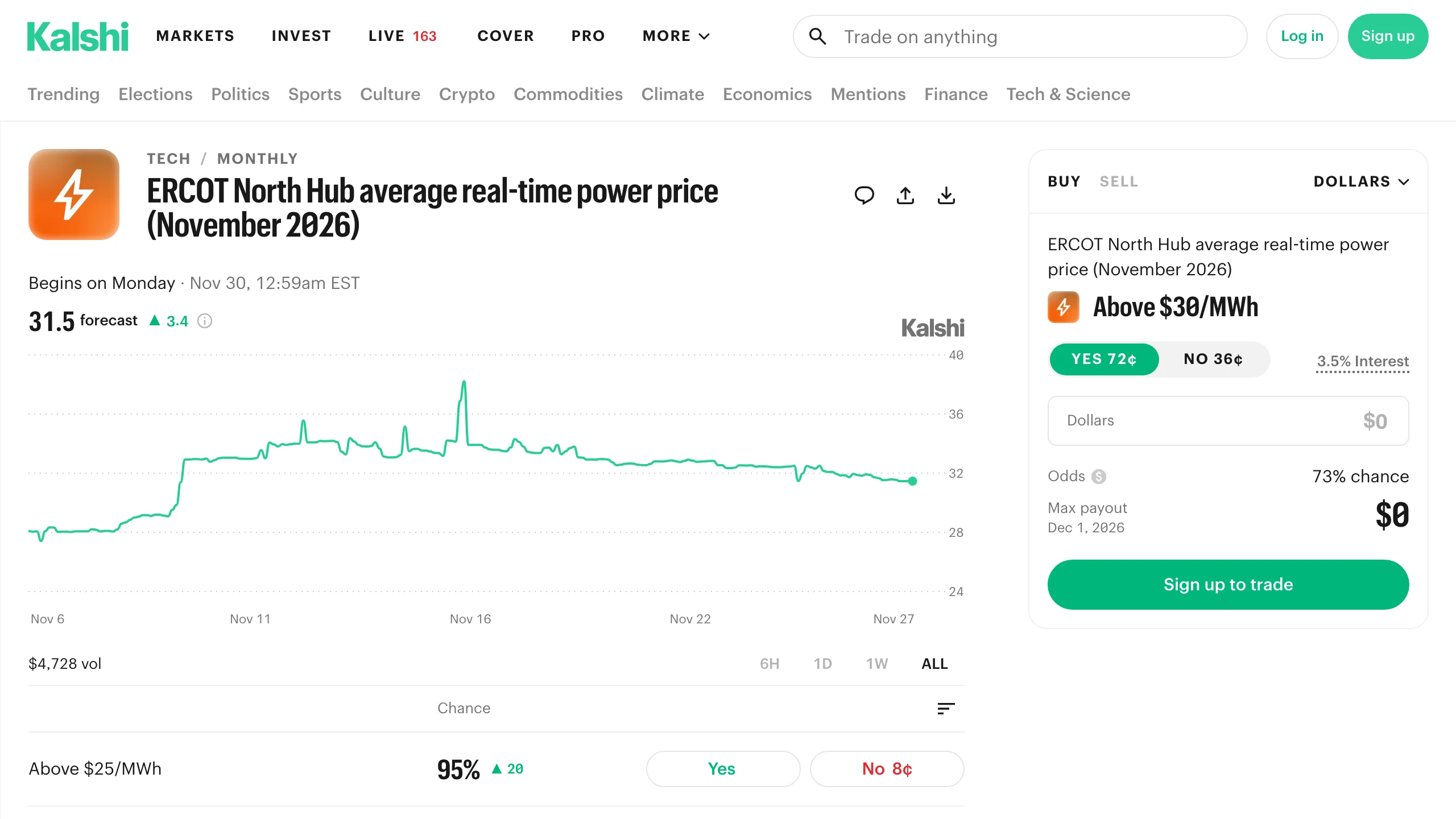
You can check where that month stands. By Ask the Grid’s count of ERCOT’s published real-time prices, the 2,545 HB_NORTH intervals through 2 p.m. Central on November 27 averaged $31.48/MWh. Roughly 328 intervals were left. To finish above $35, they would have to average about $62/MWh, nearly double the month so far. That doesn’t settle the contract, but it tells you what the Yes price is betting on.
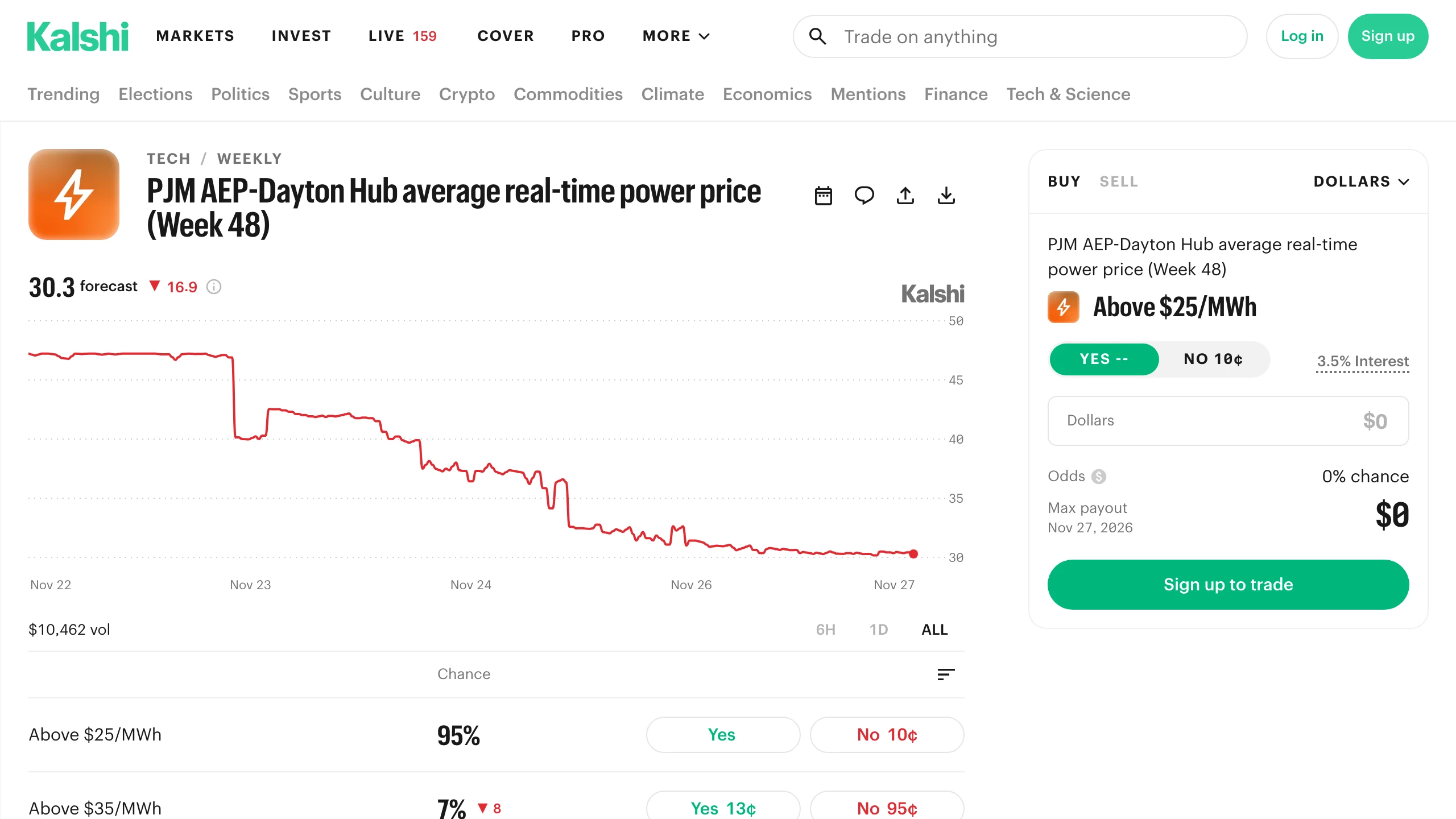
The PJM AEP-Dayton Hub contract for the week ending November 27 used a $45/MWh threshold in this example. Its settlement rules specified verified hourly real-time locational marginal prices (LMPs) from PJM Data Miner 2, from 5 p.m. Eastern on November 20 to 5 p.m. Eastern on November 27. The MISO Indiana Hub market covered the same window at a $30/MWh threshold, using MISO’s final hourly real-time prices. ERCOT’s contract averages 15-minute prices, and the PJM and MISO contracts average hourly ones. Ask the Grid tracks both hubs: AEP-Dayton and Indiana.
03
What one $400/MWh hour does to a weekly average
Suppose a hub runs at $20/MWh in every hour except one, when it reaches $400/MWh for the full hour. In a 24-hour window containing the spike, the simple average is ($400 + 23 × $20) ÷ 24, or $35.83/MWh. In a 168-hour window containing the same spike, the average is ($400 + 167 × $20) ÷ 168, or $22.26/MWh. These are illustrative prices. At a $35/MWh threshold, the day clears the level and the week doesn’t.
ERCOT North’s November shows the same effect on a real month. The median 15-minute price through November 27 was $26.75/MWh, well below the $31.48 average. Sixty-six intervals at $100/MWh or more, including a $731.14 interval on the evening of November 11, pulled the average up. Seventy-four negative intervals pulled it down. For an averaged contract, a few extreme intervals can matter more than a typical day.
Why prices spike is a separate question. Our guide to day-ahead and real-time electricity prices walks through four settlement intervals that changed the economics of one hour. Location matters too. A generator’s node or a load’s settlement point can diverge from the contract’s hub, leaving node-to-hub basis risk even when you read the hub correctly.
04
What counts as a grid emergency on Polymarket?
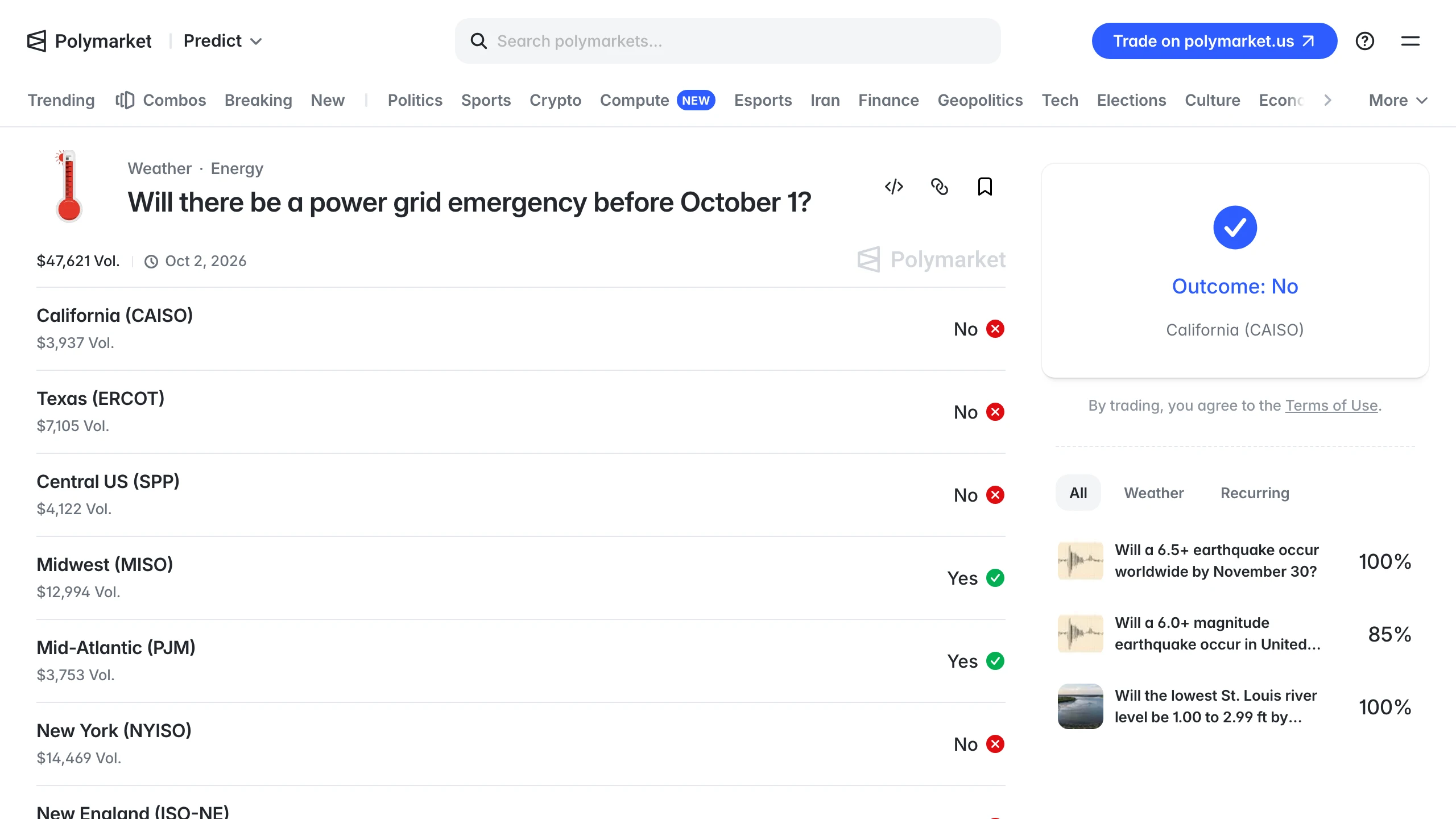
Under NERC’s emergency operations standard, an EEA-1 means all available generation is in use, an EEA-2 means load management procedures are in effect, and an EEA-3 means interruption of firm load is imminent or underway. Polymarket International’s September 2026 grid emergency event had seven regional contracts, and each required an EEA-2 or EEA-3 from the named operator by 11:59 p.m. local time on September 30.
Under the published event rules, an operator notice or qualifying documentation could confirm the declaration. An EEA-1 didn’t count, and neither did a U.S. Department of Energy emergency order under Section 202(c), even though both signal a stressed grid.
Polymarket’s archived results show Yes for MISO and PJM and No for the other five regions, including ERCOT. In PJM, a September 17 operator notice records an EEA-2 for the BGE, Dominion and Pepco areas from 2 to 10 p.m. Eastern, and the PJM emergency alert history places it among the operator’s other notices. Our MISO emergency alert history records a September 2 EEA-2. To check an emergency contract against what operators actually declared, the US grid emergency alert tracker lists current and past alerts by operator.
05
Canada’s electricity exports show why the wording matters
Polymarket International’s Canada electricity export restriction market was open on November 27. It asks whether an authorized Canadian federal or provincial representative announces the use of government authority to cut or restrict electricity exports to the U.S. by 11:59 p.m. Eastern on December 31, 2026. A qualifying announcement can settle it Yes even if measured flows never fall or the measure is later suspended.
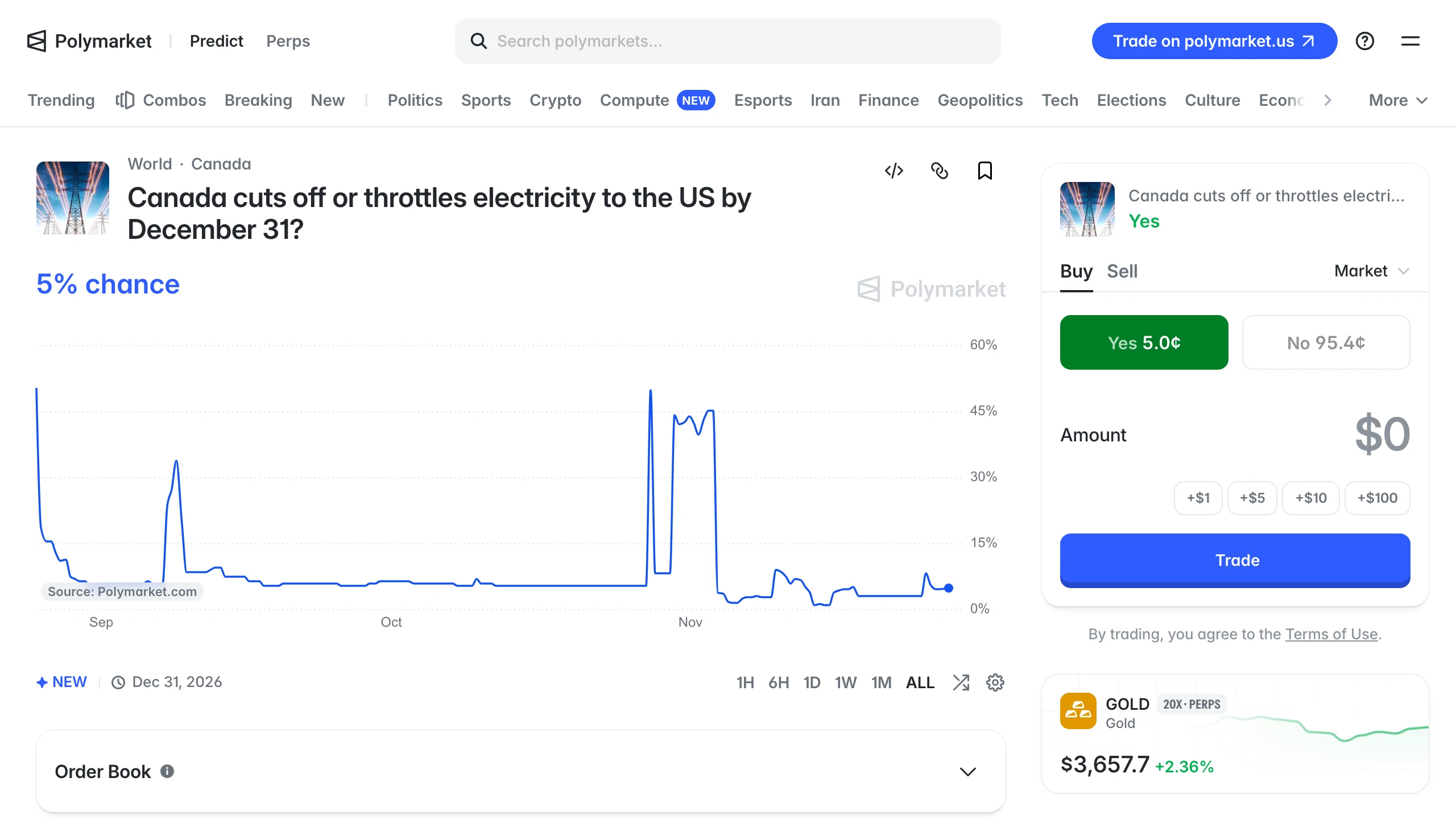
Under the contract rules, a tariff alone, a conditional threat or a routine maintenance cut doesn’t count. So the contract is a bet on a political announcement, not on electricity flows. For the flows themselves, the Canada Energy Regulator publishes monthly trade data by source and destination.
06
How ElectronX hourly electricity futures differ
ElectronX lists hourly bounded futures and binary options across ERCOT, PJM, MISO, CAISO, SPP, NYISO and ISO New England. A cash-settled bounded future tracks the real-time price of one MWh for a listed location and hour, with settlement held between a defined floor and ceiling. In ERCOT, the hourly settlement reference is the average of the four 15-minute prices. ElectronX’s binary pays $100 if that hourly real-time price is at or above the day-ahead price for the same hour, and $0 if it is lower.
That makes ElectronX’s bounded futures the closest of these products to a conventional hedge. Each covers one hour at one location, and the payout moves with the price within the bounds. Kalshi’s contracts pay a fixed amount on a week or month average.
07
Which contract matches which exposure
Match the contract to the risk you actually carry. Each type below fits a different question, and none of them is a full hedge on its own.
- A month or week of hub prices
- Kalshi’s averaged hub contracts. Compare the month-to-date average with the threshold before reading the Yes price, and remember your own node may not track the hub.
- One expensive hour
- ElectronX’s hourly futures and binaries, which settle on the hour itself rather than a long average that dilutes it.
- An official grid emergency
- Polymarket’s emergency contracts, which pay on a declared EEA level. A tight grid without a qualifying declaration resolves No.
- A policy decision
- Announcement contracts like the Canada export market, which turn on what a government says rather than what the grid does.
08
The same checks apply to compute
Kalshi and Polymarket now also list contracts on GPU rental prices, and the five checks carry over. Both venues have listed the same chip and month with different averaging rules. Our guide to AI compute futures and GPU rental markets applies the checks there, and estimates how much of a GPU-hour’s cost is actually electricity.