What Is PJM? How Three Utilities Built a Regional Power Market
How PJM grew from a 1927 power pool into the grid operator for all or parts of 13 states, with its own energy, reserves and capacity markets.
November 18, 20269 min read


PJM Interconnection runs the high-voltage grid and wholesale electricity markets across all or parts of 13 states and the District of Columbia. Its initials stand for Pennsylvania, New Jersey and Maryland. Those states gave PJM its name when the original power pool expanded in 1956. Today PJM decides which resources should supply electricity minute by minute, arranges for reserves, and runs an auction for capacity that can be available years later.
The idea goes back to 1927. Three utilities realized that a transmission line could save them from running a more expensive plant or building another one just to cover local peaks. Nearly a century later, PJM is still trying to match available power to the places that need it, across a much bigger grid and with much more at stake in the rules.
01
Why three utilities formed a power pool in 1927
On September 27, 1927, Pennsylvania Power & Light, Philadelphia Electric and Public Service Electric and Gas formed the Pennsylvania–New Jersey Interconnection. By then they had studied two ways to serve growing demand. Each company could keep enough generating capacity on its own system to handle an outage. Or they could connect their systems and share generation and reserves. The three companies chose to pool. As PJM’s account of the early years records, the 220-kV line that made it possible was completed in 1928.
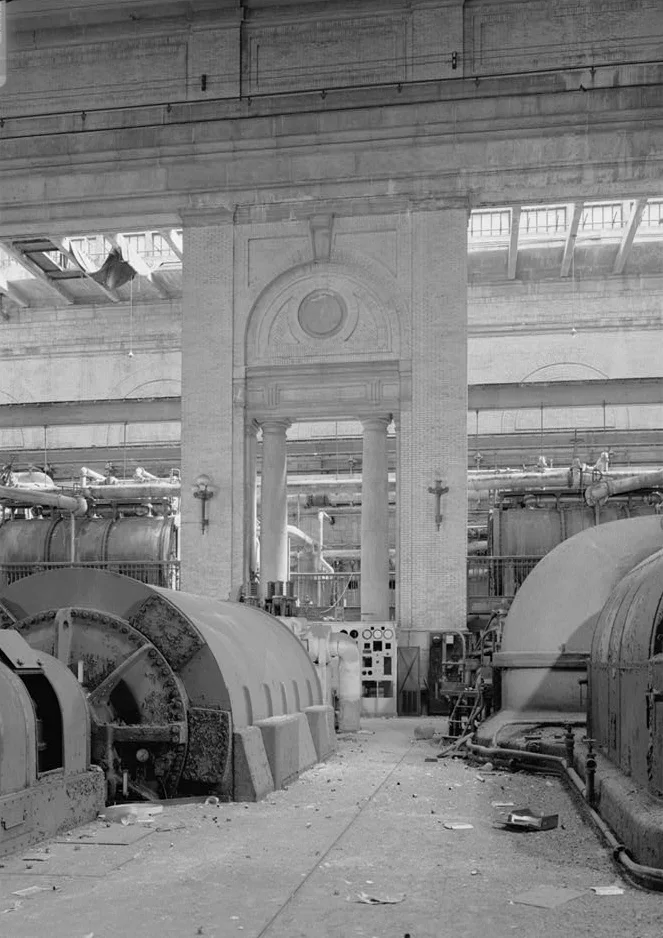
Take two plants on opposite sides of the Delaware River. If one has cheaper power to spare in the evening, the pool can use it to serve some of the other utility’s demand. If a plant suddenly trips, the same connection gives the utilities more options. Those benefits depend on the line having room to carry the power. Connecting the systems also means that a disturbance can spread across them, so the companies have to coordinate how they run.
02
Maryland joined and dispatch became a full-time job
Electricity use climbed after World War II. In September 1956, Baltimore Gas and Electric and subsidiaries of General Public Utilities joined under a new interconnection agreement. The larger pool became the Pennsylvania–New Jersey–Maryland Interconnection. In 1965 Potomac Electric Power Company joined. Atlantic City Electric and Delmarva Power followed in 1981. The names and dates in the PJM timeline show how utility territories were added one agreement at a time.
The utilities delegated more to the pool as coordination grew. In 1962 PJM installed an analog computer for automatic generation control. It could send instructions that adjusted output as system conditions changed. In 1968 a digital computer took on energy management. For decades the pool still operated as a department of one member utility. Its operating responsibilities had become regional before its governance became independent.
03
The wholesale market changed who could participate
A transmission owner could also own generators that used those lines to sell power. That raised a question once more sellers wanted access to the network. Could a new generator get the same treatment as the wire owner’s own plant? In 1996 FERC’s Order 888 required interstate transmission providers to offer nondiscriminatory open access. PJM’s utilities had already started a transition by forming the PJM Interconnection Association in 1993.
In 1997 PJM became independent, elected its own board and opened membership beyond utilities. FERC approved the ISO and PJM began administering a bid-based wholesale energy market. The operator’s account dates these changes to 1997. Running the pool had meant coordinating among a set of companies. Running the market also meant judging offers and access requests from participants who might be competing with those companies.
04
How PJM learned to price power by location
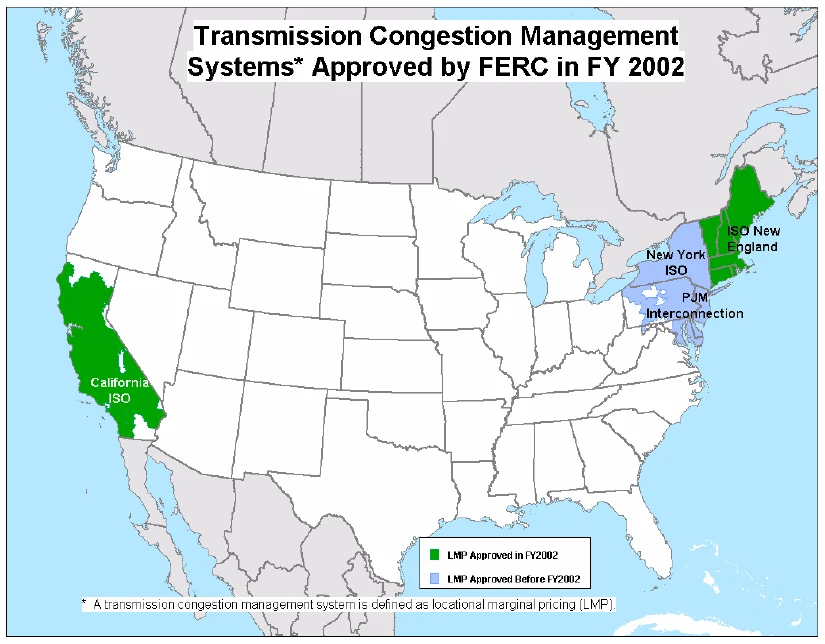
The first market and the modern pricing system arrived in stages. PJM began calculating locational marginal prices in April 1998, initially with cost-based pricing. In April 1999 generators could submit market-based offers subject to a cap. A two-settlement system followed on June 1, 2000, giving the day-ahead schedule and real-time deviations separate prices. PJM’s 1999 market monitor report records all three steps.
The locational marginal price is the cost of serving another unit of demand at a specific point. If there is room on the transmission line to use a cheaper distant generator, its power can help serve the next increment of demand. If the line is full, a more expensive generator closer to that customer may set the price there. Even within one regional market, prices on opposite sides of the bottleneck can diverge.
The first summer of market-based pricing sharpened a separate question about competition when power was tight. The monitor found most of the year’s overall increase was concentrated in a small number of hours on 15 hot, high-demand days. Higher demand, fuel costs and the behavior of suppliers all mattered. The monitor’s report examined where prices reflected real scarcity and where sellers might have been able to influence them. That distinction still matters when interpreting the live PJM price map.
05
Why becoming an RTO took two decisions
FERC’s Order 2000 encouraged utilities to put transmission under regional organizations that were independent and large enough to run a regional grid. FERC granted PJM provisional RTO status in July 2001. Commissioners wanted it to expand, coordinate better with neighboring markets and give its independent board authority over reliability decisions. In its December 20, 2002 order, FERC granted full RTO status after changes including shifting decision-making on reliability from a committee to the board.
PJM added Allegheny Power and Rockland Electric in 2002. American Electric Power, Commonwealth Edison and Dayton Power & Light extended its reach west in 2004. The market reached farther south when Dominion joined in 2005, the same year Duquesne Light joined. Wider geography added options for trading and sharing reserves. It also gave PJM more interfaces to monitor within its own footprint and along the border with neighboring operators like MISO.
Deciding where to build lines also became a regional task. Starting with its 2006 transmission expansion plan, PJM looked 15 years ahead so that projects with long lead times could be identified earlier. Planners use modeled peak demand, generator retirements and potential equipment failures to test where the grid needs reinforcement. They also examine whether an upgrade could relieve costly congestion. PJM’s current planning manual traces the 15-year process to that change.
06
Which states does PJM cover?
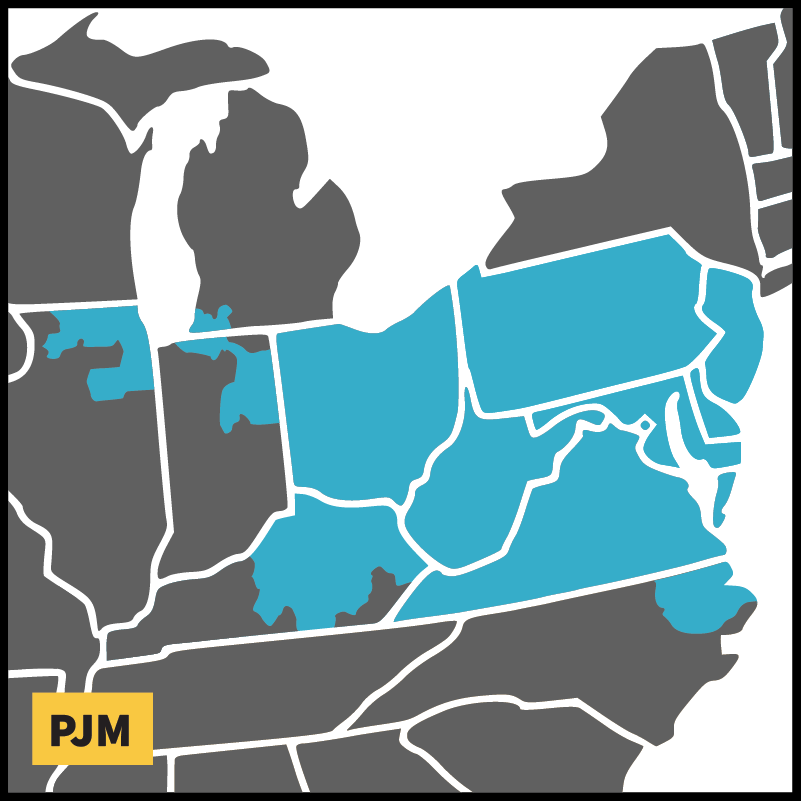
PJM serves all or parts of Delaware, Illinois, Indiana, Kentucky, Maryland, Michigan, New Jersey, North Carolina, Ohio, Pennsylvania, Tennessee, Virginia and West Virginia, plus Washington, D.C. The Chicago area is in PJM, while much of central and southern Illinois is in MISO. FERC’s territory overview and the state-by-state grid finder show why knowing the state alone often does not tell you the grid operator.
07
What does PJM buy in its capacity market?
The energy market pays for electricity delivered. It can produce high prices when supply is scarce, but customers also need enough dependable resources in place years ahead of a tight hour. In 2006 FERC found PJM’s older capacity market insufficient for reliability and approved a settlement that established the Reliability Pricing Model. The auctions use forecasts and reliability requirements to procure commitments for later delivery years. They can value capacity differently in areas that cannot import enough power when demand is high. See FERC’s history of the 2006 settlement.
PJM’s July 2026 auction cleared at $325 per megawatt-day of accredited capacity for the 2028/29 delivery year. A plant with 100 accredited MW clearing at that price would earn $32,500 for one delivery day before adjustments. If it separately delivered 100 MWh in an hour at an illustrative energy price of $40/MWh, that energy would be worth $4,000. Local utilities and retail suppliers face both kinds of costs when they procure power for their customers.
08
A cold morning put capacity promises to the test
A commitment only helps if the resource can actually deliver when the grid is under stress. In January 2014 a polar vortex pushed up electricity demand and left about 22% of PJM generating capacity unexpectedly unavailable during the peak hour. Generators that could usually run struggled with cold-weather equipment failures or fuel supply. PJM’s analysis of Capacity Performance explains why it sought more than a general commitment to be available.
FERC approved PJM’s new Capacity Performance rules in 2015. During designated emergency intervals, committed resources can owe penalties for falling short and earn bonuses for performance above their obligation. That changes an owner’s incentive to winterize equipment or secure firmer fuel. After Winter Storm Elliott in December 2022, PJM initially assessed about $1.8 billion in non-performance charges. The FERC-approved settlement reduced those charges to about $1.25 billion. The case showed how the availability promise had become a financial obligation with consequences during a real event.
09
How the old decisions shape PJM today
PJM reported that the 2028/29 auction left the region 6,831 MW below its reliability requirement after counting capacity secured outside the auction. Nearly a century after the first utilities pooled generation to meet growing demand, PJM is working through the same physical problem with different customers and institutions. The board’s July 2026 direction called for a proposal to procure additional supply and a separate proposal for serving large new loads during a capacity shortage. Those are ways to respond to gaps the auction exposed, while the original job of dispatching across the grid continues every day.
Large computing sites also present an operating question even when enough capacity has been procured. In a November 2026 filing, PJM proposed requirements for certain large computing loads to stay connected through brief grid disturbances. The immediate issue is what happens to the balance of supply and demand if a large block of customers stops drawing power at once. The filing addresses a different timescale from the capacity auction.
The same issue can show up in one afternoon. In our account of PJM’s September maintenance-season emergency, region-wide demand was well below the summer record, but scheduled outages and local transmission limits still mattered. A region may have generation on paper that it cannot deliver everywhere at once. That is the same problem the original 220-kV line was built to address.