The 2024 Solar Eclipse and the Texas Grid
April 8, 2024. A total eclipse reduced the Texas solar fleet to a fraction of its output in under an hour, and the grid operator had forecast it to the minute.
For about ninety minutes on the afternoon of April 8, 2024, the Moon dimmed the entire Texas solar fleet on a schedule that astronomers had published years in advance. The path of totality crossed the state from the southwest, entering near Eagle Pass and Del Rio in the early afternoon and moving up through the Hill Country, Austin, Waco, and Dallas-Fort Worth over the next hour. As it passed, the largest solar fleet on any grid in the Moon's path faded out and came back, and the grid operator had planned for exactly that. It was, in the language of the people who run the system, a scheduled sunset and sunrise dropped into the middle of a workday.
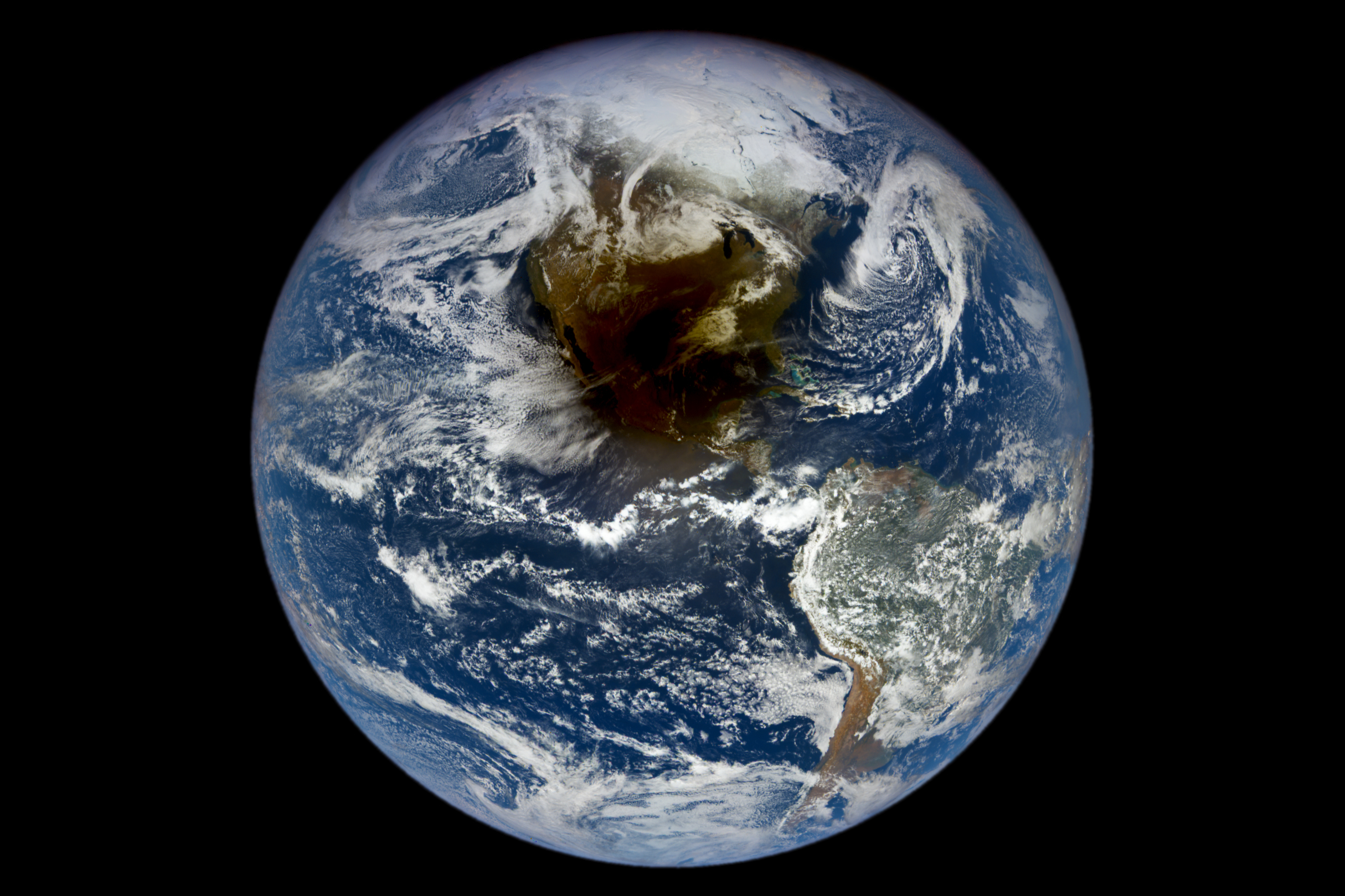
The shadow moved quickly. The umbra crossed Texas and the rest of the continent at well over 1,500 miles per hour, and it was photographed from orbit by NOAA's GOES-16 weather satellite and from a million miles out by the DSCOVR EPIC camera that took the image above, according to NASA Earth Observatory. About 32 million people lived inside the path of totality across the United States, which made the Great American Eclipse one of the most watched celestial events in the country's history. For most of them it was a few minutes of viewing. For ERCOT, the operator of the Texas grid, it was the single largest scheduled swing in generation the system had planned for.
The geometry was well suited to a grid story. The eclipse crossed the ERCOT region from the southwest to the northeast between roughly 12:10 p.m. and 3:10 p.m. Central, with totality reaching the solar fleet around 1:40 in the afternoon, per ERCOT's official market notice. Dallas was the largest U.S. city to fall entirely inside the path, with about three minutes and fifty-one seconds of darkness, while Kerrville and Lampasas out in the Hill Country each saw roughly four minutes and twenty-four seconds, the longest totality in the state. The line on the map above is not a weather front. It is an orbit, and it ran directly over the panels.
Forecast to the minute, a week ahead#
The thing that makes an eclipse different from most other supply shocks a grid faces is that it is not a surprise. A cold snap, a turbine trip, a transmission fault, a passing thunderstorm, all of these arrive with hours of warning at best. An eclipse arrives on a timetable computed centuries in advance. ERCOT treated it as a planning exercise. The operator began folding the event into its official photovoltaic generation forecasts a full week ahead, on April 1, and then updated those forecasts hourly through the day itself, all of it governed by a formal market notice to every participant on the grid.
The notice was plain about what was coming and what was expected of everyone reading it. The eclipse would reduce the output of the grid's photovoltaic generation resources across that three-hour window, and market participants were told to watch conditions and revise their current operating plans as needed. In other words: this is a known event, here is when it lands, plan around it. The operator paired that instruction with a public statement that it did not expect reliability problems.
“ERCOT does not expect any grid reliability concerns during the eclipse.”
That assessment rested on arithmetic. ERCOT's pre-event projections, reported by Newsweek, called for solar output to fall from 99.2 percent of its available capacity just after noon to 7.6 percent at 1:40 p.m., and then to climb back as the shadow moved off. That is a forecast precise to a tenth of a percent and to a single minute, and the grid proceeded to do close to what the forecast said it would.
The fleet faded out on schedule#
Solar is now one of the largest sources of power on the Texas grid, normally second only to natural gas during the midday hours, which is why a few minutes of darkness translated into the largest planned generation swing in ERCOT's history. The regional output series (ercot.solar_generation_geo) tells the story in one shape. At 1 p.m. the fleet was producing 12,294 MW. One hour later, at the depth of the eclipse, it was at 3,396 MW, a drop of roughly 73 percent, about nine gigawatts of supply, in sixty minutes. An hour after that it was back near 11,000 MW. A symmetric V, set by the eclipse rather than by weather.
The grey line is the part that turns this from an astronomy story into a grid story. It is ERCOT's own planned capacity for solar that day, and it falls alongside the actual output, from about 6,500 MW down to 1,000 MW and back. The forecast and the reality are nearly the same curve. Because an eclipse can be predicted to the minute, the operator had folded it into its day-ahead plans more than a week early, and what the chart shows is a plan being executed rather than a system being surprised.

It helps to hold the two scales side by side, because the photograph and the chart are the same moment seen from opposite ends. The image to the right was taken from Dallas City Hall at 1:42 p.m. Central, the minute the city sat under the deepest shadow. That is the same minute the grey and amber lines bottom out on the chart above. What a person standing downtown experienced as a sudden cool dusk, with streetlights coming on and the corona overhead, the grid experienced as nine gigawatts of supply dropping out on cue. The corona in that frame is the direct cause of the trough in the data: the Sun's disc is almost entirely covered, and the panels below have almost nothing left to convert.
ERCOT carried the most solar of any grid the eclipse touched, which is why Texas had the most to manage, but it was not alone in preparing. Operators across the country had prepared for the same loss on their own systems, and even those that caught only a partial eclipse planned for a real, measurable reduction in supply. The lesson the day taught was not regional.
“Even a partial eclipse can have a major and measured impact on the power system.”
The mirror image: solar falls, gas rises#
A grid does not simply absorb a nine-gigawatt gap in its supply; it fills it, in real time, with whatever it has standing ready. In Texas that meant gas. The fuel-mix settlement series (ercot.fuel_mix_report) captures the trade in a single picture: as solar falls, gas climbs almost in step, and as solar recovers, gas slides back down. The two curves form a near-symmetric X, crossing around the totality minute. This is the grid's response made visible, supply shifting from one fuel to another while demand is largely unaffected.
Inside this settlement-level window, solar fell from about 3,409 MW at 17:30 UTC to a trough of 256 MW at 18:45 UTC, 1:45 p.m. Central, the depth of totality, before climbing back to 3,428 MW by 20:00 UTC (ercot.fuel_mix_report). That is a roughly 93 percent drop and a full recovery inside about an hour and a quarter. Gas ran the inverse, rising from about 4,810 MW to 6,883 MW at the trough and then sliding back to 4,480 MW as the panels came back online. The recovery was about as fast and as orderly as the loss, which is the point: nothing about it was improvised.
The independent analysts who watched the same event at the full-fleet scale saw the same shape. The clean-energy group WattTime measured ERCOT solar falling from roughly 13.8 GW to 0.8 GW, a 94 percent reduction in 45 minutes, falling from 27.6 percent of the grid's generation to 1.7 percent at the eclipse's depth, while natural gas ramped from about 19 GW to more than 27 GW and then, in their words, quickly tapered back to about 18 GW. (The absolute megawatt figures differ from the settlement series above because WattTime measured the broader real-time fleet over a slightly different window; the proportions and the timing are the same story.) WattTime read the day as a window into the energy transition.
“The response to the eclipse can be seen as a microcosm of how grids are managing the transition to renewables and their predictable variability.”
The two-grids framing matters because it shows there was a choice in how to fill the gap, and the two largest solar grids in the country filled it differently. Where Texas used gas, California used storage: its batteries shifted from charging at 2.6 GW to discharging at 2.7 GW, a swing of more than five gigawatts that backfilled almost the entire solar gap without burning anything. The contrast is a clear snapshot of where each grid sits on the transition. WattTime put it directly.
“In grids like Texas and the Northeast, where there is not yet considerable excess renewable energy or sufficient energy storage, fossil natural gas plants are used to make up the difference.”
The federal accounting confirmed the Texas side of that picture. The U.S. Energy Information Administration found that ERCOT lost roughly 8.9 GW of solar generation during totality, the largest solar resource of any U.S. grid in the Moon's path, and that gas-fired plants generated an additional 6.2 GW between 1 and 2 p.m. Central, the hour of totality, replacing about 80 percent of the lost solar. Coal and battery storage each added about 0.8 GW to cover the rest. The mirror chart above is, in effect, that EIA sentence drawn as two lines.
| Resource | Change during totality | Direction | Share of the gap |
|---|---|---|---|
| Solar | about 8.9 GW lost | down | the hole |
| Natural gas | about +6.2 GW | up | roughly 80 percent |
| Coal | about +0.8 GW | up | part of the balance |
| Battery storage | about +0.8 GW | up | part of the balance |
How we know it was the Moon, not the weather#
A 73 percent solar drop in an hour usually means a storm rolled in. This one did not, and the weather record shows it. Across the same afternoon, average cloud cover over the ERCOT footprint (open_meteo.era5_grid) held essentially flat, near 80 percent the whole time, from before the eclipse to well after. Nothing in the sky changed except the Moon's position. The dip lines up not with any front moving through, but with the umbra's path across the state, which is why both the timing and the depth were known in advance rather than estimated after the fact.
One detail behind that flat cloud line is that the clouds nearly obscured the view. In the days before the eclipse the forecast for Texas worsened, with models showing close to 100 percent low cloud cover over much of the state during the early-afternoon window. Space City Weather called the outlook fairly grim for the millions of people who had traveled to stand in the path. For the grid it would not have mattered much, since heavy cloud only deepens a dimming that was already going to happen, but for spectators it was the difference between a clear view and a gray afternoon that simply got darker.
There is one more signature that ties the grid event to the sky, and it is thermodynamic. As the shadow moved across the ground, NASA Earth Observatory reported land-surface temperatures dropping 8 to 12 degrees Fahrenheit and air temperatures falling 5 to 6 degrees, a measurable change that moved with the umbra. The National Weather Service office in Fort Worth recorded a 3.3 degree drop during its own two minutes of totality. The same loss of incoming sunlight that reduced the solar fleet's output also cooled the air above it; the dip in the solar curve and the dip on the thermometer are two readings of one cause.

The recovery has a signature of its own, and it is the image to the left. Those bright points along the Moon's edge are Baily's Beads, the last and first rays of sunlight passing through valleys on the lunar surface, and the pink flares are solar prominences on the Sun's limb. They mark the moment totality ends and light begins to return. On the grid, that moment is the bottom of the V starting to turn upward. Within roughly 75 minutes the solar fleet climbed from its 256 MW trough back to about 3,428 MW in the settlement series, and gas eased back down in step (ercot.fuel_mix_report). The beads in the photograph are the first light of that recovery.
A dress rehearsal for a solar grid#
Texas will not see another total eclipse for decades, so the value here is not the event itself but what it showed. A grid that now leans heavily on solar has to absorb large, fast swings in supply, and the eclipse was the rare case where the swing was both very large and fully forecastable. The system handled a nine-gigawatt ramp down and back up inside two hours without an emergency, as the operator had said it would, and that is a useful data point for every ordinary evening when the sun sets on schedule and solar hands the grid back to gas and storage.
Read the day the way ERCOT did and the spectacle resolves into operations. A predictable ramp is a manageable ramp. The same forecasting discipline that turned a total eclipse into a non-event, the week-ahead modeling, the hourly updates, the gas and storage held ready to step in, is the discipline a high-renewables grid runs on every day. The eclipse compressed a year of ordinary sunsets into ninety minutes and let everyone watch the same process work at speed. The corona over Dallas was the rare part. The mirror image of solar and gas crossing on cue was the routine part, and it is the part that matters.
This is the same live ERCOT data behind Ask the Grid. Open ERCOT on the main map and scrub April 8, 2024 yourself. The numbers above come from ercot.solar_generation_geo, ercot.fuel_mix_report, and open_meteo.era5_grid, with the federal figures drawn from the U.S. Energy Information Administration and the timing from ERCOT's own market notice.